Karst & Crvenica
Soils
Dig a hole in a vineyard on Pelješac, and you won't get far. Within just a few centimeters, the shovel hits pale, fractured limestone, which the Croatians call Vapnenac: bare karst, barely covered by soil.
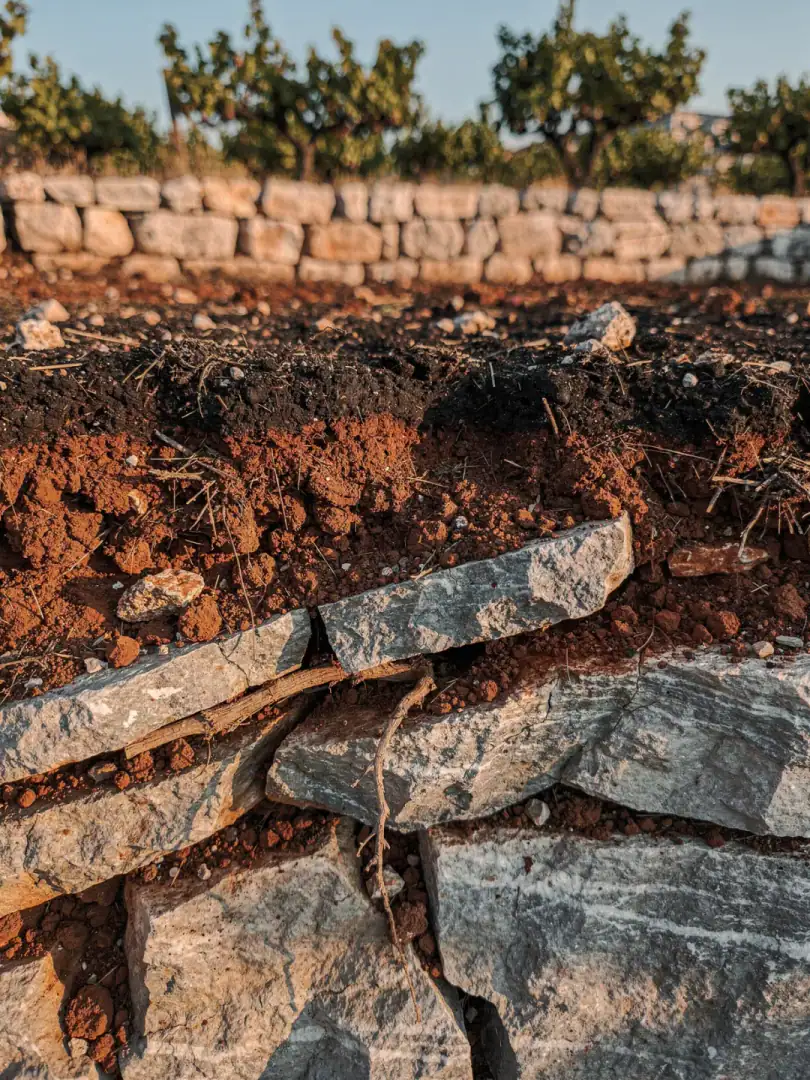
In the cracks and hollows of this rock, a second, entirely different layer collects. It's called Crvenica, a red, clay-rich earth left behind as limestone dissolves over thousands of years, holding far more water than the rock beneath it. Iron gives it its color.
The roots of Plavac Mali have to force their way through this hard rock, crack by crack, often several meters deep, until they finally strike moisture somewhere. This struggle produces small, thick-skinned berries. More skin means more color and more tannin in the finished wine.
On the slopes of Dingač, the gradient reaches up to forty-five degrees. For a long time, there was no road at all. Until 1973, the harvest was driven out on donkeys over a mountain pass four hundred meters high, or lowered on ropes down to waiting boats.
A striking counterexample lies just a boat ride away. Near Lumbarda on Korčula, the limestone gives way for a few hectares to fine sand, deposited by an old river branch long before anyone ever planted a vine here. This sand is exactly why the rare white variety Grk can grow there at all; on the hard karst all around, it wouldn't stand a chance.
Barely more than a finger's width of dark earth between the stones, entirely absent in many spots.
The root: Here the vine finds almost nothing. The fine roots take whatever the rare rainfall brings, and dry out again first.