Why Wind Matters
Climate
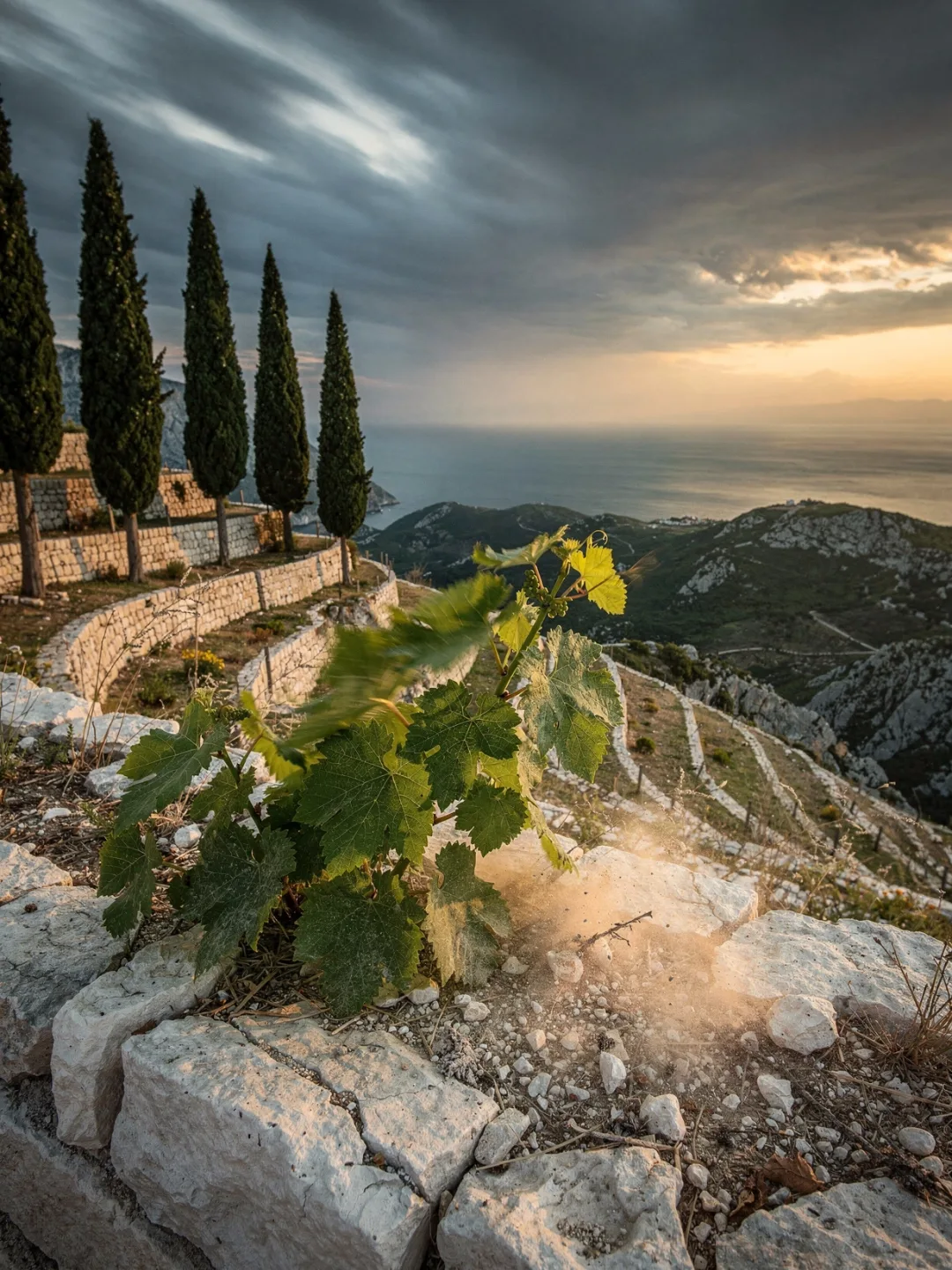
The coast is one of the sunniest regions in Europe. The reason comes down mainly to one number. On the steep slopes of Dingač, the sun shines for roughly 2,800 hours a year, nearly as much as almost anywhere else on the Adriatic, plus the light reflected back off the water. Two sides of sun, then: direct and reflected off the sea.
Two winds determine what becomes of all that sun: the Bura and the Jugo. The Bura falls cold and dry from the mountains in the northeast, often in fierce gusts, keeping the air over the vineyards dry so fungal diseases have little chance to take hold. Many winemakers manage with almost no spraying because of it.
The Jugo, by contrast, comes from the exact opposite direction. Warm and humid, it blows up from the south, bringing clouds and sometimes days of rain, right before harvest of all times. Then the thin-skinned grapes rot right on the vine. Winemakers in September watch the sky more closely than the calendar because of it.
Near the sea, the difference between day and night temperatures stays small. Inland, in the mountains an hour's drive away, it's a completely different story. These mild nights let acidity in the ripening grape break down faster, since that breakdown mainly continues when nights don't cool down properly, and this explains exactly why Plavac Mali so often ends up in the glass with plenty of alcohol and little acidity.
Just a few kilometers inland, the Zagora hinterland begins. There, everything runs hotter in summer and colder in winter, since the mountains cut off the moderating influence of the sea. Over thirty years, harvest has shifted noticeably earlier, often already into August. Some winemakers are now planting their new plots higher up the slope because of it.