Crljenica & Fliš
Soils
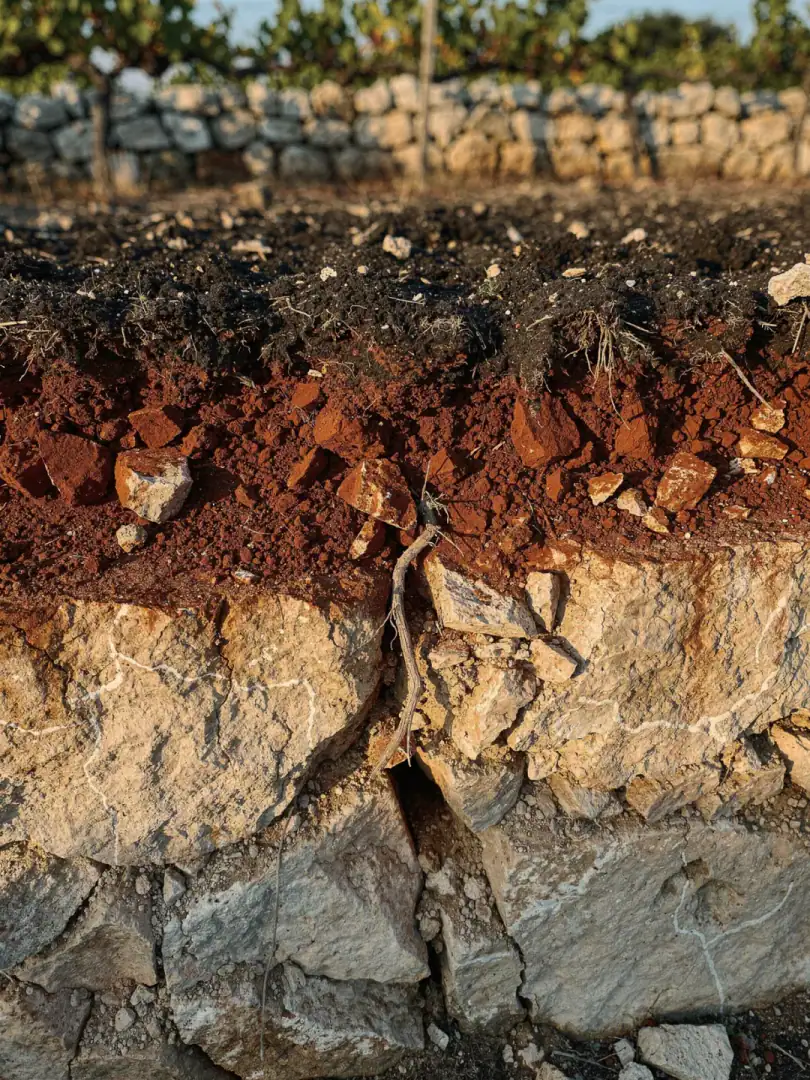
Dig a hole in a Teran vineyard near the coast. Right after the thin layer of humus, an earth appears so red it almost looks like a wound in the ground. Locals call it crljenica, roughly "the reddish one" in dialect. The coloring agents are iron and aluminum oxides. They remain behind as rainwater dissolves the underlying limestone over millennia and washes everything else away.
The story isn't quite that simple, though. Mineralogical studies of Istrian crljenica found components that cannot have come from the local limestone alone. They likely represent windblown loess dust from the Middle Paleolithic, which mixed over millennia with what the rock itself produced. Experts therefore call crljenica polygenetic — formed from multiple sources rather than a single one. So the soil beneath a Teran vine is older and has traveled further than the landscape would suggest.
Just a few kilometers further inland, around Buzet and Motovun, the subsoil looks completely different, for there fliš takes over, a banded sediment of marl and sandstone in shades of gray that crumbles pale and loose as it weathers. It holds less warmth than the dark crljenica, but more moisture. For a long time, it has been considered the soil on which Malvazija produces its finest, most fragrant wines.
Beneath the crljenica, the limestone quickly turns hard and fractured. A vine root forces its way into its cracks and finds water reserves there for high summer. In doing so, it barely spreads sideways, growing almost entirely downward instead. That costs energy the vine lacks elsewhere: the berries stay small, with a high ratio of skin to juice. And it's precisely in the skin that color, tannin, and most of the aromas reside. This explains why Teran from steep crljenica sites tastes denser and darker than the same Teran grown on flat ground.
A thin, dark layer of rotted leaves, barely a hand's width above the red earth.
The root: Here lie the fine roots that catch the first rain — and are the first to dry out.