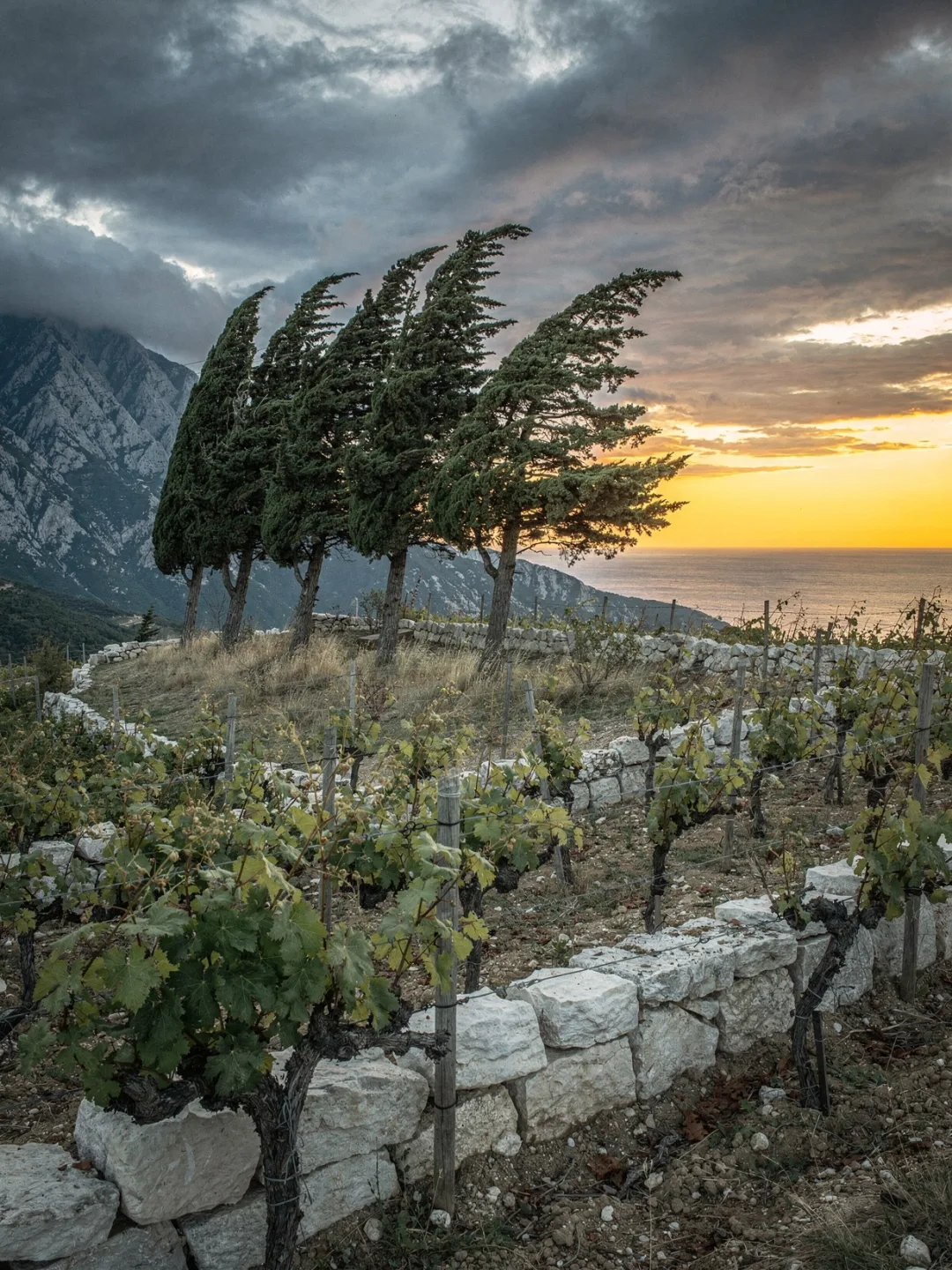
Bura and Sea
Climate
Istria's weather is shaped by a clash between two winds blowing from opposite directions. The sea keeps the coast mild. In the evenings, it brings cooler air that extends the grapes' ripening period and preserves their acidity, while from the northeast, down from the Ćićarija and the Učka mountain range, a very different wind blows: the Bura. It's a cold, gusty downslope wind. Along the nearby Kvarner coast, its gusts exceed a hundred kilometers per hour, and in winter it can persist for days on end.
For the vines, this isn't purely a disadvantage. The Bura dries the grapes very quickly after rain, and dry grapes don't rot, which is why fungal diseases occur less often in Istria than in damper wine regions. However, the wind forces many growers to keep their vines low and train them in its direction. Otherwise it tears off the young shoots. Ignore that, and you lose entire rows after a harsh winter storm.
The second wind, the Jugo, comes from the south. It brings the exact opposite: humid, warm air and often days of rain. Istria's true weather pattern lies between these two winds, not in fixed averages. One summer can be dominated entirely by the Bura, dry and crisp, or belong entirely to the Jugo, muggy and rain-soaked. This decides more about the vintage than any single temperature figure.
Toward the coast, less rain falls than further inland. Overall, around eight hundred millimeters fall annually, most of it in winter and spring. Further inland, around Buzet and Motovun, the climate turns more continental. There, the temperature swings more sharply between day and night than right by the sea, and it's precisely this swing that locks acidity into the grape, while at the milder coast it fades away faster. That's why wines from the hinterland often taste tauter than their neighbors from the sea, even though sometimes only twenty kilometers separate the two sites.