Malvazija & Teran
Grape Varieties
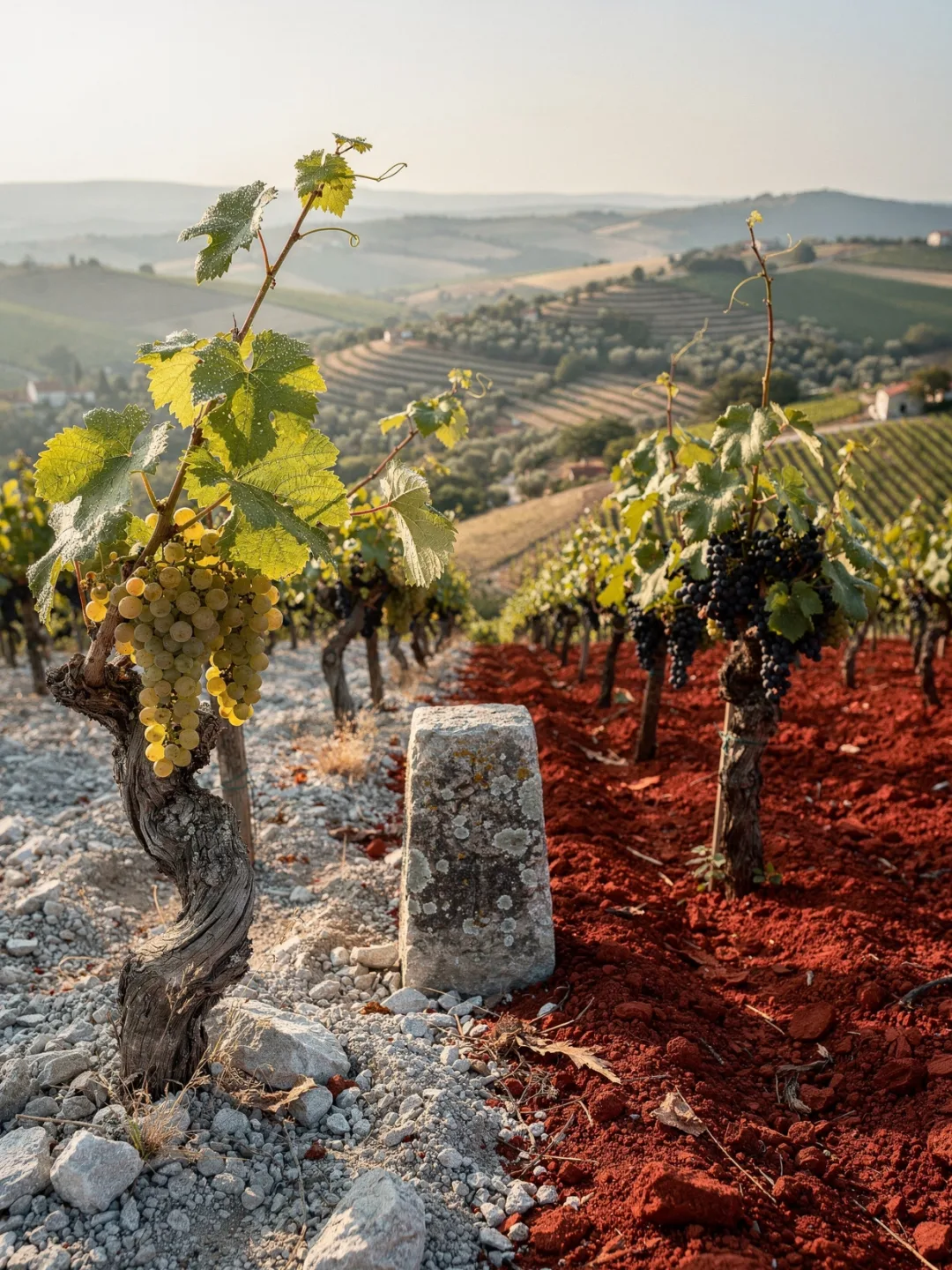
Two varieties share nearly the entire area here, and they could hardly be more different. Malvazija Istarska, usually just called Malvazija, covers around sixty percent of all Istrian vineyards. That makes it by far the country's most important white grape. A hundred years ago, the ratio was reversed: red varieties like Teran dominated, and Malvazija was a sideshow. The swap only happened in the twentieth century, quietly and without a single decree.
In the glass, Malvazija shows pale straw yellow and a bouquet of acacia blossom, green apple, and a salty note known as salinity. This is an echo of the nearby sea, not a contradiction of it. Acidity is medium, the body rather slender. Yet plenty of winemakers leave the grapes on the skins far longer than any Sauvignon Blanc could ever tolerate. That changes everything. A light summer wine turns into one with structure, tannin, and a color that shifts toward amber.
Teran is the opposite in almost every respect. The berries are small and dark, the wine pours nearly black into the glass, and both acidity and tannin run high — tannin being the rough coating you feel on your gums after a sip. Also typical is a slight bitterness in the finish, coming from the grape's abundant tannins and high acidity, a trait found in hardly any other red variety. Teran thrives best on crljenica, the red earth of the coastal region, which gives it its power.
Alongside these, two smaller varieties survive with their own stories. Borgonja was long considered a distinct Istrian grape, until genetic testing showed it to be identical to Frankovka. Around Poreč and Višnjan, it used to grow even more widely than Teran. From the village of Momjan in the northwest comes Muškat Momjanski, a variant of Muscat. It already won a gold medal in Brussels in 1935 and has been protected since 2021 as Croatia's eighteenth EU wine designation of origin. International varieties have also arrived, including Merlot, Cabernet Sauvignon, and Chardonnay, often blended with Teran into wines Istrians call Superistrians.