Limestone, Clay, Gravel
Soils
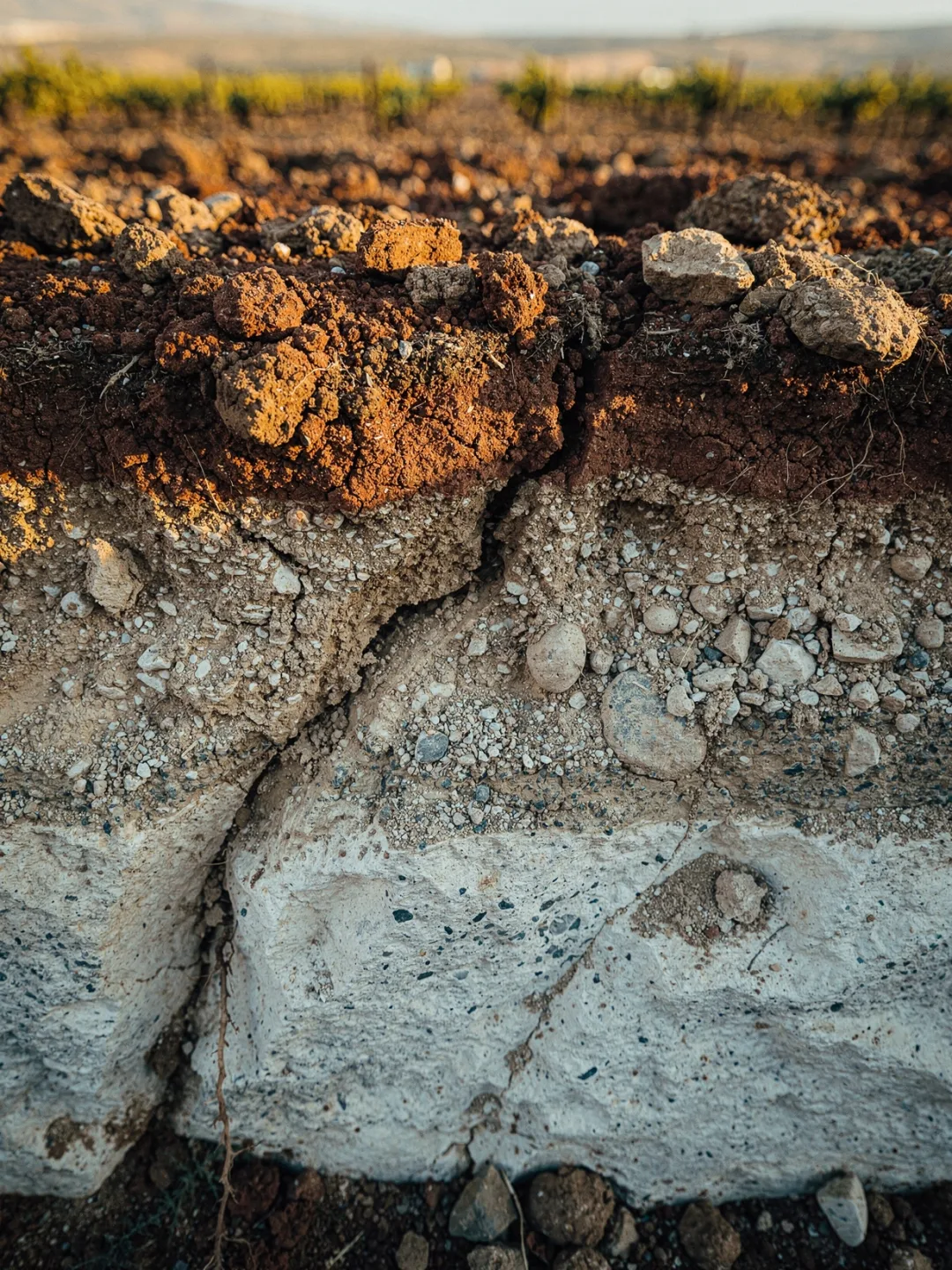
Dig a hole in a vineyard near Kefraya, and you first hit reddish clay. The red comes from iron in the weathered limestone beneath it — experts call this color terra rossa, red earth. It's only a thin skin over something much older.
Beneath it lies a layer of gravel and rubble, deposited back when large parts of the valley were still covered by a lake. The Bekaa Valley sits on a rift zone, cut through by the Yammouneh Fault. Its movements have alternately created lakebed and dry land over millions of years, and each phase left behind its own layer of clay, sand or rubble. Anyone digging into a roadside bank in the West Bekaa can see this layering with the naked eye. Where the root has to force its way through the gravel, the berries stay small and their skins thick — and most of a wine's tannin sits in the skin.
At the very bottom, often only after several meters, comes the true foundation: pale limestone from the Jurassic and Cretaceous periods, well over a hundred million years old. It soaks up winter rain like a sponge and releases it slowly across the dry summer. It's precisely this storage capacity that turns an area with almost no summer rain into a vineyard at all.
One misconception persists stubbornly: that a wine tastes 'mineral' because the vine absorbs minerals from the limestone and passes them straight into the glass. That's not true. What comes in through the root are dissolved ions in quantities no palate could ever actually taste. The soil works indirectly instead — through water, warmth, and the depth to which it forces the root to reach.
Reddish, iron-rich clay from weathered limestone, thin and loose.
The root: This is where the fine roots sit, first to absorb the scarce winter rain.