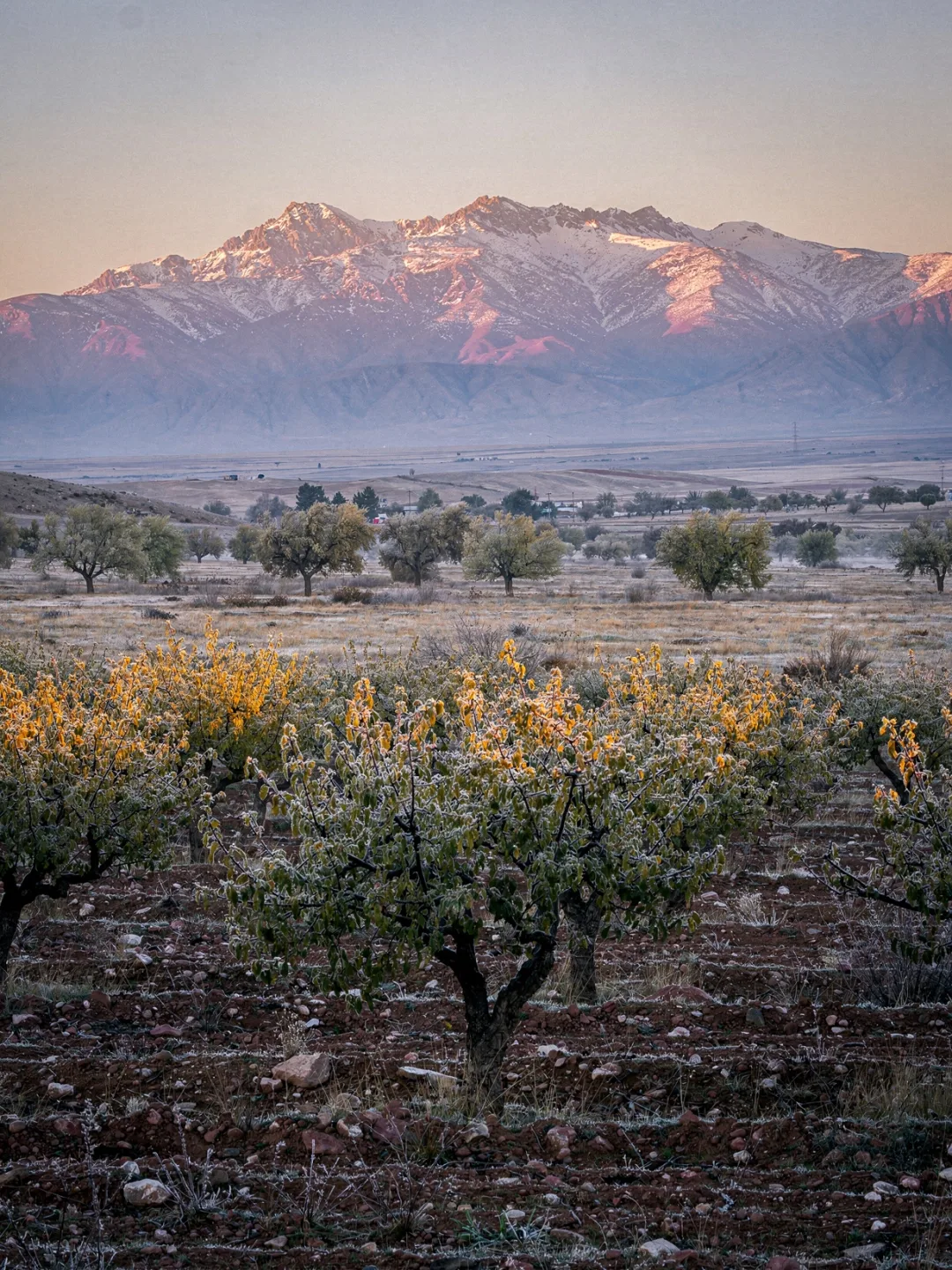
A Valley Between Mountains
Climate
Anyone driving from the Lebanese coast into the Bekaa Valley in summer first crosses a green coastal strip, then, after the summit of Mount Lebanon, suddenly finds a dry plain. The mountain range intercepts nearly all the moisture coming off the Mediterranean before it can reach the valley. Beyond it lies the Bekaa Valley, flanked by Mount Lebanon to the west and the Anti-Lebanon range to the east, at roughly a thousand meters elevation.
Rain falls here almost exclusively in winter, often as snow on the surrounding peaks. Between six hundred and seven hundred millimeters accumulate over the year, concentrated into just a few months. The Litani, Lebanon's largest river, rises in the north of the valley near Baalbek and collects part of this meltwater. In summer, by contrast, it stays essentially dry for weeks on end. The vines survive nonetheless, because snowmelt from the mountains seeps slowly into the groundwater and feeds the roots from below. Without this reservoir, there would be no viticulture here at all.
Sunshine is never lacking: the sun shines over the valley roughly three hundred days a year. Even more important than the hours of sunshine is the swing between day and night. On an August day, the thermometer climbs above thirty degrees Celsius during the day and drops to around sixteen degrees at night — a swing of nearly fifteen degrees. For Cabernet Sauvignon and Syrah, this is decisive. The berry ripens in the daytime heat, while the night-time cool locks in the acidity that would otherwise cook away.
This balance is increasingly under threat. Winemakers in the Bekaa Valley report ever earlier harvests and vintages in which the usual night-time cool simply failed to arrive. What was once considered a reliably stable highland climate is growing steadily more unpredictable.