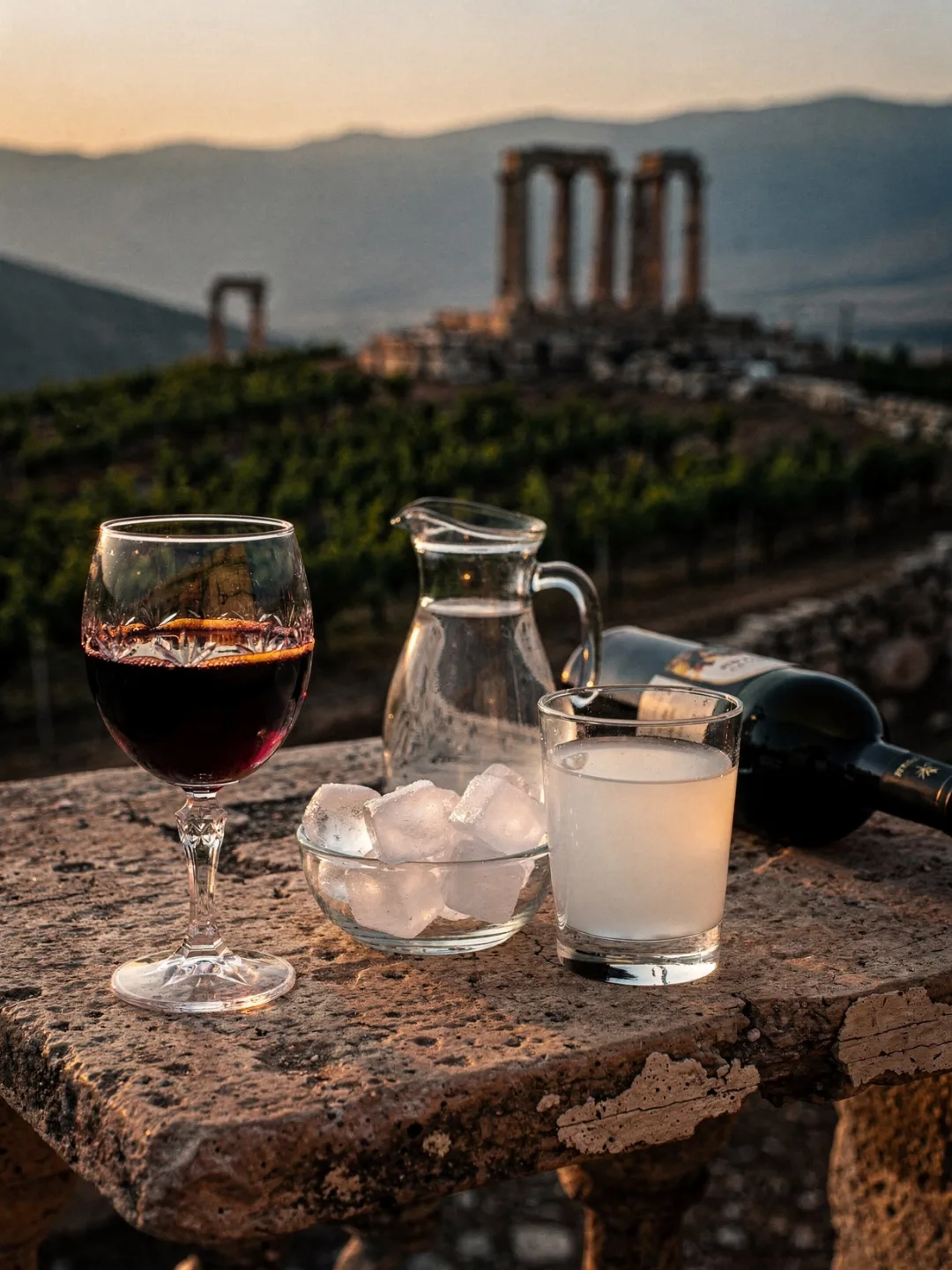
The Bordeaux Glass and the Arak Glass
Glassware
Two glasses belong to the Bekaa Valley, and they could hardly be more different. One is a wide-bowled Bordeaux glass for the red blends of Cabernet Sauvignon, Cinsault and Carignan. The other is a small, plain water tumbler — for arak.
A wine from Château Musar reaches the market already at seven years of age. It spends two years in barrel, another year in concrete, and at least four more years in bottle after that. Even so, a wide glass is worth it. The slow aging has already opened up the wine, but its aromas — dried fig, leather, a hint of the barnyard — still need room to unfold rather than stack up in a narrow opening. Sixteen to eighteen degrees Celsius is the right serving temperature, cooler than a living room in a Lebanese summer would normally offer.
For arak, the opposite logic applies. It's poured neat, without ice, into a small glass — water comes only afterward, in a ratio of roughly one part arak to two parts water. The clear spirit instantly clouds into a milky white; Lebanese simply call this effect 'the milk of the lions.' Ice comes last of all, straight into the finished mixture. Reverse the order and drop ice cubes into the neat spirit first, and you end up with an unpleasant oily film on the surface.
At the family table in Zahle, tradition has the eldest man open the first bottle of home-distilled arak. Before anyone drinks, he pours three small glasses: one for the ancestors, one for the land, one for the guests. Only then does the evening properly begin.