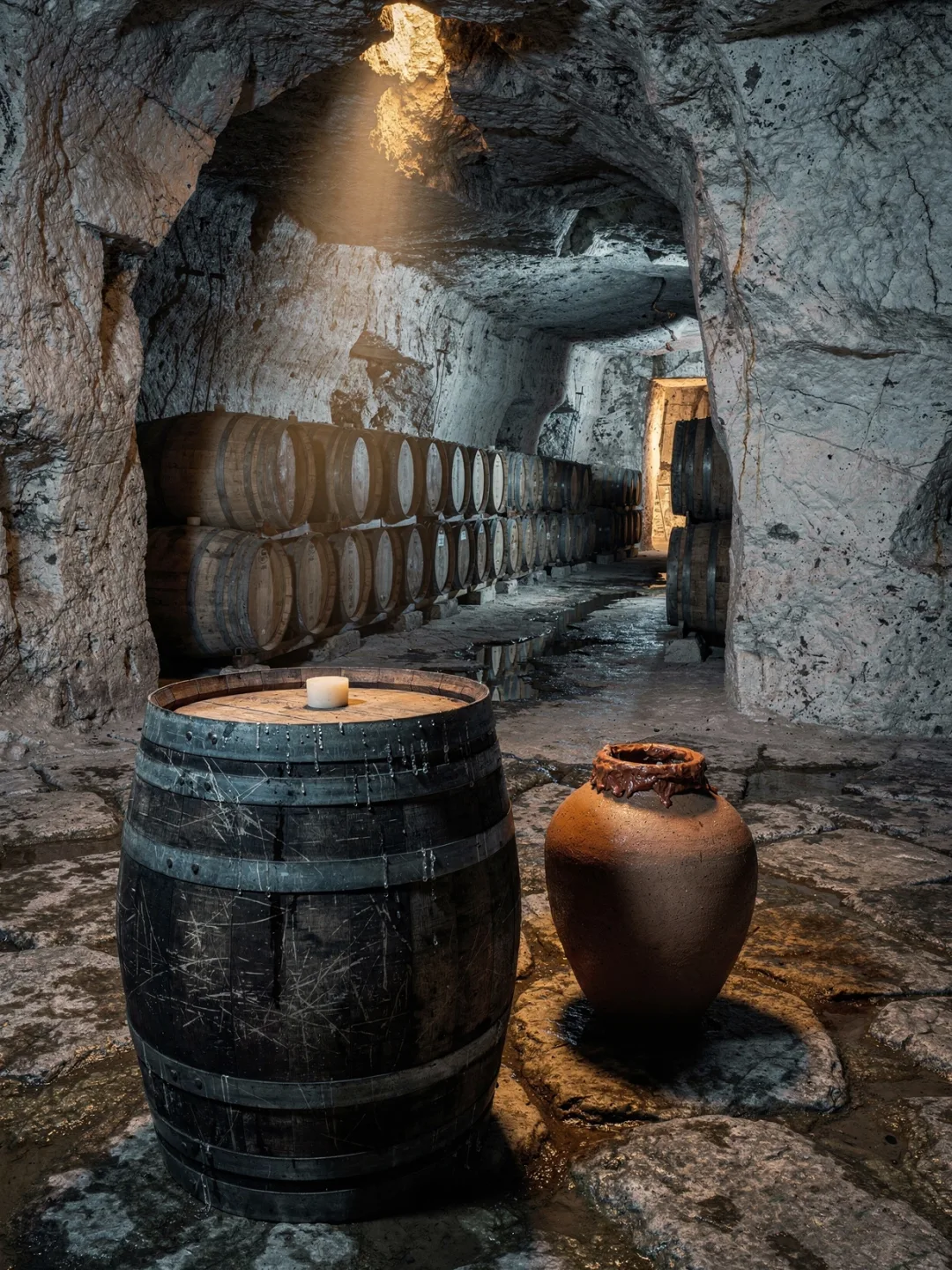
Concrete, Barrel, Amphora
Winemaking
No winery in the Bekaa Valley works with more stubborn independence than Château Musar. Each of the three grape varieties — Cabernet Sauvignon, Cinsault and Carignan — ferments separately at first, in concrete tanks, using only the yeasts naturally present on the grape skins, at temperatures below thirty degrees Celsius. Only six months after harvest does the wine move into French oak barrels from Nevers, for twelve months. Blending doesn't happen until two years after the harvest. After that, the finished cuvée ages another year in concrete before being bottled unfiltered and unfined. From harvest to sale, a full seven years pass — a patience hardly any other winery in the world affords itself.
Quite different, yet equally shaped by history, is how wine ages at Château Ksara. In 1898, workers expanding the cellar stumbled by chance on a cave dating from Roman times. Today the passages stretch over two kilometers beneath the winery, at a temperature and humidity that barely shift across the whole year. Barrels stored here need neither air conditioning nor heating. The rock does the work on its own.
Not every grape in the Bekaa Valley becomes wine at all. By law, arak may only be distilled from Obeideh or Merwah, triple-distilled in copper stills. Only in the final pass is crushed aniseed added, its oil giving the spirit its characteristic flavor. After that, the arak must age at least a year in clay vessels before it can be sold. Wine and arak, then, often come from the very same vines. Only the path afterward diverges completely.