Rara Neagră & Co.
Grape Varieties
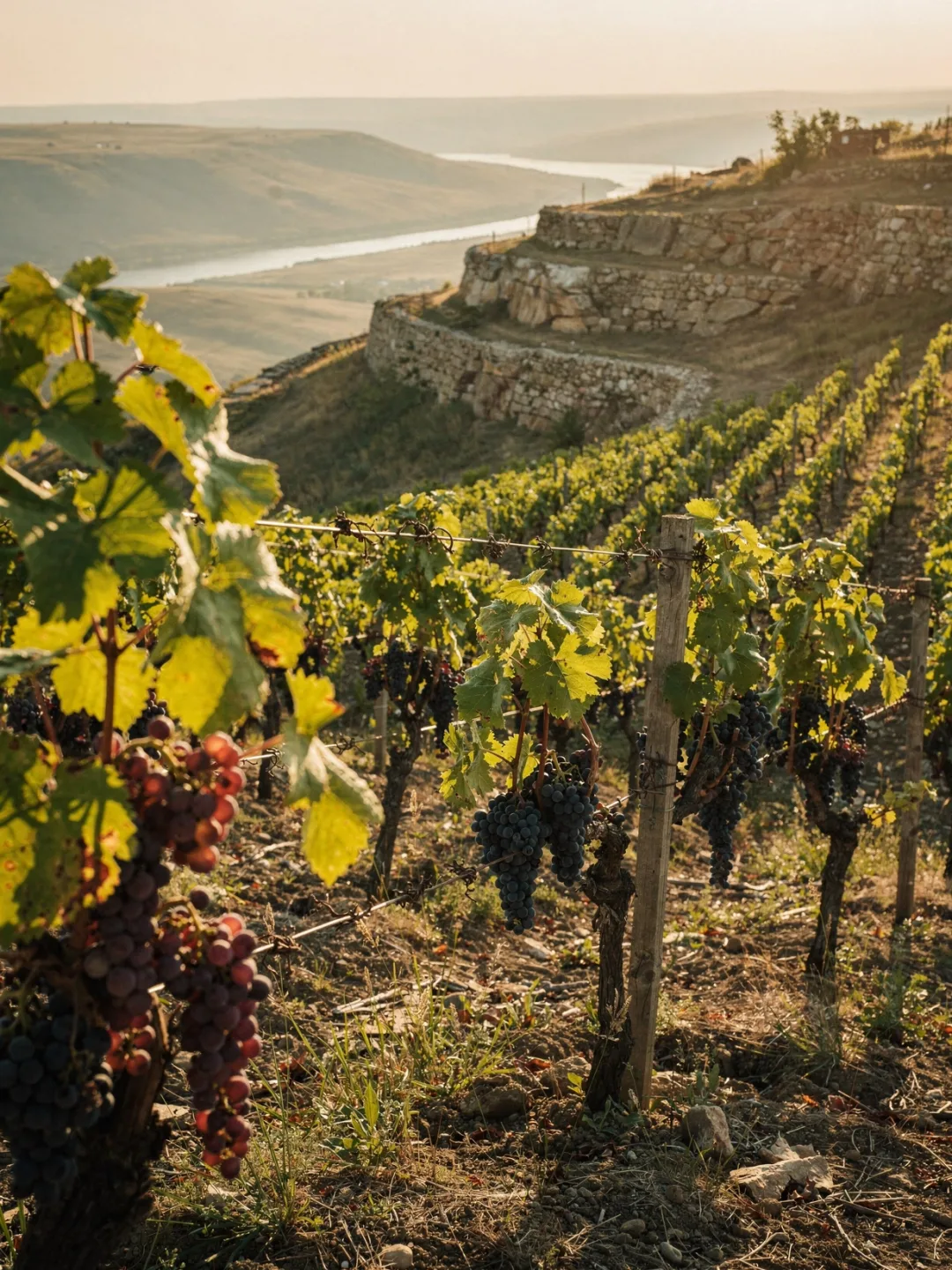
One variety here tells the oldest story of all: Rara Neagră. It has become rare today, barely two hundred hectares in the whole country. Along the Nistru it carries this name, elsewhere in Moldova it's called Băbească Neagră, and the legend behind it involves Ștefan cel Mare. A commander is said to have served the prince a wine that an old woman, a 'babă', had sent from the village of Nicorești. The prince loved the drink immediately. He called for a second cup, and the old woman's name stuck to the wine.
In the glass it's light for a red wine, almost like a hearty rosé, yet high in acidity. Alcohol levels stay moderate, usually between ten and eleven point five percent, while acidity climbs above five, sometimes six grams per liter. That's unusually high for a red wine. That's why it ages slowly and heavily, yet keeps for decades, and across all of Moldova it grows on barely two hundred hectares. A good portion of that stands right here, around Ștefan Vodă, second only to the Cahul wine region.
Alongside it stands a second native variety, Fetească Neagră, the 'black maiden'. It's darker, warmer in tone, with aromas of ripe cherry and a hint of prune, and it handles oak barrels better than the more reserved Rara Neagră. Overall, the entire native share of vines around Ștefan Vodă makes up only a small fraction, just six out of every hundred vines.
The rest of the area belongs to imported varieties. Cabernet Sauvignon forms the backbone of the region's most famous cuvée, Negru de Purcari, rounded out with Saperavi from Georgia and a small splash of Rara Neagră on top. Merlot, Cabernet Franc and Chardonnay fill out the rest of the fifteen approved varieties. Does it taste of blackcurrant or of sour cherry? That almost always reveals which of the two worlds is currently in the lead, right there in the glass.