Gimblett Gravels
Soils
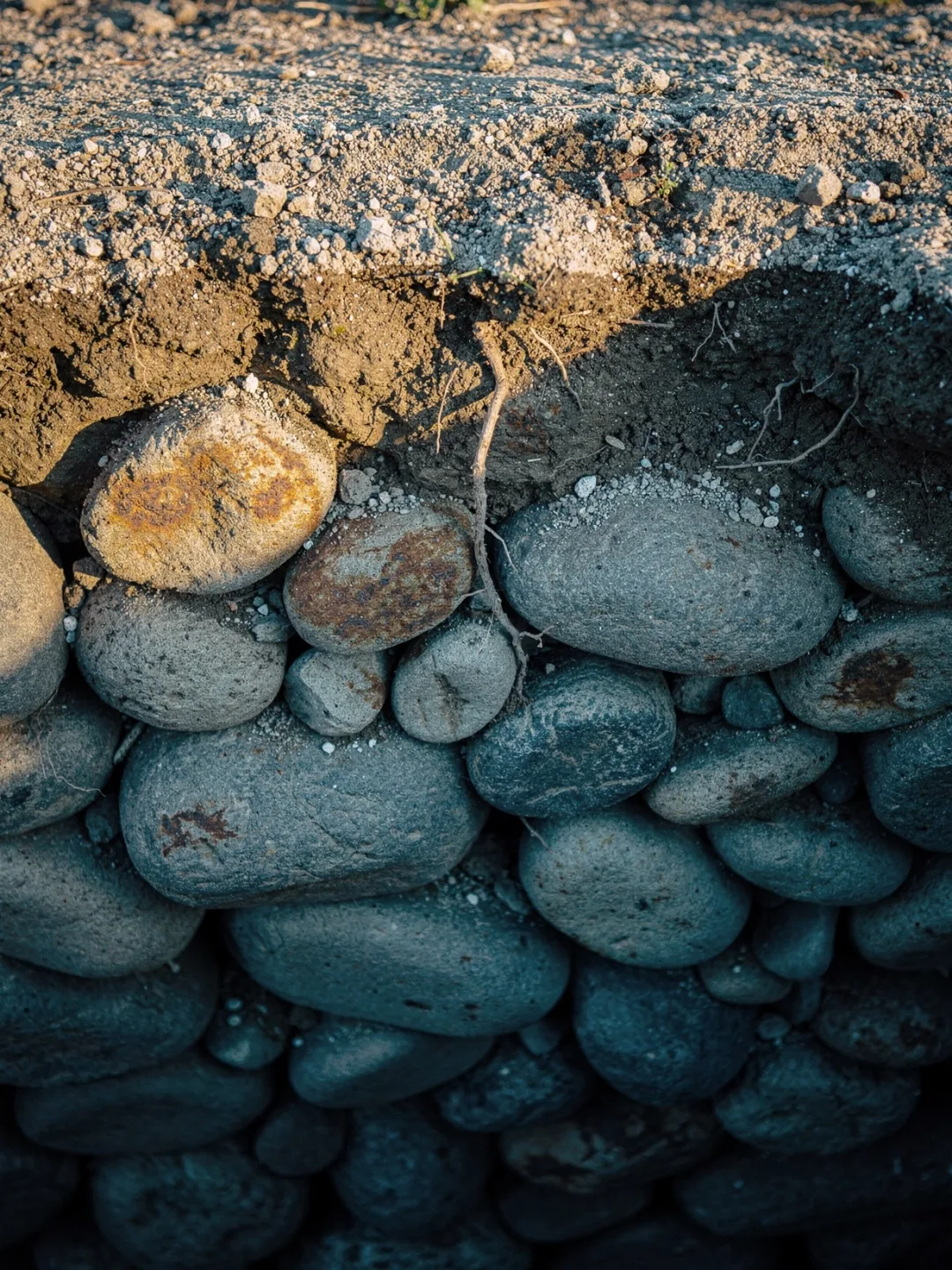
In 1867, the Ngaruroro shifted course. A flood pushed the river out of its old bed near Omahu to the other side of Roy's Hill, where it still flows today. Left behind was a plain of rounded river gravel, in places more than thirty meters deep.
Too stony for farming, the land served for decades only as a shooting range and dump. Only in 1981 did the first vines go in. Today Gimblett Gravels covers around eight hundred hectares, protected as a registered trademark by the local winegrowers' association. Anyone wanting to use the name must source at least ninety-five percent of their grapes from this exact gravel.
The reason behind all this effort lies underground. The stones store the sun's warmth by day like an oven and release it again at night, so that Cabernet, Merlot, and Syrah ripen here more reliably than on any other soil in the region. Water drains away instantly. The vine has to drive its roots deep just to find anything at all, and ends up bearing smaller, thicker-skinned berries. More skin relative to juice means more color and more tannin in the finished wine.
Just to the north lies the Bridge Pa Triangle, more than two and a half times larger at around two thousand hectares, where a thin layer of sandy loam still covers the gravel. Wines from there often feel a touch rounder. They lack the pure minerality found in the stoniest parcels of Gimblett Gravels, but bring more fruit instead.
Right at the surface, in the topmost centimeters, lies a paper-thin layer of ash: fine pumice dust that the massive eruption of the Taupō volcano scattered across much of the North Island roughly one thousand eight hundred years ago. It holds almost no water. The soil's real character only begins beneath it, in the gravel itself.
A paper-thin layer of sandy loam, mixed with fine pumice dust from the Taupō eruption roughly 1,800 years ago.
The root: Holds almost no water — the fine roots dry out here first.