Greywacke & Loess
Soils
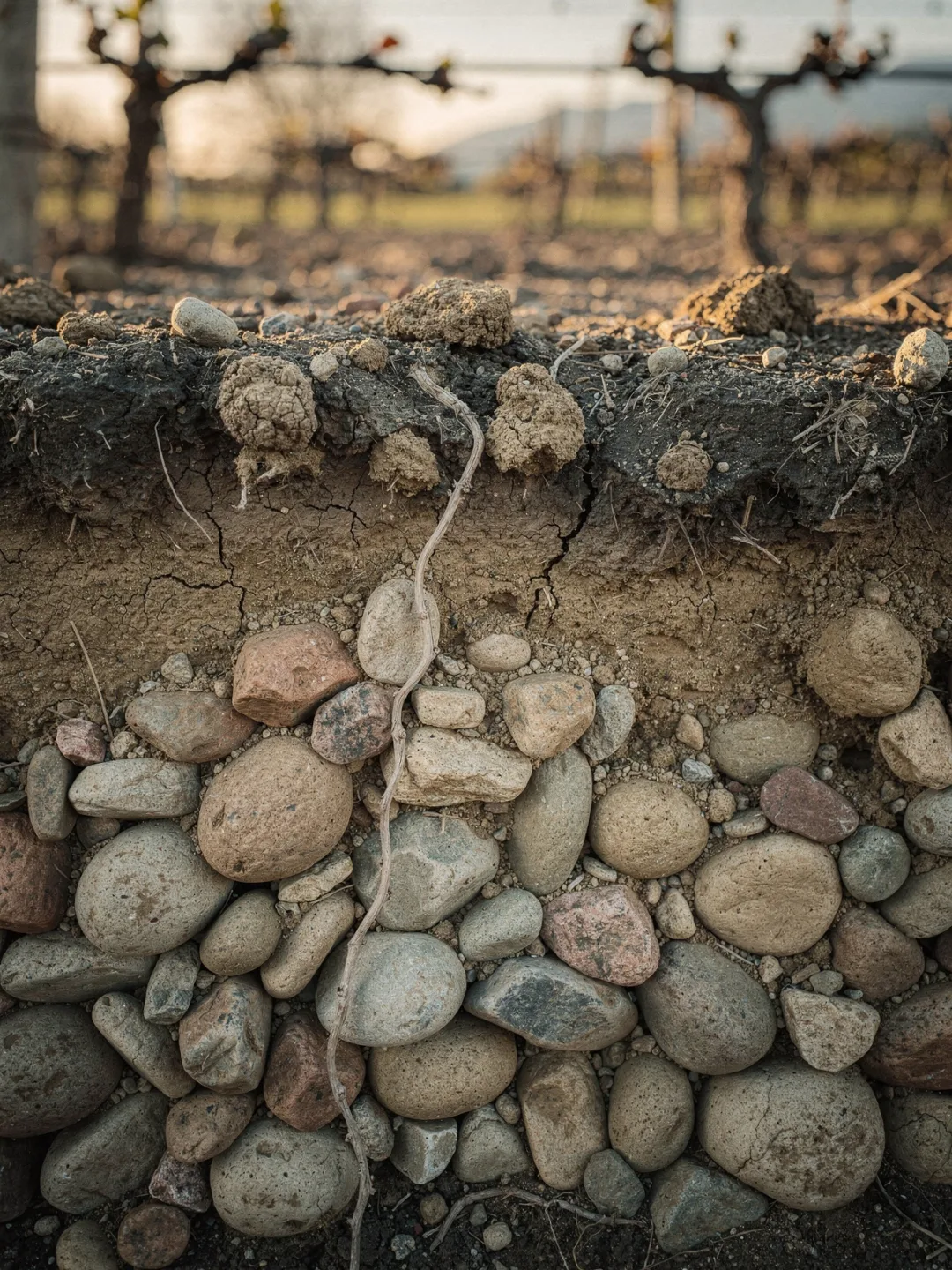
Dig a hole in a vineyard in the Wairau Valley. You'll first hit dark, gray-brown silt, barely more than a hand's width deep. Below that the soil turns lighter and sandier, and after about half a meter the spade strikes stone. Rounded river gravel lies here, deposited by a river that has shifted its course several times since the last ice age.
This gravel is greywacke, a hard sandstone from the inland mountains that the Wairau has rolled downstream and worn smooth over millennia. Between the stones there's barely any soil. Nutrients are almost entirely absent. Water runs through like through a sieve, and that's exactly what forces the vine to root deep instead of sprawling near the surface.
A soil type called Rapaura Shallow Silt Loam is considered by New Zealand soil scientists to be almost ideal for winegrowing. It's permeable enough to prevent waterlogging, yet carries just enough fine soil on top for a young vine to establish itself at all. It runs through large parts of the Wairau and also through the deeper sites of the Awatere.
In the Awatere, a second ingredient joins in: loess, fine, wind-blown dust that has settled in thin layers over the same gravel. On the flattest, stoniest terraces, the soil layer is so thin and so permeable that winemakers would be lost in summer without drip irrigation. Irrigation here is essential. Vines on such soils yield smaller berries, thicker skins, and, ultimately, more concentrated wines.
Still, the soil doesn't literally show up as a flavor in the glass, tempting as that idea is. What it passes on is water balance and warmth: a lean, gravelly soil warms quickly, holds little moisture, and lets the vine ripen early. A deeper, clay-rich soil in the southern side valleys retains moisture longer and slows that same process by days. Two vineyards, the same variety, two entirely different harvests.
Dark, gray-brown silt with some fine sand, recorded as its own soil type after the nearby town of Rapaura.
The root: This is where the fine roots sit, catching the last rainfall before the surface dries out again.