Sun, wind, nights
Climate
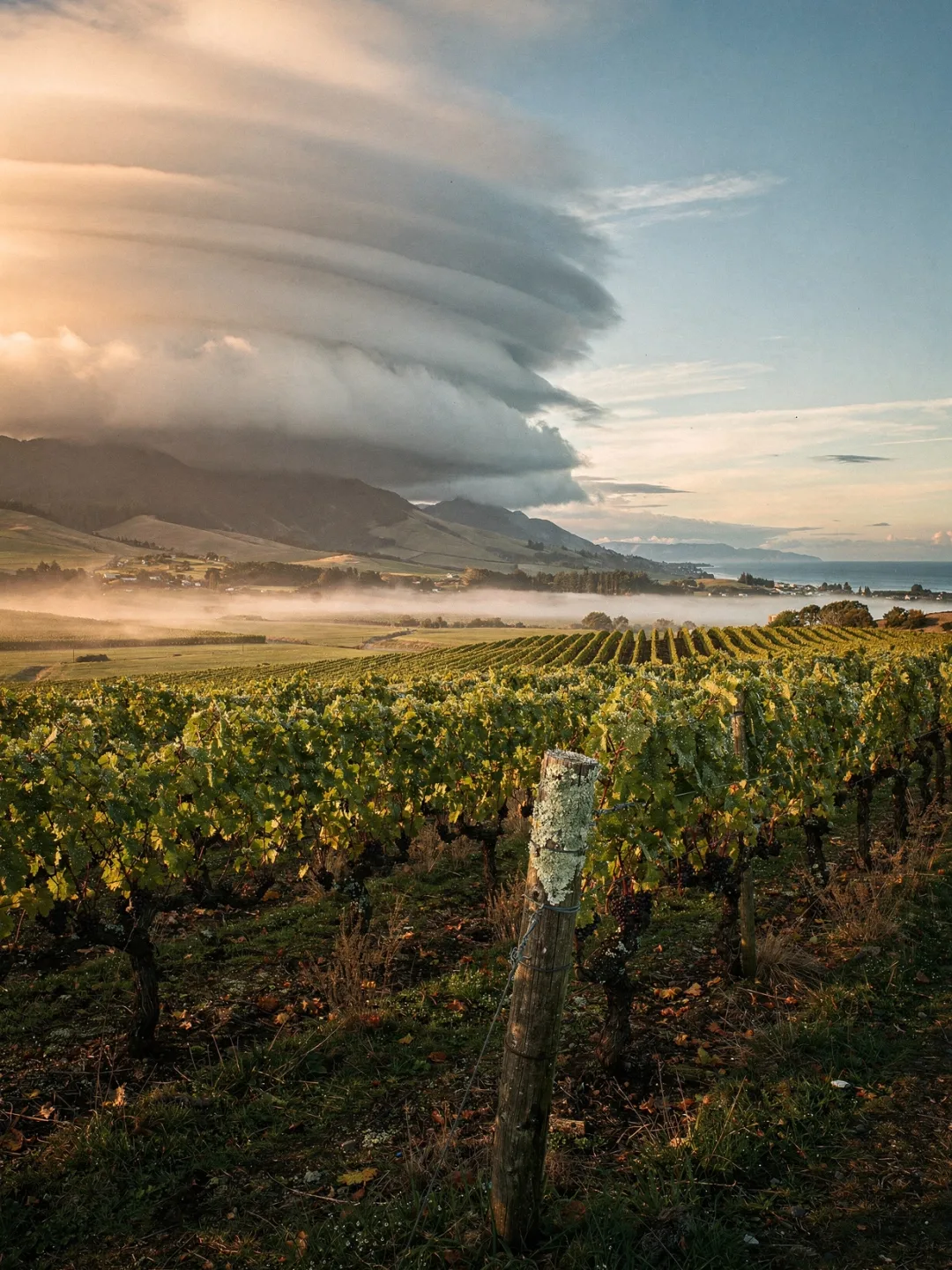
No place in New Zealand sees more sun than Blenheim in the heart of the Wairau. Over 2,475 hours a year, more than Auckland, more than Christchurch, even more than sun-blessed Nelson right next door. For a vine, that means above all one thing: time to build sugar, without the sun itself becoming a threat.
This sunshine is no accident. Mountain ranges to the west intercept the moist winds coming off the Tasman Sea before they reach the Wairau and Awatere Valleys, casting a rain shadow across the entire valley floor. Around Blenheim and Seddon, annual rainfall therefore drops below eight hundred millimeters, and in parts of the Awatere Valley near Lake Grassmere it falls below six hundred. Just a few kilometers further east, at the Marlborough Sounds, the same year brings over sixteen hundred millimeters. Between the dry vineyard and the dripping-wet coast sometimes lies only twenty kilometers as the crow flies.
The climate is shaped by water on two sides. To the north lies the Cook Strait, to the east the open Pacific, and both send cool breezes inland as soon as the sun sits low. Inland, in Blenheim, the temperature swings between day and night by an average of almost eleven degrees. Along the coast, say at Pelorus Sound, it's only around seven. This difference decides where a wine ultimately holds onto its acidity and where it loses it.
Sometimes, though, the whole system flips completely. When a dry northwest wind rolls over the mountains, heat builds up as if trapped under a blanket, and the temperature shoots up within hours. On February 7, 1973, of all years the founding year of Marlborough's modern winemaking, the thermometer at The Jordan in the Awatere Valley climbed to 42.2 degrees. That's close to New Zealand's heat record, still standing today. For the young plantings near Brancott, it was an early, harsh lesson.
All of this compresses the harvest into a narrow window at the end of the Southern Hemisphere summer. Chardonnay usually comes first, often as early as late March, Sauvignon Blanc follows shortly after, and Pinot Noir is picked a little later still, once its thinner skin has developed enough color. Pick too early, and you risk green, underripe aromas. Wait too long, and you lose exactly the acidity that makes these wines so fresh.