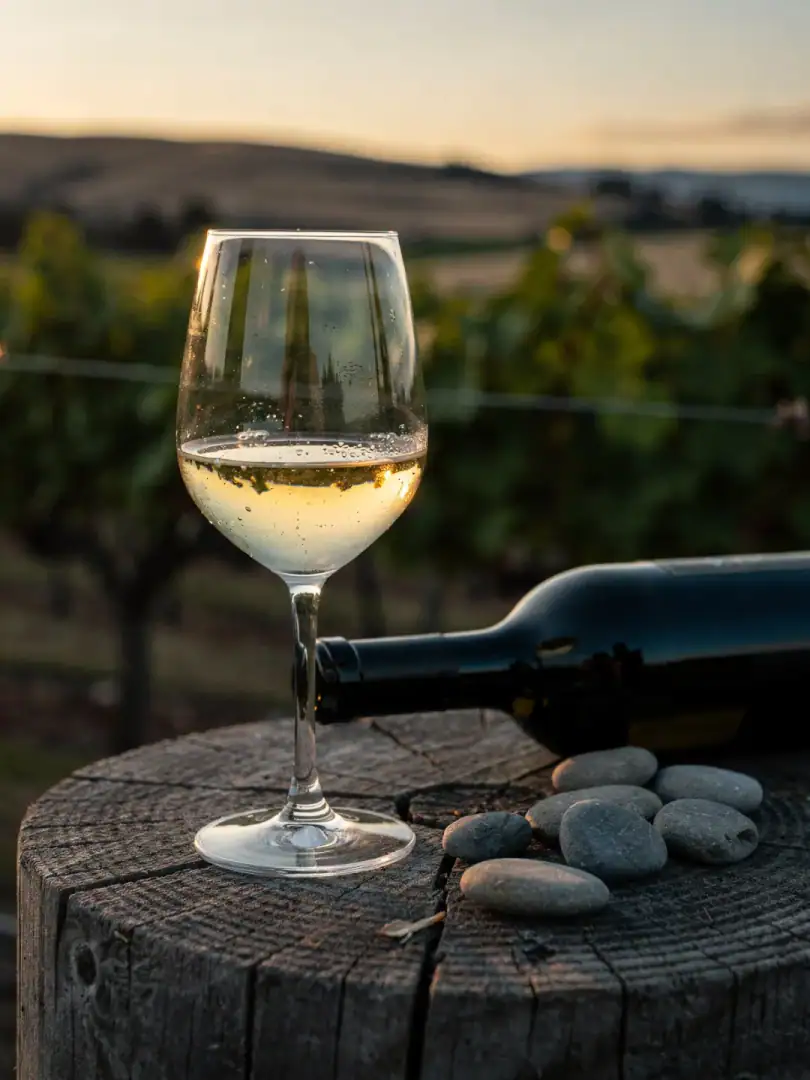
Slender glasses, chilled
Glassware
Shape decides everything here. A glass can ruin a Wairau Sauvignon Blanc before you've even tasted it. Too wide, and the volatile aromatic compounds that made this wine famous escape before your nose ever reaches them. That's why Sauvignon Blanc gets a slimmer glass here than Chardonnay, a narrower tulip shape with a smaller bowl that funnels the aroma upward instead of letting it dissipate in open space.
The main compounds responsible are thiols, sulfur-containing aroma compounds that smell of passion fruit, gooseberry, and blackcurrant bud. They're extremely volatile and react sensitively to warmth and oxygen. Warmth kills them instantly. Too large a glass gives them too much surface area to evaporate from, and a wine served too warm loses them even faster. Seven to nine degrees Celsius, straight from the fridge, isn't a matter of taste here but a chemical necessity.
Pinot Noir from the cooler sites of the Awatere Valley or the southern side valleys demands the opposite: more room. A bowl-shaped glass with a wide opening lets the delicate red wine breathe and softens the youthful, sometimes slightly green tannin. It's served cooler than a Bordeaux, around fourteen to sixteen degrees; any warmer, and the fine sour cherry and herbal notes quickly tip into alcohol.
For the sparkling wine made from Pinot Noir, Chardonnay, and a touch of Pinot Meunier, a third rule applies. Bubbles need a narrow space. A slender flute rather than a flat coupe holds the carbonation in the wine longer and protects the delicate yeasty aromas that developed over months in the bottle. Pour it into a flat coupe, and within minutes you'll have nothing left but still wine in your glass.
The same basic rule applies to all three: never fill more than a third of the glass. No one needs more than that. The empty space above isn't wasted room, it's exactly where the aromas gather before your nose can even perceive them.