Sauvignon Blanc & Co.
Grape Varieties
One single variety has put Marlborough on the wine map of the world. Sauvignon Blanc now grows on roughly 25,150 hectares of Marlborough's nearly 30,500 hectares under vine, a good eighty-two percent. As recently as 2012, according to a study by New Zealand researchers, it was around sixty percent. In little more than a decade, a grape that thrives above all in the Wairau has crowded out almost everything else.
What makes this Sauvignon Blanc so unmistakable lies in the chemistry of its skin. Cool nights preserve two groups of compounds particularly well: thiols, which smell of passion fruit and gooseberry, and methoxypyrazines, responsible for the green bell pepper note and the scent of tomato leaf. It's exactly this combination that sets Marlborough apart from Sancerre or South African Sauvignon Blanc. There, the grapes ripen through warmer nights, and the volatile aromas dissipate faster. A glass from here smells louder, more direct, more tropical as a result. You can taste it immediately.
Far behind, but unrivaled in second place, comes Pinot Noir with around two and a half thousand hectares. It thrives especially in the cooler sites of the Awatere Valley and the southern side valleys, where its thinner grape skin suffers less under the sun. It produces both standalone red wines and the base wines for Marlborough's sparkling wine.
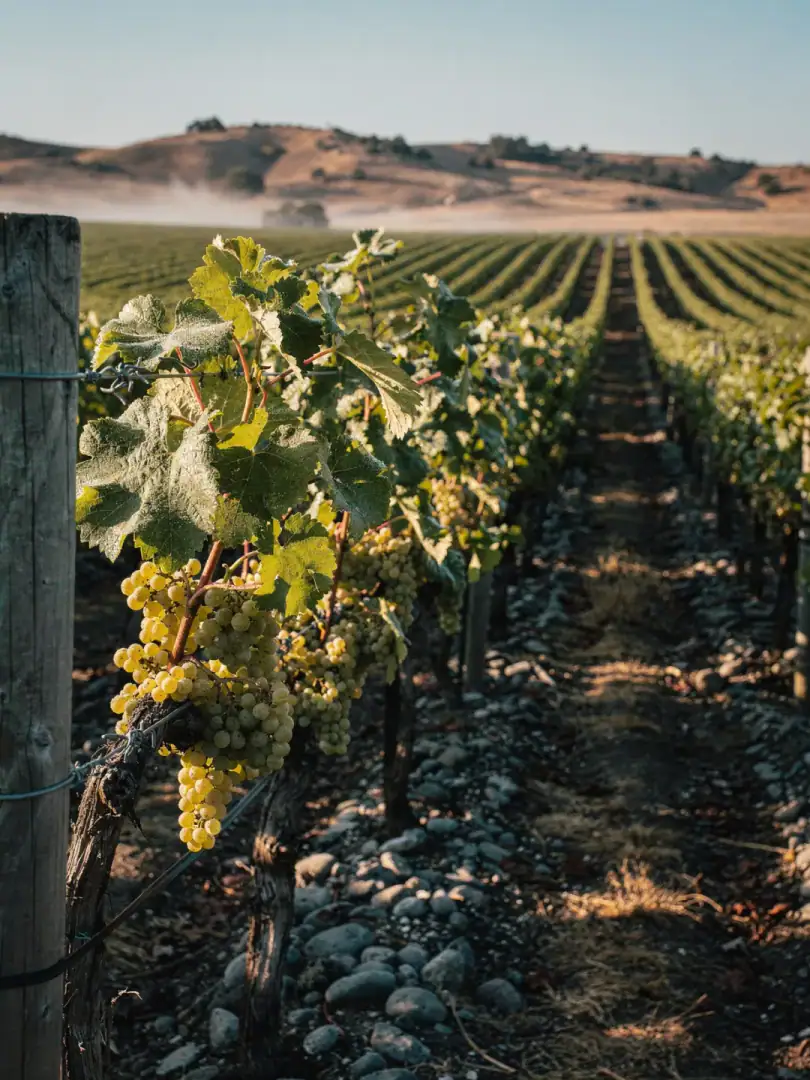
The rest is spread across a small but refined catalog. Pinot Gris and Chardonnay together account for just under eight percent. Riesling remains a niche at under one percent. At the very margins there's even Pinot Meunier, almost exclusively destined for the bottle fermentation of sparkling wine and never bottled as a standalone wine, plus a few hectares of Gewürztraminer, Sauvignon Gris, and even Grüner Veltliner, barely more than a footnote in the statistics. Yet anyone driving through the vine rows still sees mostly one thing: row after row of Sauvignon Blanc, all the way to the horizon.