Terraces of Gravel
Soils
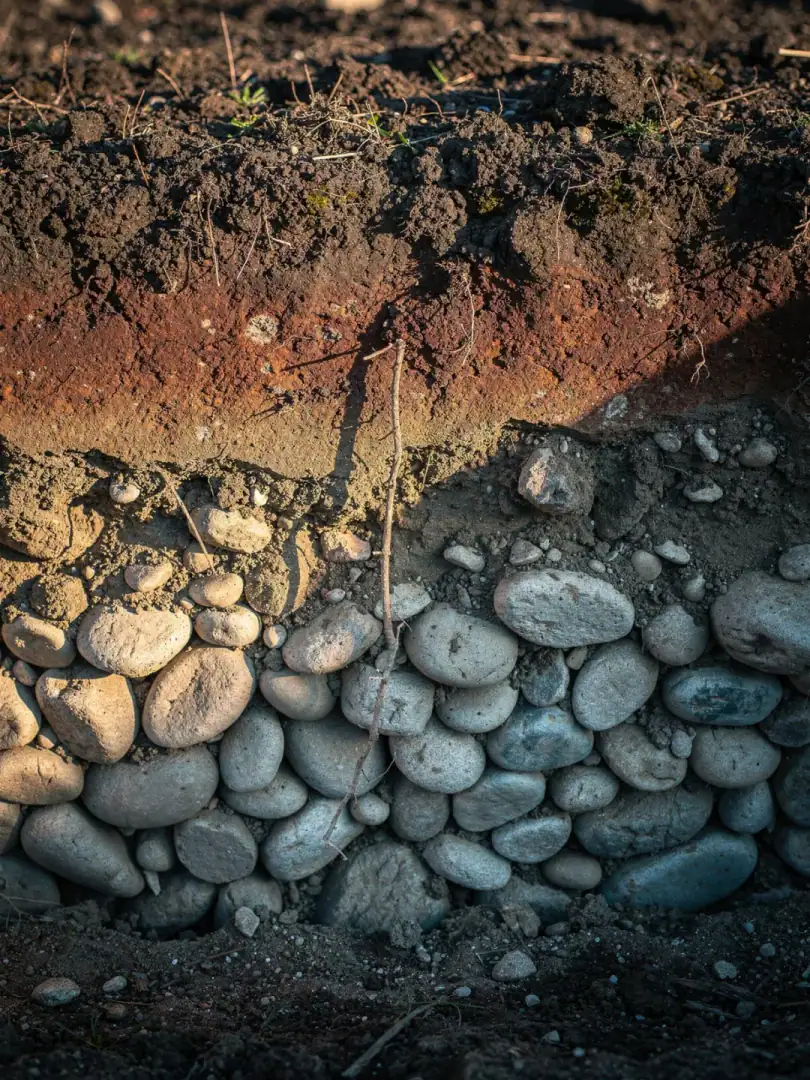
A single spade cut into the Martinborough Terrace is enough to understand why wine grows here at all. Beneath a thin layer of dark topsoil lies round river gravel almost immediately, sometimes fist-sized, sometimes as small as a pea. These are stones a vine root cannot push through — it must instead squeeze its way between them.
This gravel terrace is a gift from the Huangarua River. Around twenty thousand years ago, when the river carried far more water, it pushed rubble down from the Tararua Range and deposited it in broad bands. As the river later cut deeper into the land, the old deposits remained behind as a dry terrace, well above today's riverbed. It's exactly there that the region's oldest vineyards now stand.
This gravel lets water drain through almost unimpeded. That might sound like a drawback, but for Pinot Noir it's an advantage: the vine must send its roots deep just to reach any moisture. In doing so, it grows downward rather than outward. Less water means less foliage and smaller berries. Smaller berries have proportionally more skin. And that's exactly where color, tannin, and much of the aromatic compounds reside.
Seven kilometers to the east, in the Te Muna Valley, the soil is different again. The higher terrace there carries ancient, iron-red clay over the gravel, a soil Pinot Noir thrives in. The lower terrace is younger, stonier, and threaded with veins of limestone, which is why Sauvignon Blanc tends to grow there instead. At Dry River, there's even a single block known as Craighall, located just outside town, whose gravel is said to be several tens of thousands of years older than the rest — the coldest, windiest, and stoniest parcel on the entire estate.
A persistent myth lingers here too: that the vine draws minerals from the rock, giving the wine a stony taste. What the gravel actually does is more mundane, and just as important: it drains water away, stores heat during the day and releases it at night, and forces the root down a path that makes the berry smaller and more concentrated. In the end, flavor is made in the berry, not in the rock beneath it.
A thin, dark layer of decomposed plant matter, barely a hand's width deep.
The root: This is where the fine roots sit, absorbing the first rains — and the first to dry out.