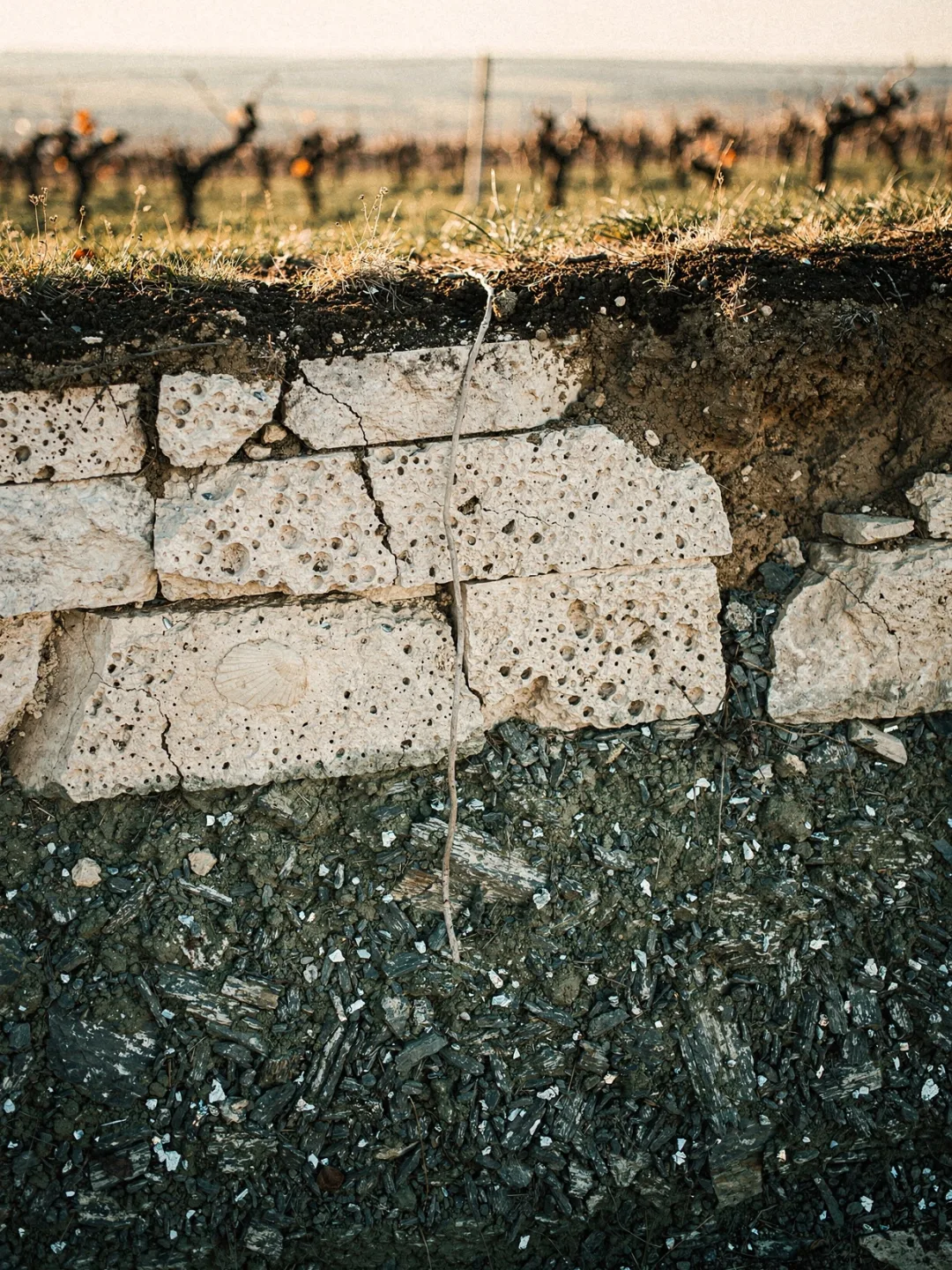
Leithakalk & Schiefer
Soils
Dig a hole in a vineyard on the Leithaberg and you'll quickly hit pale, almost white stone slabs. That's Leithakalk, a porous limestone riddled with tiny holes and sometimes whole shell imprints. What today lies as a gentle ridge above Lake Neusiedl was seabed sixteen to thirteen million years ago. Red algae and corals built a reef over millions of years in a warm shallow sea known as the Paratethys, which gradually compressed into stone.
Beneath this limestone layer lies something much older. The core of the Leitha range consists of gneiss and mica schist, crystalline rock that was already there long before the reef formed on top. Where the limestone is thin, the vine roots push through into this schist. That's exactly where the region's most austere, longest-lived wines come from, with a smoky, mineral note that pure limestone soil simply can't produce.
A short hour's drive south, the subsoil looks completely different. In Mittelburgenland, loess lies over heavy clay, fine-grained wind-blown dust from the last Ice Age that holds water like a sponge. Blaufränkisch from these soils comes across rounder and more dark-berried than that from the Leithaberg, with fewer edges and more fullness — a difference you can taste blind, without ever seeing the label.
Right in the south, a third soil type joins the mix. At Eisenberg lies green schist shot through with iron-rich clay, which local winemakers simply call the Blaufränkisch soil. Hardly any other site gives the variety such a cool, mineral, almost peppery edge. The iron in the clay gives the wine structure, the green schist gives it that cool spiciness — two ingredients that appear together in exactly this combination only here.
One misconception persists stubbornly, precisely because the soils here look so different. The limestone from the Leithaberg doesn't taste directly in the glass, any more than the schist from Eisenberg sits on the tongue like a stone. What actually matters is the detour through water and warmth. Limestone stores little moisture and reflects light, schist stores warmth and releases it back at night, clay holds water for a long time. These detours shape how a vine grows, not what arrives directly in its roots.
A thin dark topsoil over fine-grained loess dust, as found across much of Burgenland.
The root: This is where the fine roots sit. After rain, this layer turns damp quickly, and dries out just as fast in summer.