The Steppe Lake as a Buffer
Climate
Anyone reading weather maps for Burgenland rarely sees rain. The Pannonian climate brings hot, dry summers and cold winters, with just five hundred to six hundred millimeters of precipitation a year. That makes the region one of Austria's driest wine areas, closer in character to the Hungarian puszta than to the Alps. Summer days above thirty degrees Celsius are the norm here, not the exception.
In the midst of this dryness lies a counterweight of some three hundred square kilometers: the Neusiedlersee. On average, it is only one and a half meters deep. In summer, it therefore warms quickly to over twenty-five degrees. This body of water stores heat and releases it slowly. It softens spring frosts and keeps autumn nights milder than the location would otherwise allow. A deep lake couldn't do this — it would be too sluggish. It's precisely the shallowness that makes the difference.
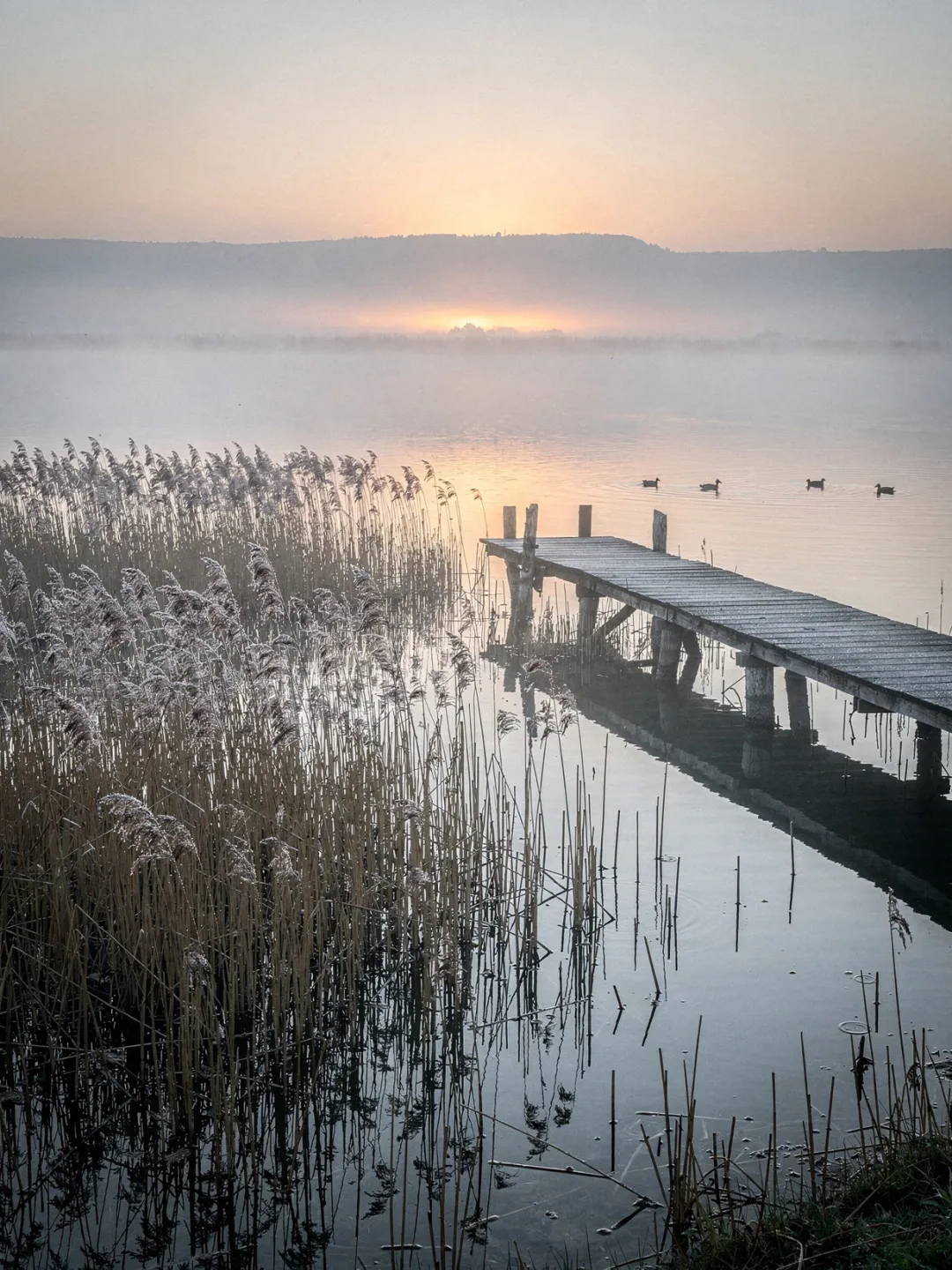
In autumn, this advantage flips into its opposite — and that's exactly what sweet wine needs. Moist air off the lake meets cool nights in the Seewinkel, east of the shore, settling as early morning fog over the vine rows, often lingering into late morning. When the sun then breaks through and the fog clears, the berries dry out again. This alternation between wet and dry lets Botrytis cinerea grow exactly where it's useful — on the berry skin, not in the flesh beneath.
To the west stands guard a mountain range. It's called the Leithagebirge, running crosswise to the wind and slowing cooler air coming from the Vienna Basin. As a result, the vineyards on the Leithaberg ripen noticeably more slowly than those in the flat Seewinkel across the lake, and their wines come across as tauter, with more acidity. Between the lake's two shores, within just a few kilometers as the crow flies, lie two almost opposite climates.
Day and night here differ less sharply than in the alpine valleys of other wine countries, because the lake evens things out where elsewhere sharp nighttime cooling is what preserves acidity. Blaufränkisch and Zweigelt don't need that sharpness to the same degree; their acidity holds up around the Neusiedlersee even without cold nights, as long as autumn doesn't turn too hot.