Loess & Permian Rock
Soils
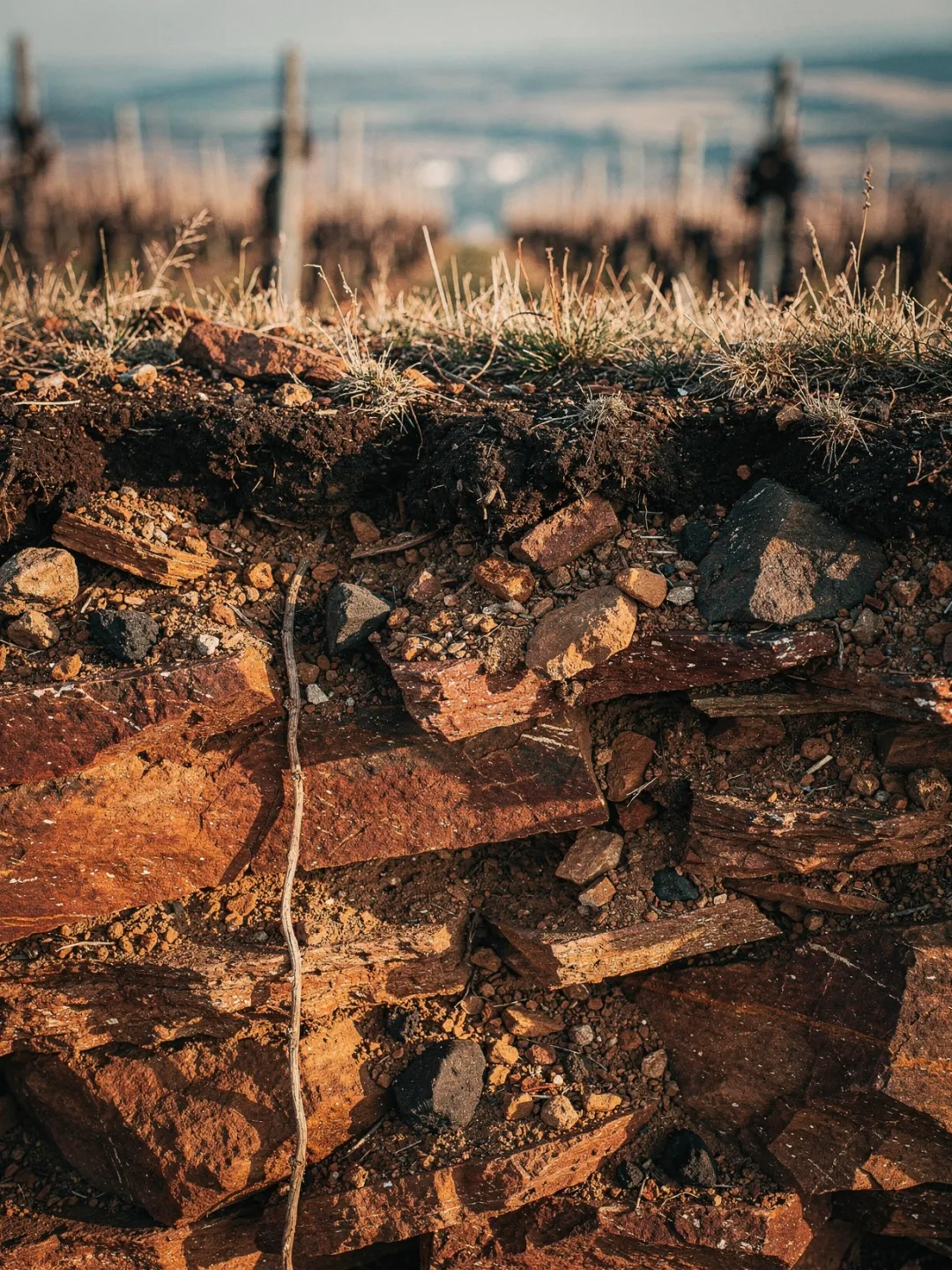
Dig a hole at the Heiligenstein near Zöbing, and you'll quickly hit stone — reddish and crumbly. This rock comes from a desert that existed at exactly this spot around 270 million years ago, when the land still lay flat and close to the equator. Over millions of years, pressure compacted it all into rock. Geologists today call this mixture the Zöbing Permian, a formation found nowhere else in Austria in this particular form.
Between the layers of sandstone lie darker chunks of volcanic material, embedded like foreign bodies from eruptions that occurred nearby around the same time. This mixture makes the slope so distinctive that part of it is now a protected nature reserve. Steppe plants grow there that are rarely found anywhere else in Central Europe — the pasque flower, for instance, or the steppe sedge, both of which are normally native much further east.
For the vine, this soil is a hard school. The topsoil layer is thin, barely a hand's width. Beneath it comes almost immediately the weathered rock, through which water drains quickly and where nutrients barely linger. The root has to force its way through every crack just to find moisture, and that effort costs it energy, slows its growth, and ultimately yields small, concentrated berries. It's from berries like these that the dense Riesling of the Heiligenstein is made.
Further south, around Langenlois and Gobelsburg, the earth looks completely different. There lies deep loess — fine, yellowish windblown dust from the last ice age, often several meters thick. It holds water well, warms up quickly, and the wines from there grow noticeably broader and softer. Between these two extremes, rock and loess, lie the transitional zones where most Kamptal vineyards are actually planted.
One misconception persists stubbornly: that a wine tastes like the rock it grows on. Only dissolved salts in the tiniest amounts make their way from root to glass, and that's nowhere near enough to shape flavor. What really makes the soil audible in the wine is its indirect route via water, warmth and root depth — and at Heiligenstein, that route is especially long.
A thin, stony topsoil layer with dry grassland and steppe herbs like the pasque flower. In a vineyard at Heiligenstein, rarely more than a hand's width deep.
The root: Only the fine roots sit here. After just a few hot days, this layer is already bone dry.