Veltliner & Riesling
Grape Varieties
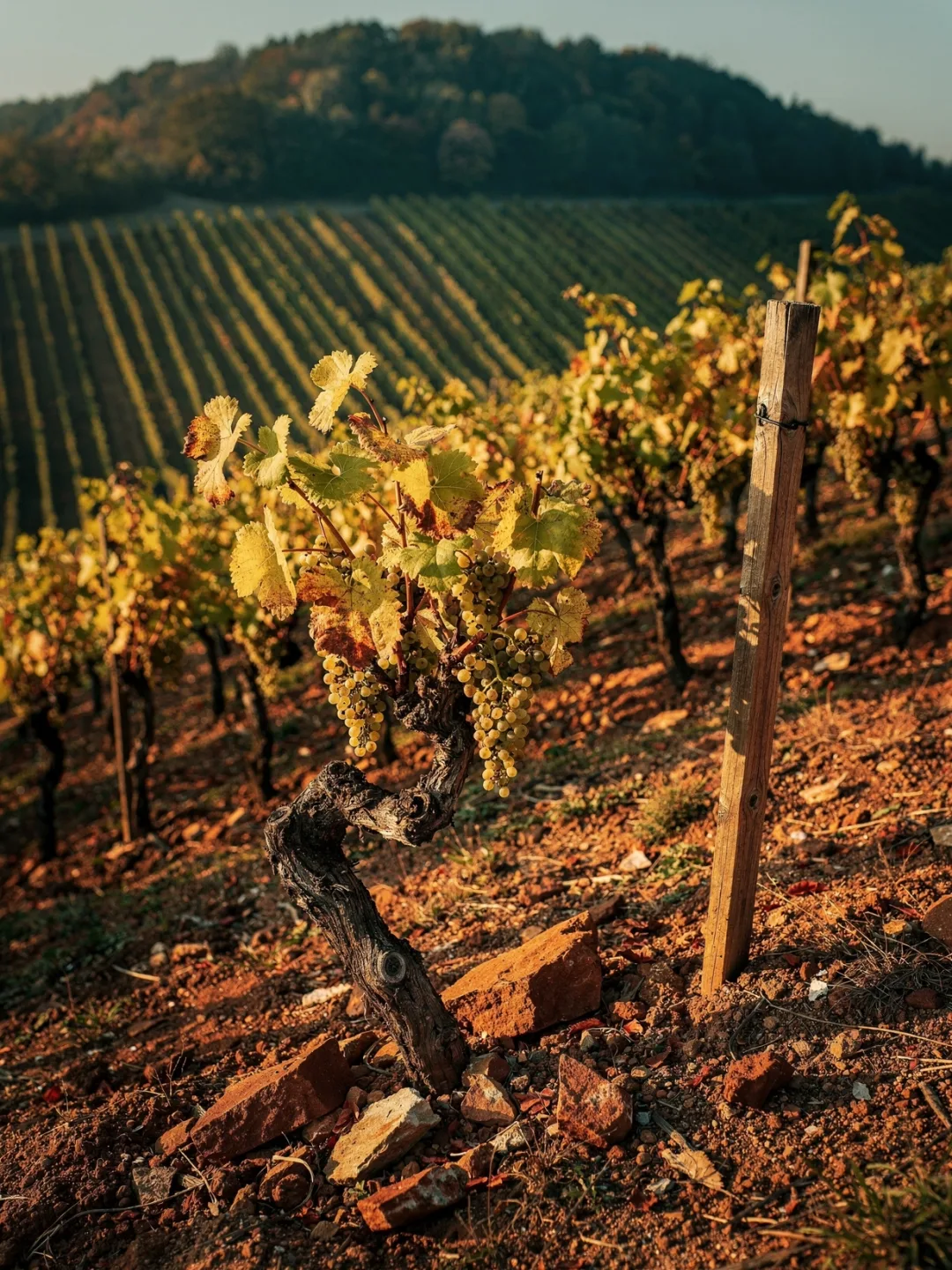
No other wine region in Austria is as defined by a single grape variety as the Kamptal is by Grüner Veltliner. It covers a good 55 percent of the roughly 3,570 hectares of vineyard area, or nearly 1,965 hectares, according to a 2022 survey. Riesling accounts for just over ten percent. Yet it holds the best slopes: Heiligenstein, Gaisberg, Käferberg. Wherever the rock lies closest to the surface, it is almost always Riesling growing there, not Veltliner.
For a long time, nobody knew where Grüner Veltliner actually came from. It wasn't until 2009 that a DNA study led by Ferdinand Regner at the Klosterneuburg viticultural college finally clarified its origin, after years of searching among dozens of possible candidates. One parent is Traminer. The other was, until the year 2000, essentially lost: a single, overgrown vine on a pasture near Sankt Georgen in Burgenland. Nobody was tending it anymore, and it had nearly been ripped out shortly before someone recognized its value.
Grüner Veltliner can be recognized by an aroma winegrowers affectionately call the "peppery note." Responsible for it is rotundone, the same aromatic compound that gives black pepper its sharp scent. An Austrian study of more than a hundred samples found an average of around 31.7 nanograms per liter, with significantly higher levels in cool, rainy vintages than in hot, dry ones. Not everyone can smell it, though. Estimates suggest that about one fifth of all people cannot perceive rotundone at all, no matter how much of it is in the glass or how carefully the winemaker has worked.
Since 2024, Chardonnay, Weißburgunder and Grauburgunder have also fallen under the Kamptal DAC seal, either as varietal wines or blended with the two flagship grapes. Even so, their names may not appear prominently on the label. And then there's Zweigelt, the leading red grape variety in the Kamptal, with a good 456 hectares — actually the second-largest variety overall. Yet it cannot be used to produce DAC wines; instead, its wine only carries the broader designation Niederösterreich.