Opok & Volcanic Rock
Soils
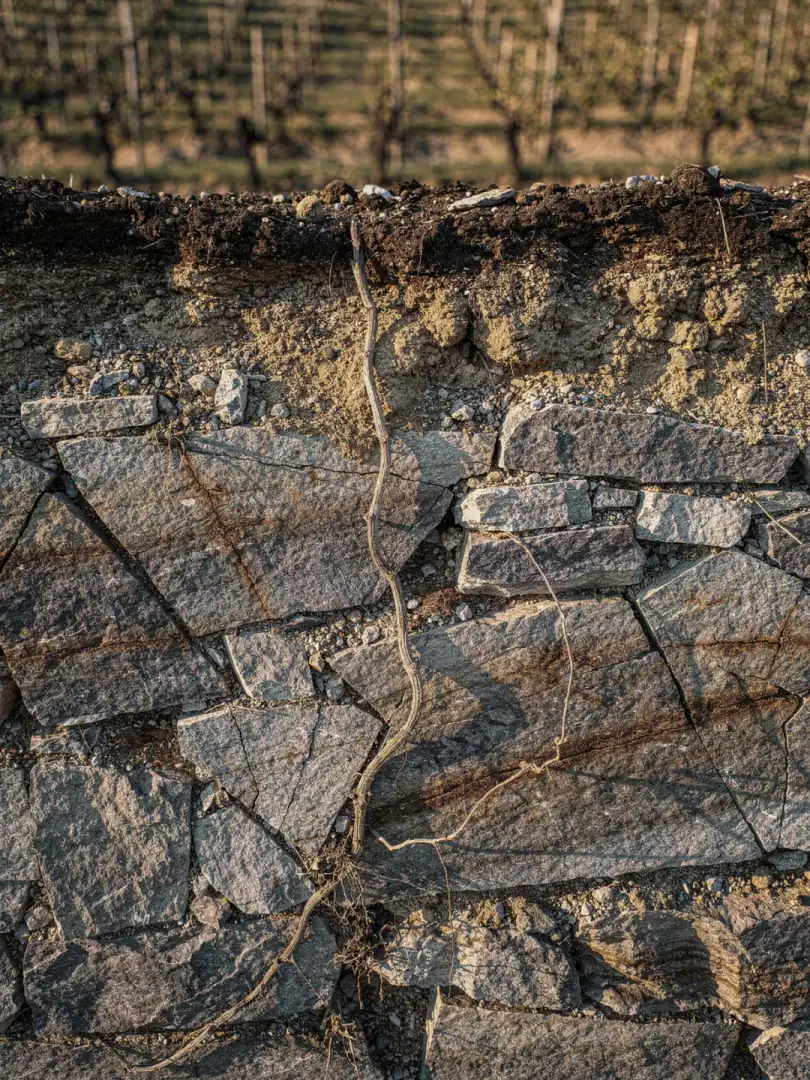
Dig a hole in a vineyard along the South Styrian Wine Road. After the thin layer of topsoil, you hit a rock the winemakers here call Opok: a fine-grained calcareous marl, grey to bluish, sometimes streaked with rust-brown bands. Wet, it barely yields to a spade. Dry, it fractures hard as concrete.
Its story begins in the sea. Millions of years ago, this was the Paratethys, an inland sea stretching between the present-day Alps and the Balkans. Rivers repeatedly washed sand and fine gravel into its silty seabed. Pressure compacted it all into rock — thin bands of coarse material sandwiched between fine marl layers, a striped legacy of the ancient seafloor.
For a vine root, this is a hardship with benefits. In summer, Opok dries out bone-dry at the surface while holding moisture deeper down like a sponge. The roots must therefore push far downward to survive — and that's exactly what forces small, concentrated berries. Opok is often credited with giving wine a cool, almost smoky minerality found in hardly any other Sauvignon Blanc in the world.
In Sausal, the steepest part of South Styria, a different soil takes over: shale from the Paleozoic era, three hundred to three hundred and fifty million years old, splitting there into thin, glossy sheets of clay slate and green schist. It holds almost no water, but retains heat — on slopes reaching up to ninety percent gradient, Riesling ripens here to a density rarely expected from a cool-climate wine region.
In Vulkanland, everything is different again. There you'll find tuff — compacted volcanic ash that erupted explosively from the ground millions of years ago — alongside hard black basalt. Both lie next to remnants of limestone and sandstone from the same primeval sea that also created the Opok in the south. Heat-retaining volcanic rock meets pale limestone layers, often within the same vineyard. This explains why Vulkanland, despite its three degrees of extra warmth, produces wines that are so spicy, almost saline.
In West Styria, finally, gneiss dominates — a crystalline bedrock that breaks down into grey, flaky slabs in the north of the region and contains almost no lime. Combined with sandy-loamy soils in the south, this creates a lean, well-draining subsoil. It's precisely this condition that drives Blauer Wildbacher toward its relentless acidity, rather than letting it turn soft and round.
A thin, dark layer of decomposed grass and root matter, typical of a vineyard along the South Styrian Wine Road.
The root: This is where the fine roots sit. They absorb whatever rain provides at the moment, and are the first to dry out in summer.