Sauvignon & Schilcher
Grape Varieties
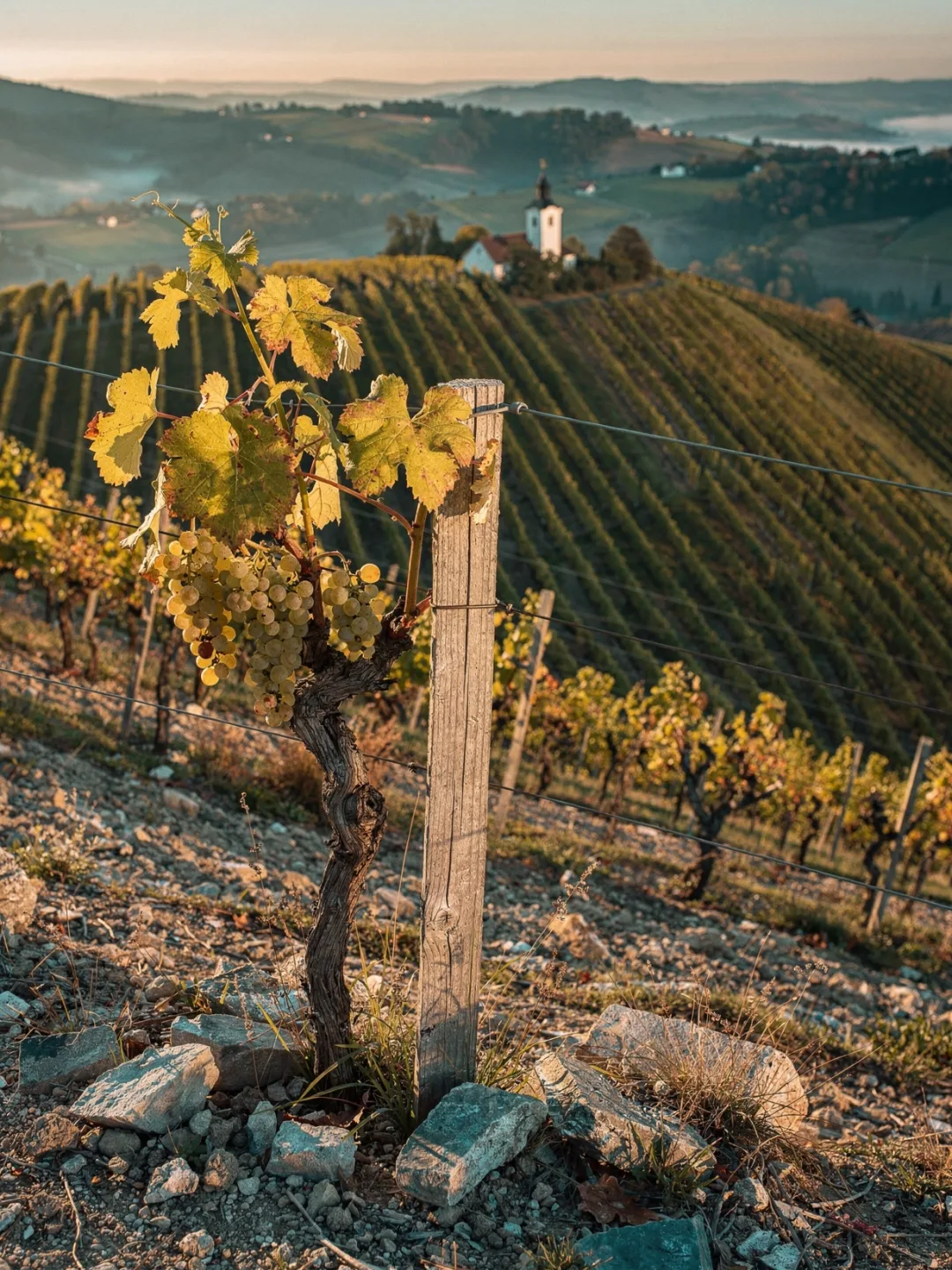
One state, three regions, three completely different answers to the same question. In South Styria, Sauvignon Blanc is clearly number one: it covers around a fifth of the area, a good 691 of 2,785 total hectares, and international tasters now count the best bottlings among the finest dry white wines in the world.
In Vulkanland, a good hundred kilometers to the east, Welschriesling dominates instead, with 310 of 1,644 hectares, narrowly ahead of Weißburgunder (Pinot Blanc) at 239. Sauvignon Blanc grows there too, but only on 108 hectares, well behind Morillon at 92. Austria's warmest wine region apparently favors different varieties than its cooler neighbor to the south.
West Styria plays in a league of its own. Over 400 of the 667 hectares there are planted with Blauer Wildbacher, used exclusively to make Schilcher — a rosé found nowhere else in the world. Of the roughly 500 hectares Austria has of this variety in total, practically all of them lie in Styria. Two hectares elsewhere are barely a footnote.
Here, Morillon is the name for what elsewhere is called Chardonnay — the very name Archduke Johann's cellar masters brought from Pickern in the 19th century has simply never changed. Gelber Muskateller covers around 505 of Styria's total 5,096 hectares and smells so intensely of grapes, roses and muscat that it's recognizable blind. Then there's Weißburgunder, Grauburgunder (Pinot Gris) and Traminer.
Red wine is rare, but not absent. Zweigelt, Austria's most widely planted red variety, yields around 77 hectares of light, cherry-toned red wine for everyday drinking in Vulkanland. It remains a side note in a region that has built its reputation almost entirely on white and rosé — and on a 19th-century import that became a language all its own.