Shell Limestone & Loam
Soils
A fault line runs between the Anninger and the Eichkogel: the Thermenlinie. Here the edge of the Vienna Basin breaks away, and it is exactly at this point that water has surfaced since Roman times — the water to which Baden and Bad Vöslau owe both their name and their reputation. For the vineyards along this edge, though, something else about the fault line matters far more: it's the reason why the soil here holds so much limestone.
Around 19 million years ago, this spot was still covered by sea. Ten million years later, it separated from the open ocean, becoming a freshwater lake fed by streams from the Vienna Woods. To this day, the Eichkogel is capped by the limestone that formed in that lake: a pale, massive freshwater limestone.
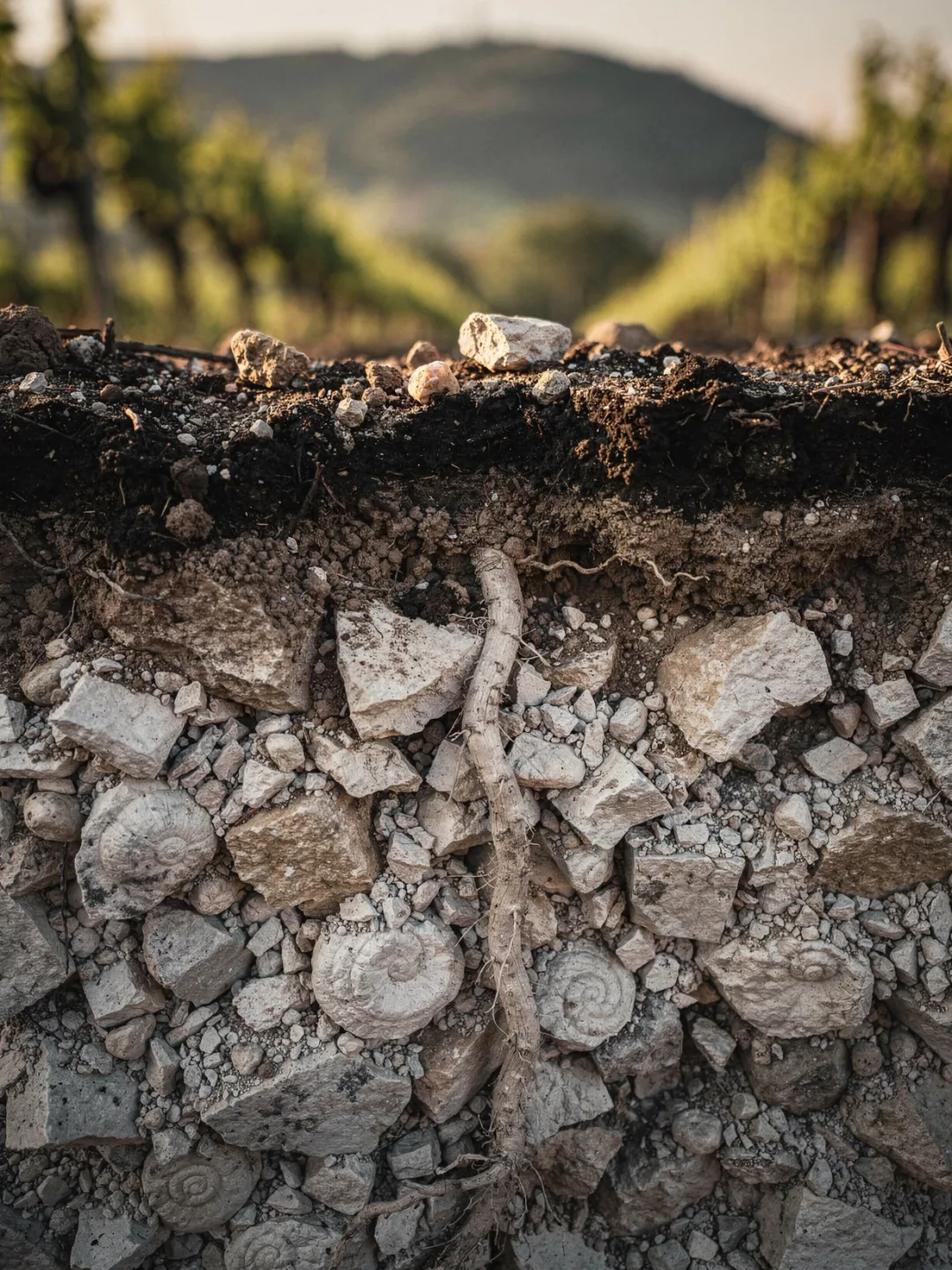
Dig a hole on a south-facing slope near Gumpoldskirchen. You'll first hit gravel: compacted and loose limestone scree full of shell and snail fragments, remnants of the ancient sea. By day, this shell-limestone gravel stores heat and releases it again at night — though no vine root can actually taste the stone itself. The effect works through temperature and water balance, not through the mineral flavor of the rock.
The soil doesn't look the same everywhere. In the south, around Bad Vöslau, Sooß and Tattendorf, gravel-rich shell limestone gives red varieties like St. Laurent warmth and good drainage. Farther north, near Perchtoldsdorf, the soil turns loamier and moister. White varieties tend to grow there instead, and the loam still holds a bit of water even through dry summers.
For Zierfandler and Rotgipfler growing on the limestone of the Eichkogel slopes, the lean, stony ground means one thing above all: small, concentrated berries. The vine has to push its roots between layers of gravel, finding little in the way of nutrients and even less water. It's precisely this scarcity that drives the vine to concentrate more aroma in the berry skin than any rich soil ever could demand of it.
A thin, dark layer of decomposed leaf litter, often no thicker than a hand's width on the south-facing slopes of the Anninger and Eichkogel.
The root: This is where the fine roots sit, drawing up whatever the next rain brings — and they're the first to dry out again.