Twenty Meters of Loess
Soils
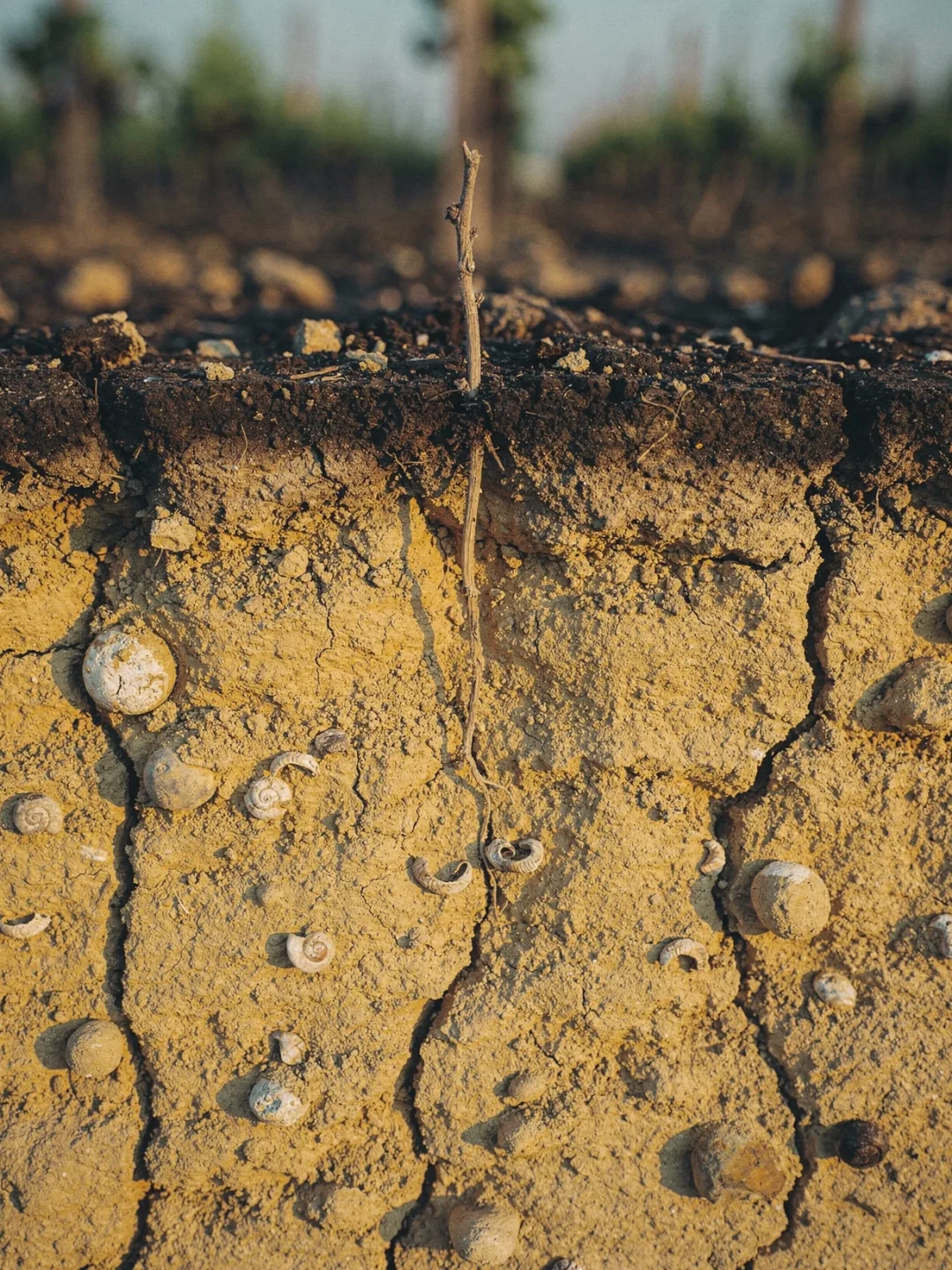
Dig a hole at Wagram, and you dig through the last ice age. Right after the thin humus layer, a yellow-brown, fine-grained mass begins, one that feels like flour between your fingers. This is loess: dust that wind lifted at the end of the last ice age from the exposed banks of a retreating primeval sea and deposited here.
At Wagram, this became one of the most powerful loess deposits in Europe. In some spots along the terrace edge, it measures up to twenty meters deep. Nine out of ten vineyards in the region stand entirely on this material. Beneath it lies hard rock made of sand and gravel, but very few roots ever reach it. They already find everything they need, and in abundance, in the loess itself.
Loess stores water well without suffocating the vine, because despite its fineness it remains loosely packed. Tiny lime nodules, known as Lösskindl, run through the layer and steadily release calcium. Fossilized snail shells also turn up, sometimes by the thousands in a small area, a remnant of long-vanished moist steppes. Together, these keep the soil basic, which softens the wine's acidity rather than letting it feel harsh.
This fertility has a flip side, though. Because loess yields so many nutrients, a vine growing on it tends to grow lushly, with plenty of foliage and large clusters, if left unchecked. Yield and concentration stand in more direct opposition here than on leaner rock. A good winegrower at Wagram therefore actively works against the soil, using less fertilizer, planting rows closer together, and deliberately reducing yields on good sites, so the soil's abundance still results in a concentrated wine.
Deeper in the profile, the picture changes. After two or three meters, the loess loses its lime, long since washed out by earlier rainy periods, and turns redder and more clay-like. This older, weathered layer stores even more water than the layer above it. It only becomes important in dry summers, once everything above has long since been used up.
A thin, dark-colored topsoil of humus and the uppermost, annually worked loess.
The root: This is where the fine roots sit. They're the first to respond to rain and the first to dry out again.