Loess, Limestone, Granite
Soils
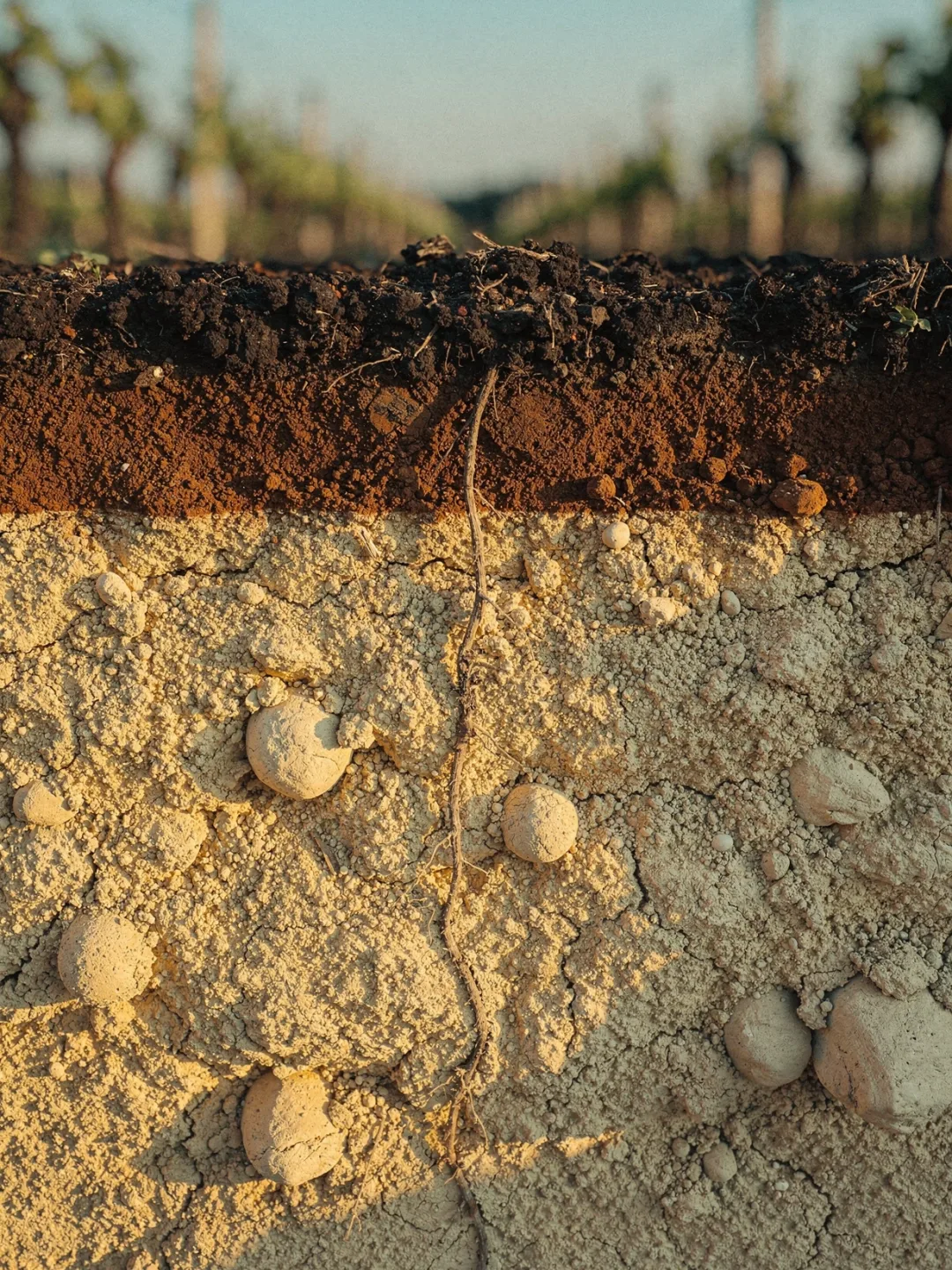
Dig a hole in a vineyard near Poysdorf, and you'll dig through windblown dust. Loess isn't rock at all, but dust carried by wind during the cold phases of the last ice ages. It's fine-grained silt that the wind gathered over tens of thousands of years from the ice-free surrounding land. More than half of all vineyards in the Weinviertel stand on this material. The region's 1,100 cellar lanes exist only because loess can be dug with a plain shovel.
Water drains through loess remarkably easily, yet it holds few nutrients. The vine root must therefore go deep just to survive. Within the loess itself you often find small, hard limestone nodules, known here as Lösskindl. This is precipitated lime that has reassembled over millennia in fine veins. Wine from deep, undisturbed loess tends to taste soft, creamy and dense, with plenty of fruit and moderate acidity.
It's a completely different picture in the north: near Falkenstein and Staatz, bare rock suddenly juts out of the gentle hill country. These are limestone cliffs of the so-called Waschberg zone, pushed up from the subsurface by tectonic pressure around seventeen million years ago and exposed ever since. On this hard, water-retaining limestone, wines grow tauter and more mineral than on the soft loess all around.
In the far west, on the foothills of the Manhartsberg near Röschitz, even older rock appears. Bare crystalline bedrock of the Bohemian Massif, granite and gneiss, lies there in places covered only by a thin layer of loess. On this barren rock, Grüner Veltliner turns spicier and more peppery, while further east on the loess it stays rounder and creamier — two very different wines from the same grape, often less than ten kilometers apart.
A persistent misunderstanding lingers here too: that a wine from limestone soil tastes of stone because the root passes minerals directly into the glass. That isn't true. What the vine absorbs are dissolved ions in vanishingly small amounts, far too little to taste. Limestone works indirectly instead — through the warmth it stores during the day, through the water it holds differently than loose loess does, and through the stress it places on the root.
A thin, dark topsoil layer of decomposed plant matter, worked into the loess. On the open hills of the Weinviertel, often barely a hand's width deep.
The root: This is where the fine roots sit, absorbing the rare rainfall immediately — and the first to dry out when so little rain falls.