Tank, committee, capsule
Production
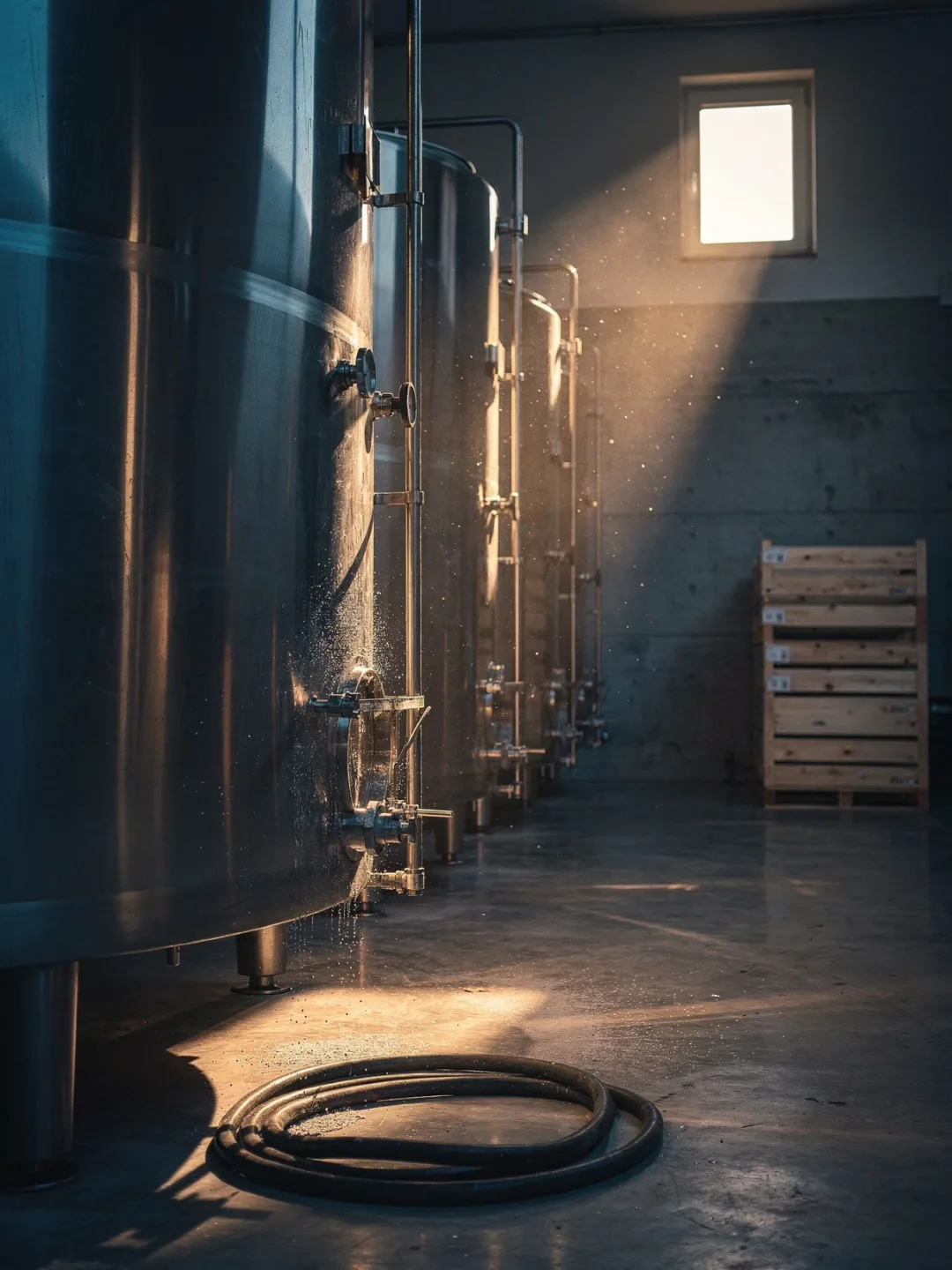
After harvest, Grüner Veltliner usually goes into the press quickly and gently. Every hour costs freshness. Fermentation takes place mostly in temperature-controlled steel tanks at a cool twelve to sixteen degrees Celsius. This way, the delicate aroma compounds don't escape with the fermentation gases — citrus, green apple, and the famous peppery note. For the basic tier, the Weinviertel DAC, oak aging is even excluded by regulation.
No machine decides whether a wine may carry this designation — a committee does. The application for the official state testing number goes through the Regional Wine Committee Weinviertel, which tastes exclusively at three locations: the regional offices of the Federal Office for Viticulture in Retz and Poysdorf, and the Federal Office for Wine and Fruit Growing in Klosterneuburg. A precise flavor profile is mandated — pale yellow to green-yellow, fruity, spicy, peppery, without any botrytis note and without any hint of oak.
When it comes to alcohol, the regulation even dictates which levels may appear on the label: only 12.0, 12.5, or 13.0 percent — no odd values in between. For the basic tier, the application may be submitted no earlier than the first of January after harvest. A young Weinviertel DAC can thus already be sitting finished on the shelf by winter. A Reserve requires more patience: the application isn't permitted until March fifteenth, and a minimum alcohol content of thirteen percent is mandatory. A subtle oak or botrytis note is explicitly allowed, as long as the structure stays dense and the finish long. Since 2020, there's also the Große Reserve, whose testing number can only be applied for from November first of the following year.
For bought-in grapes destined for a Reserve, the regulation requires the must weight, in degrees Klosterneuburger Mostwaage, to be noted on the invoice. Already-pressed must may not be purchased for this purpose at all. This keeps it traceable what actually grew in the vineyard, before it becomes a bottle with its own capsule on the neck.
A quite different path doesn't end in a still wine bottle, but in a sparkling wine tank. Roughly three-quarters of the base wines from which Austrian sparkling wine is made come from the northeastern Weinviertel around Poysdorf. These are mostly Welschriesling and Grüner Veltliner, pressed as for a still wine but deliberately kept acidic and lean, so the second fermentation has enough substance to work with.