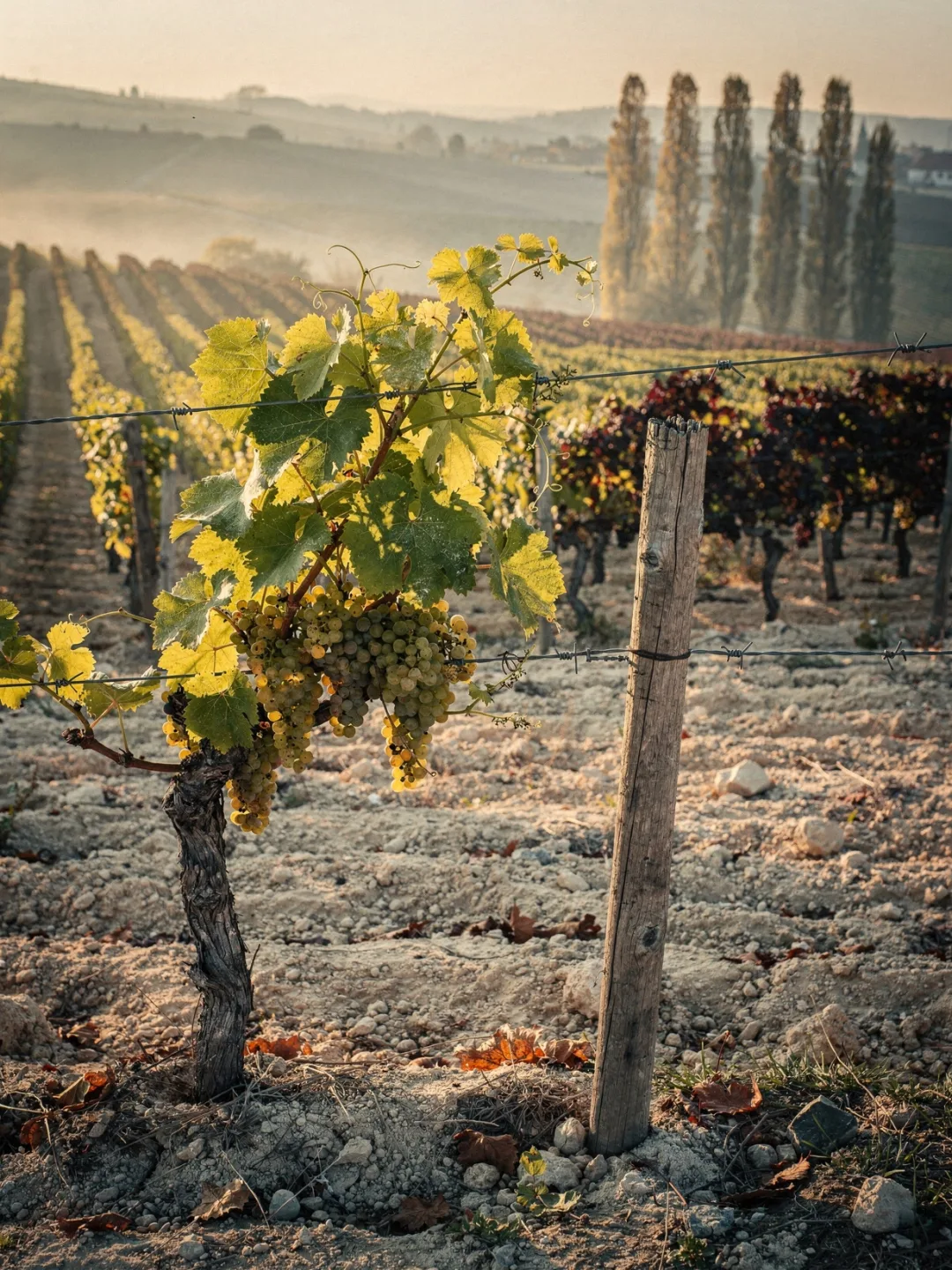
Grüner Veltliner Leads the Way
Grape Varieties
A single variety defines the Weinviertel like almost no other grape defines its region: Grüner Veltliner, planted on nearly half of the entire vineyard area, with almost every second Grüner Veltliner in Austria growing right here. To truly understand this grape, you have to come here first.
Its reputation rests on a spiciness locals simply call the "Pfefferl" — a touch of green, sometimes white pepper that emerges beneath citrus fruit and green apple. Responsible for this is an aroma compound called rotundone, the same one that gives Syrah its peppery edge. Grüner Veltliner from the Weinviertel can contain extraordinary amounts of it — concentrations up to seventeen times above the perception threshold; more on that in the tasting section.
But the Weinviertel isn't purely a white-wine story. In the west, around Retz, Haugsdorf, Mailberg, and the Pulkau Valley, red wine has traditionally taken center stage. Zweigelt — bred in 1922 by viticulturist Fritz Zweigelt from a cross of Blaufränkisch and Sankt Laurent — and the older, sturdier Blauer Portugieser dominate here. Both ripen early and thrive in the warmth of the lower-lying vineyards, unlike the late-ripening Veltliner up on the hills.
In the northeast, around Falkenstein and Herrnbaumgarten, the soil changes, and with it the grape variety. Where limestone outcrops of the Waschbergzone break through the loess, Welschriesling and Riesling take root — a small share compared to Veltliner, but grown on these limestone sites with remarkable finesse.
At the very edge, near Hohenwarth, a rarity survives that has nearly vanished elsewhere: Roter Veltliner. Despite the name, it's not closely related to Grüner Veltliner. Its yields swing unpredictably, and hardly any producer plants it fresh today. Whoever finds it holds a piece of grape diversity that may soon disappear from the Weinviertel altogether.