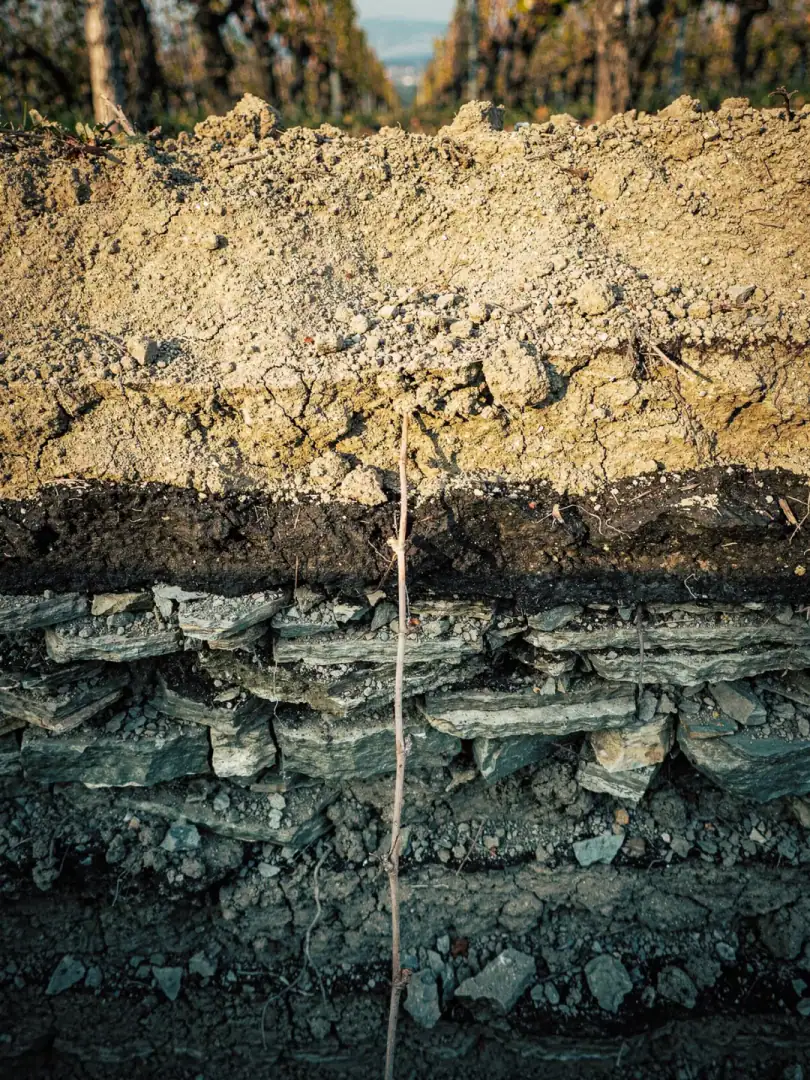
Loess over Flysch
Soils
Dig a hole on the Nussberg and you'll first hit dust. Fine, yellowish loess covers the slopes in Vienna's northwest, often in layers several meters thick — wind-blown dust from the last ice age, carried in from the plain over tens of thousands of years and deposited over the bedrock.
Only beneath that comes the actual foundation. On the Nussberg and Kahlenberg, the bedrock is flysch, an alternating sequence of sandstone, marl, and claystone. Two worlds stacked on top of each other. The flysch formed as seabed roughly sixty to seventy million years ago and today forms the northeasternmost foothills of the Alps. The vine root works its way through both: first through the loose, nutrient-poor loess, then through the firm, water-storing rock underneath.
Not every Viennese site looks like this. On the Bisamberg, north of the Danube, the same flysch lies under even thicker loess layers, sometimes several meters deep. To the south, around Mauer and Oberlaa, a completely different subsoil dominates: sandy-gravelly deposits, partly cemented into conglomerate. Rivers and debris flows from the Vienna Woods washed them to the edge of an ancient sea roughly sixteen to twelve million years ago.
You can taste these differences. But no one should claim the vine absorbs rock directly into the wine — it doesn't. What the soil really does is manage water and warmth: loess holds moisture well and releases it slowly, while the flysch beneath it still holds some back even in dry summers. On the loose gravel in the south, by contrast, the soil warms up faster, and the grapes ripen earlier there than on the cooler Nussberg.
For Gemischter Satz, this variety isn't a drawback. Because several grape varieties grow in the same vineyard, they balance out small differences in the soil among themselves. One variety copes better with the dry loess, another with the firmer subsoil beneath it. That's how the wine stays fundamentally the same year after year, even though each individual vine has something different underneath it.
Fine loess dust, worked by earthworms and decomposing greenery into dark topsoil. Often a hand's width deep on the Nussberg, sometimes more.
The root: This is where the fine roots sit, drawing on moisture after every rainfall — though the soil dries out again quickly afterward.