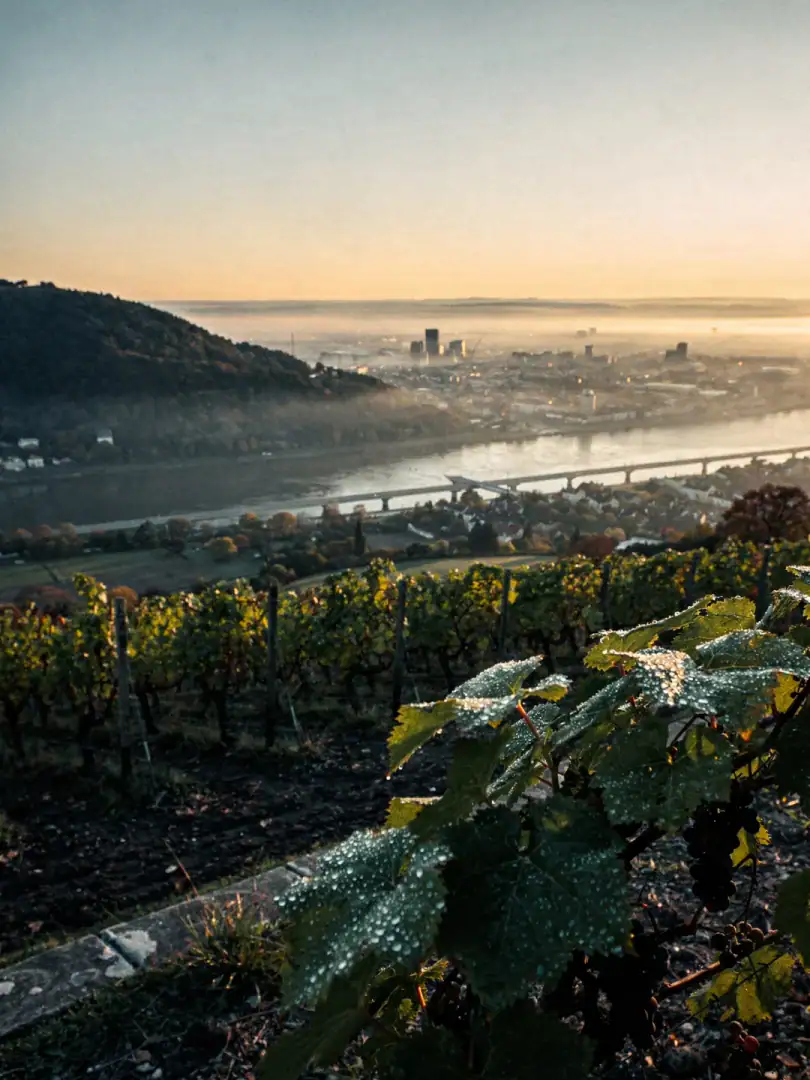
Where the Vienna Woods meet Pannonia
Climate
Vienna sits exactly where two weather worlds collide. To the west, the Vienna Woods push their damper, cooler climate against the city. To the east, the Pannonian Plain opens up with hot, dry summers and harsh winters. No vineyard in the city lies far from this dividing line.
The difference can be measured in millimeters. In the Vienna Woods, rainfall can reach up to eight hundred millimeters a year, while in the flat southeast of the city it sometimes drops below six hundred. At the same time, the average annual temperature in the densely built-up city area runs about two and a half degrees higher than in the neighboring Vienna Woods. The city heats up, as any big city does, and its vineyards sit right in the middle of that warmth blanket.
At night, the picture flips again. Cool air flows down from the wooded slopes of the Vienna Woods to the vineyards on the Nussberg and Kahlenberg, the way cold water runs down a hillside. This nightly cooling locks in the acidity in the grapes, especially for an early-ripening variety like Grüner Veltliner, which would quickly turn flabby without it.
On the Bisamberg, north of the Danube, the site is more open and windier. That lets the grapes dry off faster, but it also lets in more warmth. To the south, around Mauer and Oberlaa, the somewhat higher rainfall tempers the Pannonian heat again. So Vienna doesn't have one climate — it has several, packed tightly side by side in a small space, and each site tastes a little different because of it.
Hot, sunny summers push sugar into the berries, while cold winters force the vines into dormancy. There's barely any transition in between. Spring often arrives late, autumn is short and crisp. Anyone walking through the vineyards on the Nussberg in October will often still see yellow leaves, while the first fog is already settling in the valley below.