Everything at once
Production
Red wine and white wine are separated mainly by one question: do the skins stay in contact during fermentation or not. For Gemischter Satz, that question barely arises. It's always a pale-pressed white wine, even with several varieties blended in — the skins come off the grapes right away.
The real distinctiveness happens before the press. Because several varieties grow in the same row in a Gemischter Satz, they're all harvested together on a single day — whether or not the Grüner Veltliner is already perfectly ripe while the Riesling is still lagging behind. Picking them separately would be technically possible. But it would destroy exactly what the designation of origin protects: the blend as it grew in the vineyard.
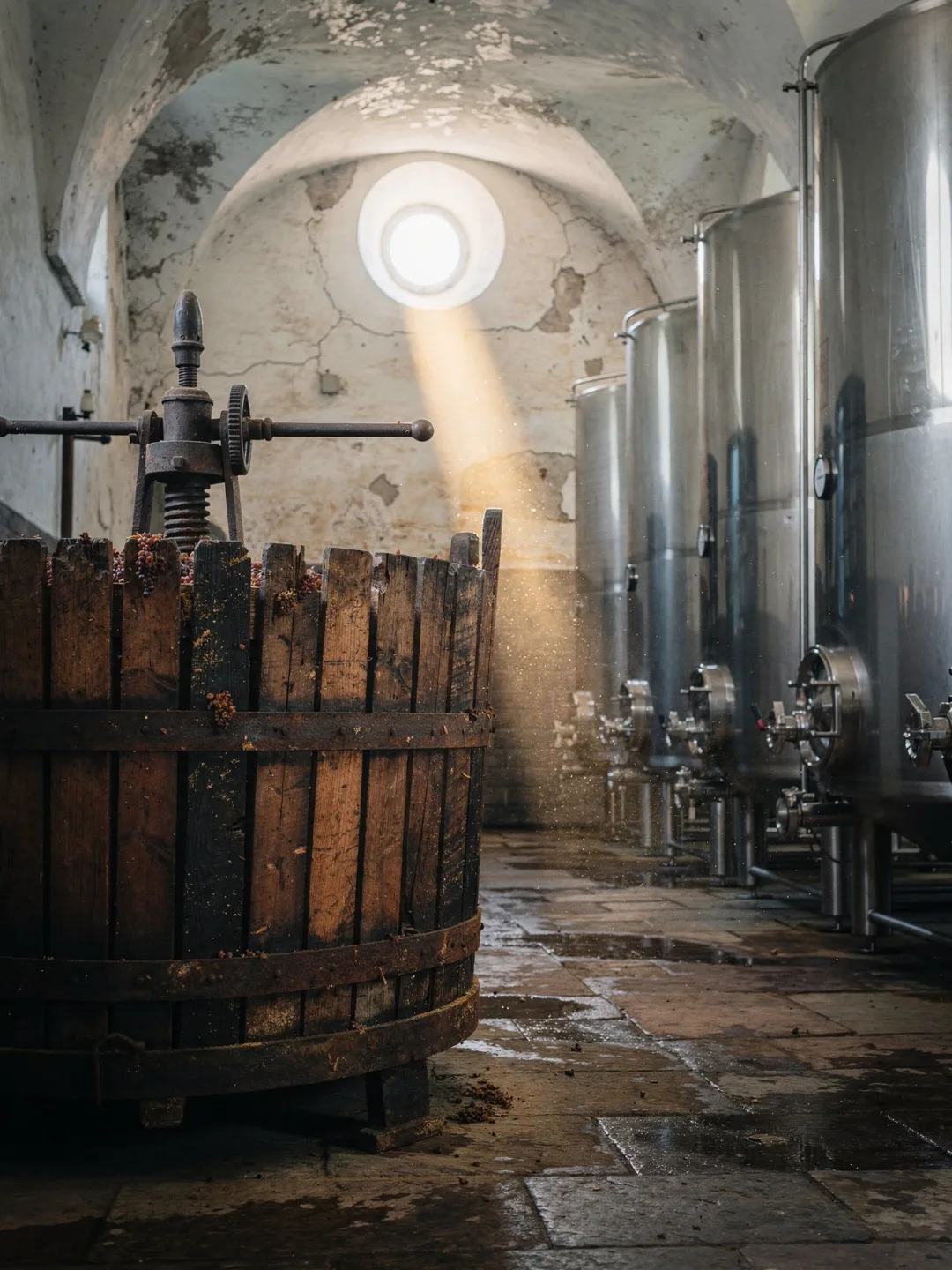
After that, the cellar work proceeds like any other white wine. The mixed harvest is pressed, the must clarifies, and fermentation begins — usually spontaneous or with cultured yeast in a stainless steel tank, sometimes also in a large old wooden cask. The DAC regulation explicitly bans new barriques with strong toasted oak character. The wine is meant to taste of its grapes, not of vanilla from the oak.
Three tiers determine how strictly the rules apply. The basic Wien DAC may have at most twelve and a half percent alcohol and must be dry. If the label names one of the seven district areas, such as Nussberg, Bisamberg, or Maurerberg, a minimum of twelve and a half percent applies, again dry only. Only the Riedenwein, named after a single vineyard site, is also allowed to be off-dry — but in return demands the strictest origin requirement: a single, named vineyard site.
The young vintage may be sold no earlier than December first of the same year. So a wine harvested in September can already be on the shelves at the Heurigen by Christmas. Up to fifteen percent of another Viennese quality wine may be blended in. The finished wine, however, may only be sold to end consumers in a glass bottle.