Marble & Clay
Soils
No wine region in Portugal mixes so many soil types in such a small area as the Alentejo. In the north, around Portalegre, granite keeps the vineyards cool and lean. Further south, around Reguengos and Redondo, schist and granite alternate within the tightest spaces, and in the far south, near Moura and Granja-Amareleja, heavy clay dominates, holding water for long periods. Nothing here is uniform.
In between lies a strip found nowhere else in Portugal: the Estremoz Anticline stretches for about forty-two kilometers between Sousel and Alandroal. It consists of marble and dolomite, compressed from the limestone of a seabed millions of years old. Around Estremoz, Borba, and Vila Viçosa lies one of the largest marble deposits in the world. This is no small matter. Even in antiquity, stonemasons quarried the rock here, later using it to adorn even the Roman theater of Mérida.
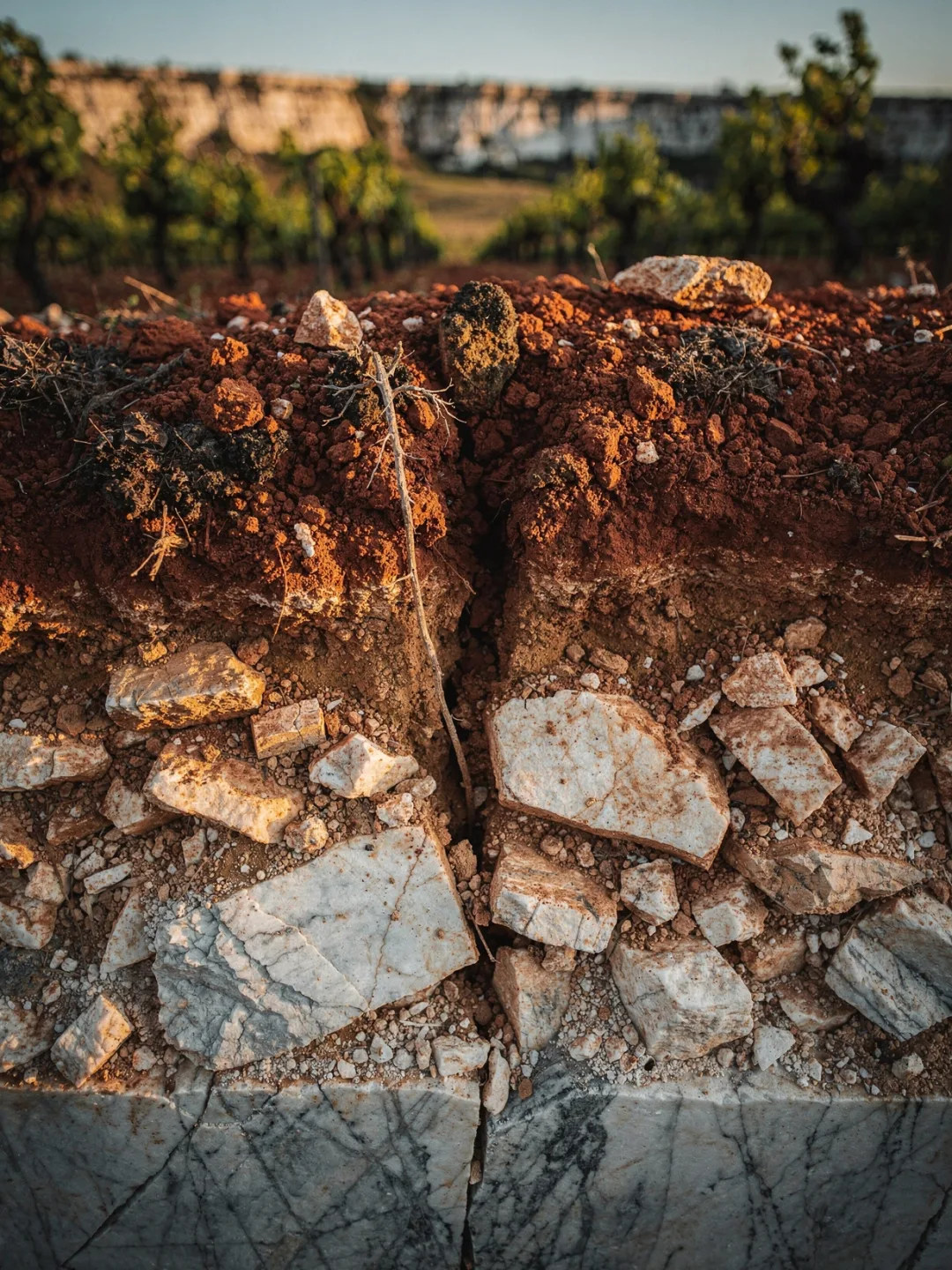
For a vine root, marble is a hard boundary; the rock itself lets almost no water through. Only along its cracks and fissures can a root pass through at all, and it's precisely there that what remains of the scarce rain collects. Above lies a reddish, lime-rich soil known in Portugal as terra rossa. Beneath follows a layer of loose, weathered marble debris before the solid rock begins; a vine near Borba must work its way through three entirely different worlds to reach water.
This easily gives rise to the idea that a wine from this soil tastes of the marble itself; that's too simplistic. What a root draws from the rock are dissolved salts in trace amounts that no palate could detect. Marble works through a detour. It stores heat during the day and releases it again at night, and it forces the root deeper. It lets through only as much water as the vine truly needs. It's precisely this detour that makes wine from Borba denser and tauter than its neighbor grown on clay. The difference is real.
Reddish, lime-rich weathered soil above the marble, barely a foot deep, but rich in iron, which gives it its color.
The root: Here lie the fine roots that absorb the scarce rain immediately — and are the first to dry out in August.