Rounded Rather Than Narrow
Glassware
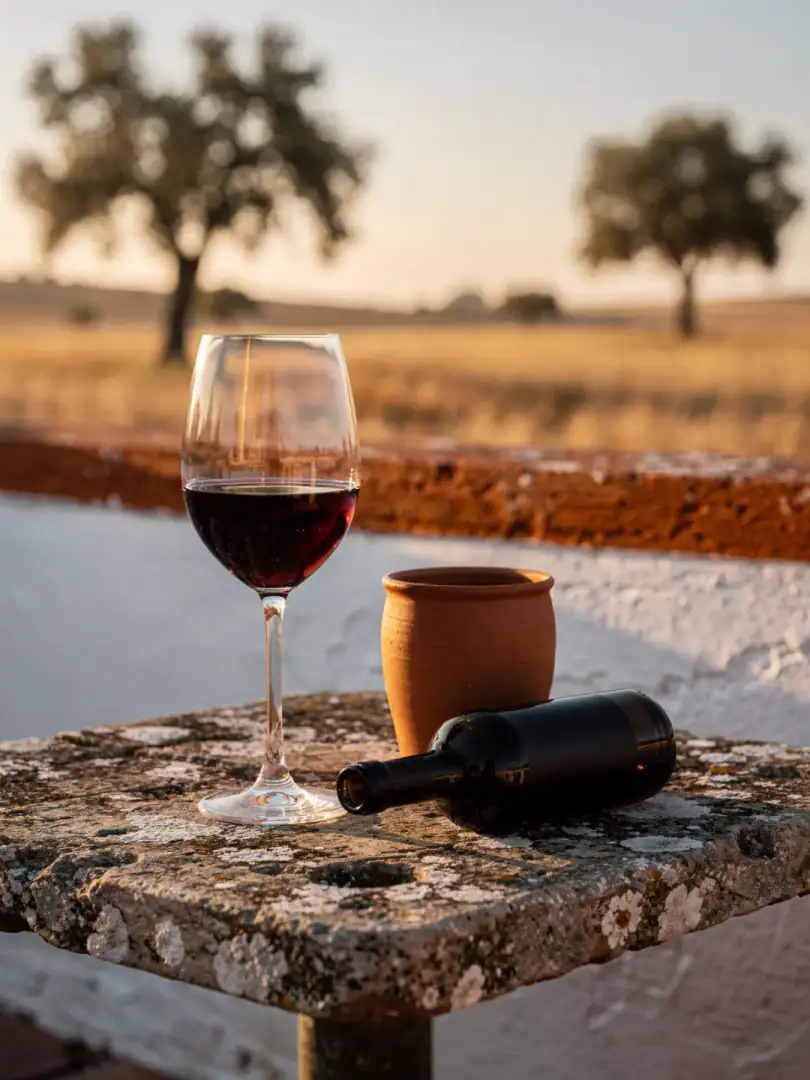
A wine from the Alentejo often carries thirteen to fifteen percent alcohol; that's more than most red wines from Central Europe, and it's exactly this that determines the right glass. A narrow glass pushes the alcohol vapor upward and stings the nose before the fruit even arrives. A wide, rounded bowl, by contrast, gives the alcohol room to dissipate. It pushes the aroma of ripe fruit forward instead.
Aragonez and its partners let their tannins ripen softly in the heat. A young Alentejo red therefore hardly needs a decanter; it's approachable from the start, unlike a young, angular wine from cooler regions. Only an aged wine with barrel maturation benefits from twenty minutes of air, so the wood and fruit can find each other again. No longer than that.
Vinho de talha is drunk quite differently. Freshly drawn from the talha, cloudy and unfiltered, it belongs in a simple, thick-walled glass. Some even drink it from a clay cup, as has been used in Alentejo taverns for generations. A stemmed glass would only add a formality it doesn't need.
With temperature, the Alentejo makes the same mistake as everywhere else: serving too warm, because the surroundings themselves are already hot. Sixteen to eighteen degrees Celsius suit a young red, leaning toward sixteen for a fresh vinho de talha. A white wine from Antão Vaz, due to its body, tolerates a somewhat larger glass than a slender German Riesling. Otherwise it feels cramped in the glass, and its oily note disappears.