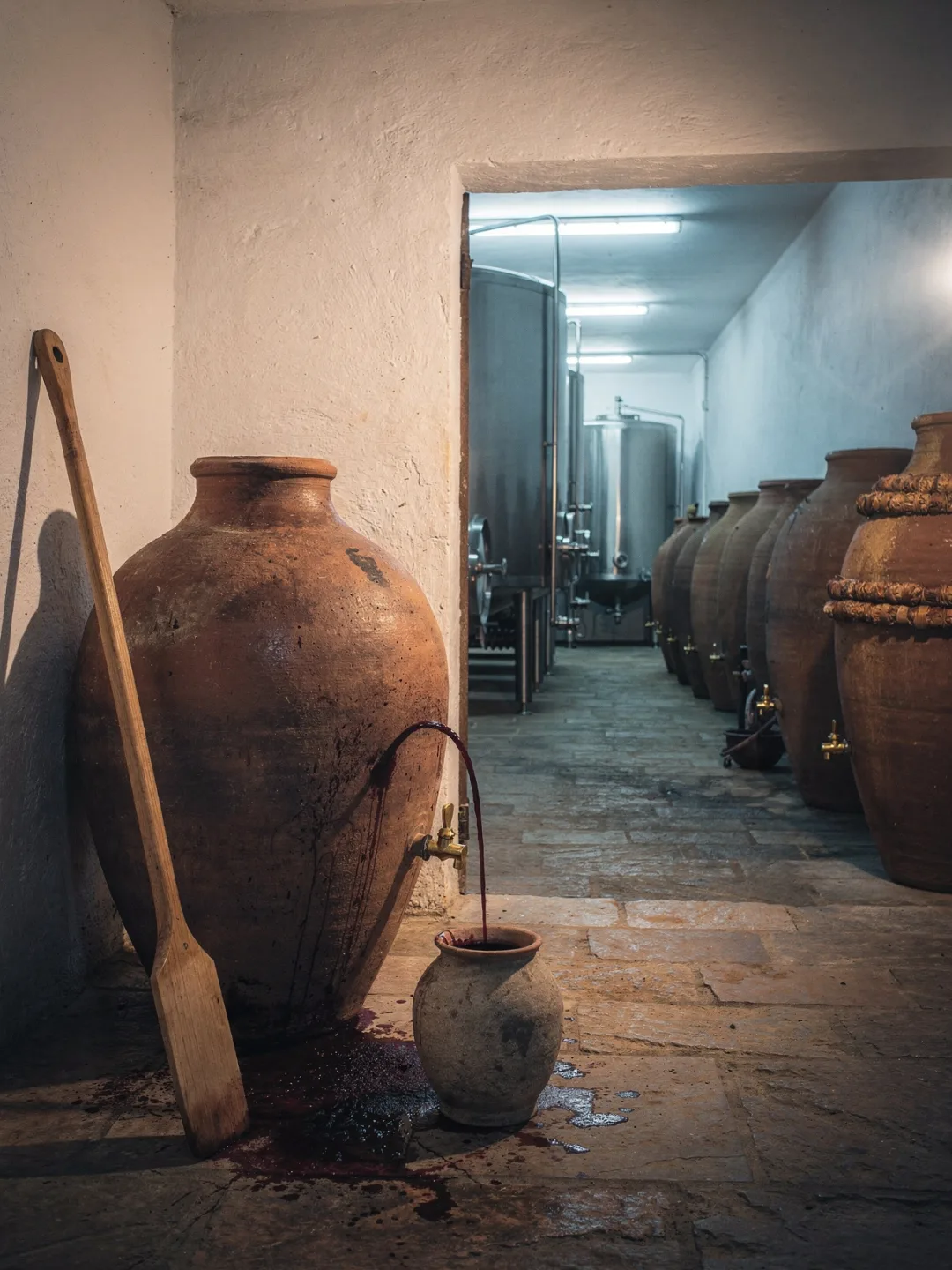
Talha & Tank
Production
In a talha, wine ferments as it did for the Romans; whole grapes, skins, sometimes stems, all together in a bulbous clay vessel. Inside, it's sealed with pine resin so the porous clay doesn't absorb any of the wine. During fermentation, someone stirs several times a day with a wooden stick through the cap of skins that forms on top. Otherwise it turns to vinegar.
The wine stays on the skins until São Martinho's Day arrives on the eleventh of November. Not before. Then the talha is opened, drawn off through a tap at the bottom, and tasted immediately. This happens with music and singing, especially in Vila de Frades, which calls itself the capital of vinho de talha. Anyone who ferments white grapes this way ends up with practically what's called orange wine elsewhere; only here, the name is much older.
Alongside the talha today stands the stainless steel tank; since the 1980s, with EU funding for cellar technology, most DOC wines have fermented under temperature control. They then age in French or American oak if intended for longer aging. The two worlds run side by side, often within the same operation. Both remain necessary. The tank delivers the reliable everyday product, the talha the piece of history sitting on the shelf next to it.
On August 18, 2026, the CVRA's general council unanimously decided: vinho de talha may henceforth be certified throughout the entire region. Previously, this applied only in individual municipalities, as still stipulated by the 2010 regulation; at the same time, it introduced two new classifications for old vineyards. Vinhas Velhas designates plantings of thirty-five years or older, Vinhas Centenárias those registered before 1931. What had been a footnote in cellar history became, overnight, an official quality seal.