Aragonez & Co.
Grape Varieties
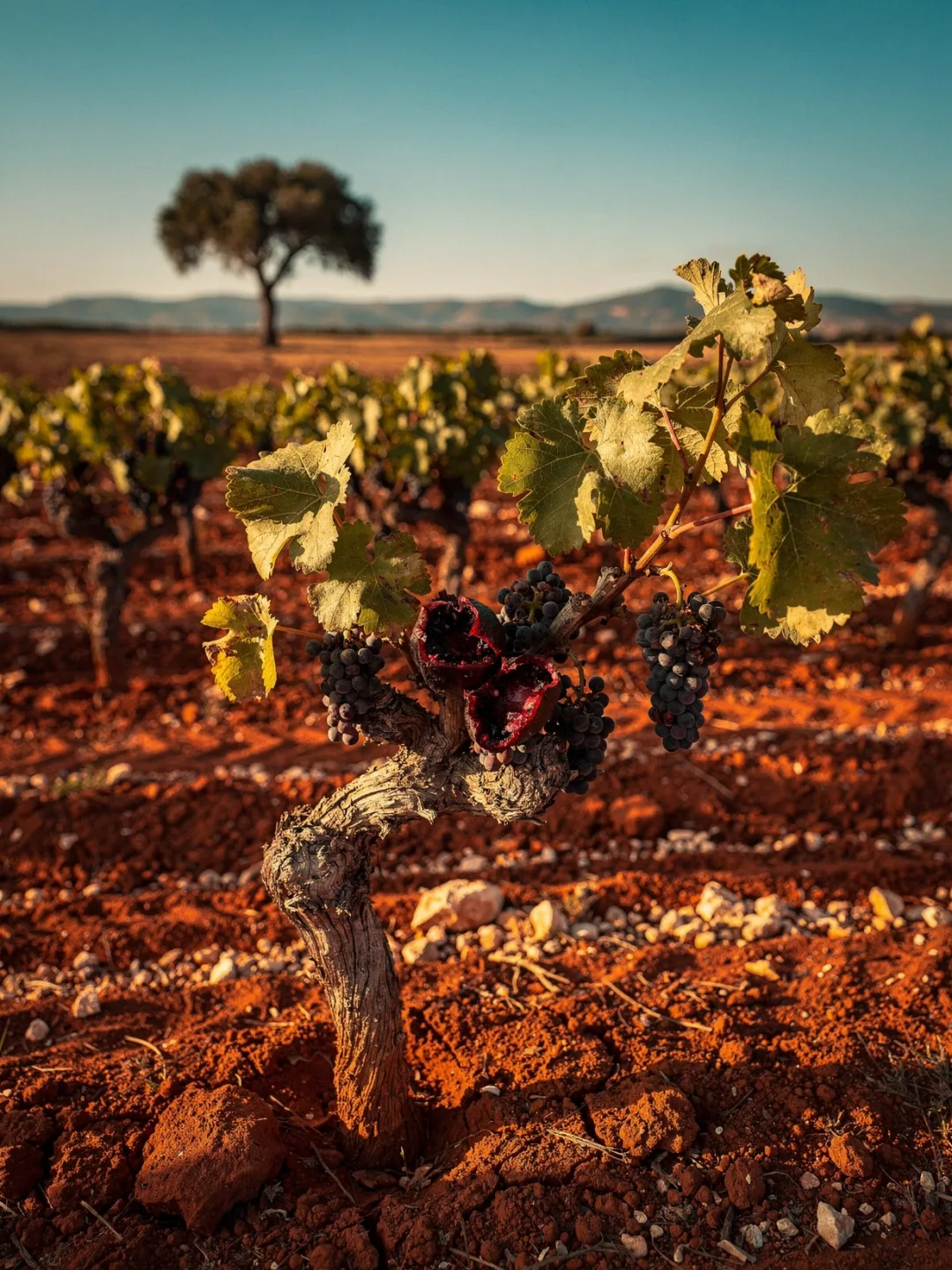
One grape variety defines the picture here; Aragonez is nothing other than Tempranillo, the same grape that goes by its own name in Rioja. In the heat of the Alentejo plain, it ripens earlier and more densely. Instead of the taut acidity it shows further north, here it brings ripe red fruit and soft tannins. It needs nothing more.
Its most important companion is Trincadeira, known in the Douro as Tinta Amarela. It buds late and rots easily in rain; in a summer as dry as the Alentejo's, this hardly matters. In return, it brings back what Aragonez often lacks: pepper, dark herbs, and an acidity that keeps the wine alive when the sun has softened everything else. That's exactly what it's missing otherwise.
The third in this alliance is an immigrant with a peculiarity that hardly any other grape shares. Alicante Bouschet was bred between 1855 and 1865 by Henri Bouschet in France's Languedoc, from a crossing of Petit Bouschet and Grenache. Its flesh is red, not white like almost every other grape. That's its signature. It first went into the ground in the Alentejo in 1894, at the Dourada estate. Here it found a home that suits it better than its southern French homeland. Wines that elsewhere serve merely to add color reach a depth in the Alentejo that connoisseurs single out.
Castelão, an old grape from throughout southern Portugal, contributes structure and dark cherry. Among the white wines, Antão Vaz leads, originally from the area around Vidigueira and Évora. It has thick enough skins to retain its acidity in the heat, with aromas of ripe pineapple and an oily texture. Roupeiro is the most widely planted, though it loses its aroma quickly; it therefore mostly ends up in young, simple wines. Arinto contributes the sharper acidity that gives the blends definition. Nothing more, nothing less.