Clay & Limestone Marl
Soils
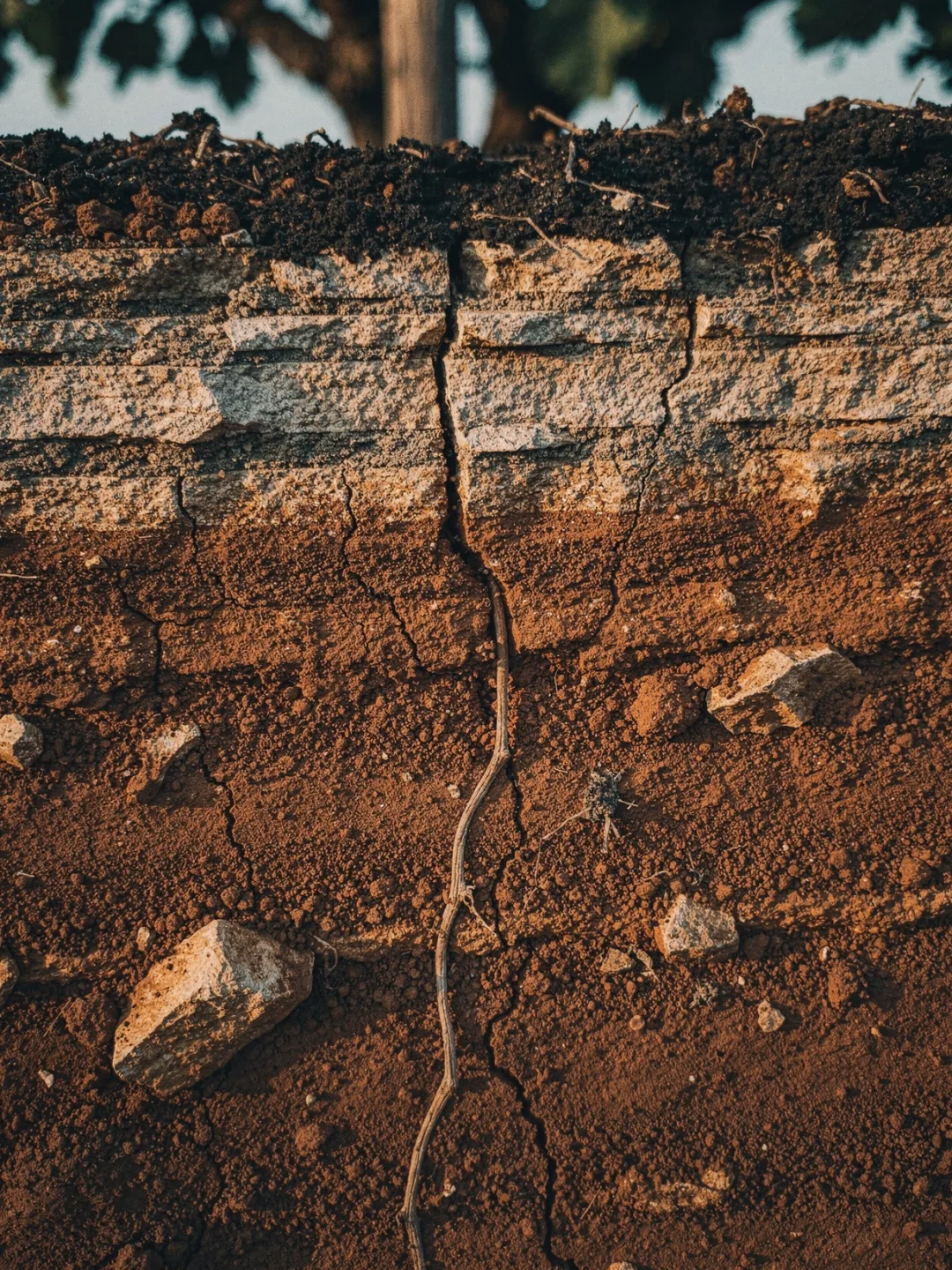
Dig a spade's depth into a vineyard near Anadia and you'll land in damp, reddish-brown clay. The local farmers call it barro. In fact, the whole region likely takes its name from this soil: a land full of clay. Unlike the dry schist found in many wine regions, barro holds water like a sponge — exactly what a variety like Baga needs to survive an entire rainless summer.
This clay formed some hundred and fifty million years ago, during the Jurassic, when a shallow sea covered the area. Limestone mud and algae remains settled layer by layer, compacting into limestone and marl. Where the two alternated, thin bands often just centimeters thick were left behind, still visible today in roadcuts near Cantanhede. The law describes the permitted soils plainly as calcareous, brown, or reddish; winemakers simply call it barro.
For the vine's roots, this clay means hard work. They struggle to spread sideways, but push deep instead, where moisture remains even in August. That explains why Baga retains so much acidity despite its thick skin: the vine never goes thirsty. So it never loses the freshness that would otherwise fade as it ripens. In sandier spots closer to the coast, where the rock contains less clay and more loose material, the grapes ripen faster and yield softer, more approachable wines.
No vineyard in Bairrada has just one soil type. Limestone clay, sandy podzol, and thin weathered layers often sit side by side, sometimes within just a few meters of each other. That's why winemakers in Anadia or Sangalhos produce such different wines from the same grape variety. Soil alone doesn't make a wine. Anyone who thinks otherwise hasn't understood Bairrada.
Dark, sandy-loamy humus with organic matter from decomposed vine cuttings and grass.
The root: Fine roots draw water here after every rainfall and are depleted within a few dry weeks.