Saibro & Granite
Soils
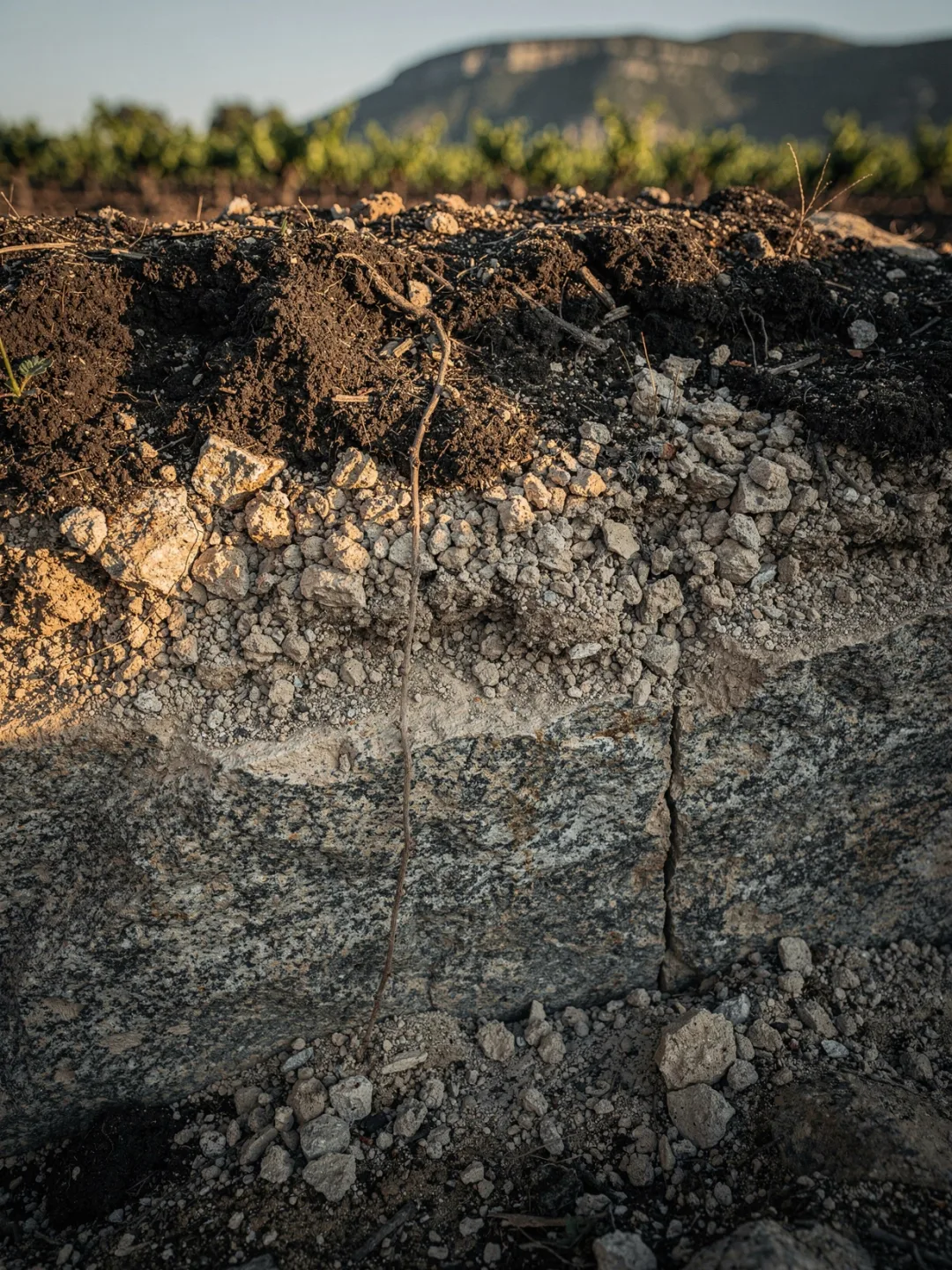
Dig a hole in a Dão vineyard and you'll quickly hit grainy grit instead of soil. The Portuguese call it saibro: weathered granite, broken down into loose quartz and feldspar grains, sandy and loose between your fingers. Over ninety percent of the region's vineyards stand on this subsoil.
Its origin lies deep in geological history. Granite is solidified magma that never reached the surface, but cooled slowly beneath older rock until the overlying layers were eroded away, freeing it to weather. Water and temperature swings have been shattering it into ever finer grains ever since, without ever fully dissolving it.
For the vine's roots, this is an obstacle course. Between the grains they easily find air and water, but hardly any nutrients, so they drive deep, often several meters, until they hit moisture that the dry summer above has long since used up. This deep search costs energy. The vine stays small.
Small berries mean more skin relative to juice. The skin holds color, tannin, and most of the aromatic compounds. A Dão from lean saibro therefore tastes denser than one from one of the few valley floors where more fine soil has accumulated.
Beneath the loose grit lies, eventually, the solid bedrock everything hangs on. Where it cracks, roots find narrow fissures full of residual moisture, and these very cracks decide dry years, because a grower can plough the grit deep, but not the bedrock beneath it. This is exactly what makes two parcels less than a hundred meters apart sometimes taste like two different wines.
A thin, dark layer of rotted leaves and some organic matter. On lean granite it stays shallow, because hardly any fine soil accumulates to replenish it.
The root: The fine roots sit here and are the first to dry out in summer.