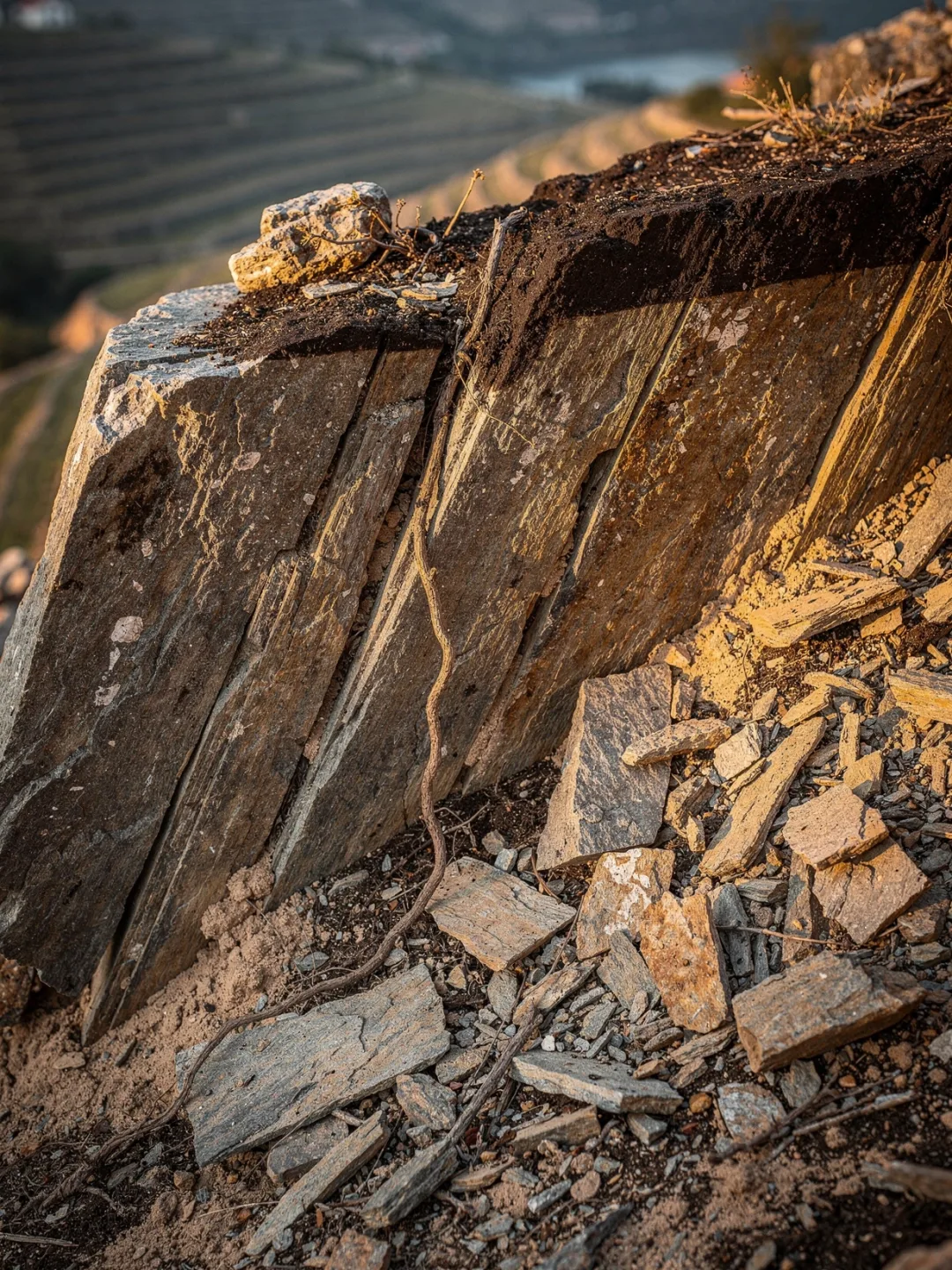
Schist in Terraces
Soils
Dig a hole in a Douro vineyard, and after just a few handspans, the spade hits resistance. Beneath a thin dark layer lies xisto, weathered schist that fractures into nearly vertical plates — a rock that resembles a dismantled stack of book covers more than solid bedrock.
This vertical structure is precisely what makes the soil so effective. The root squeezes between the plates and, rather than spreading wide, grows deep, often several meters down, searching for moisture that's long vanished from the topsoil by August. It finds little organic matter there. Organic content sits at a meager one and a half percent, lower than in almost any other European wine region. A hungry vineyard produces small berries, and small berries carry a high skin-to-juice ratio.
On slopes steep enough in places to rival a rooftop, only one solution remained. The schist could only be farmed in terraces. The oldest, called socalcos, feature tall retaining walls of dry-stacked schist and were built by hand, some over a hundred years ago. Since the 1970s, many estates have replaced them with patamares, wider terraces bulldozed from the slope and workable by machine. On slopes with up to thirty percent gradient, growers today often plant vinha ao alto — rows that simply run straight up the hillside, with no terracing at all.
One misconception persists stubbornly. People often say a wine tastes 'mineral' because the vine absorbs minerals from the schist and passes them into the glass. That's not quite right. Only dissolved ions enter through the root, in vanishingly small quantities — far too little to taste. What the schist actually provides is warmth, stored during the day. Add to that a narrow bottleneck for water that the vine must fight through. It's this struggle that shapes the wine, not the rock itself.
On the steepest slopes, harvesting remains handwork to this day. No mechanical harvester can climb the narrow stone ledges of the socalcos. Even on the wider patamares, only a handful of specialized machines operate. Anyone driving through the valley in September will still see pickers with baskets moving between the rows along the Douro — not nostalgia, but the only option the schist allows.
A thin dark layer with barely any organic matter — across the whole Douro Valley, humus content sits at only around one and a half percent.
The root: This is where the fine roots sit. They draw whatever the rare rainfall brings, and are the first to dry out in summer.