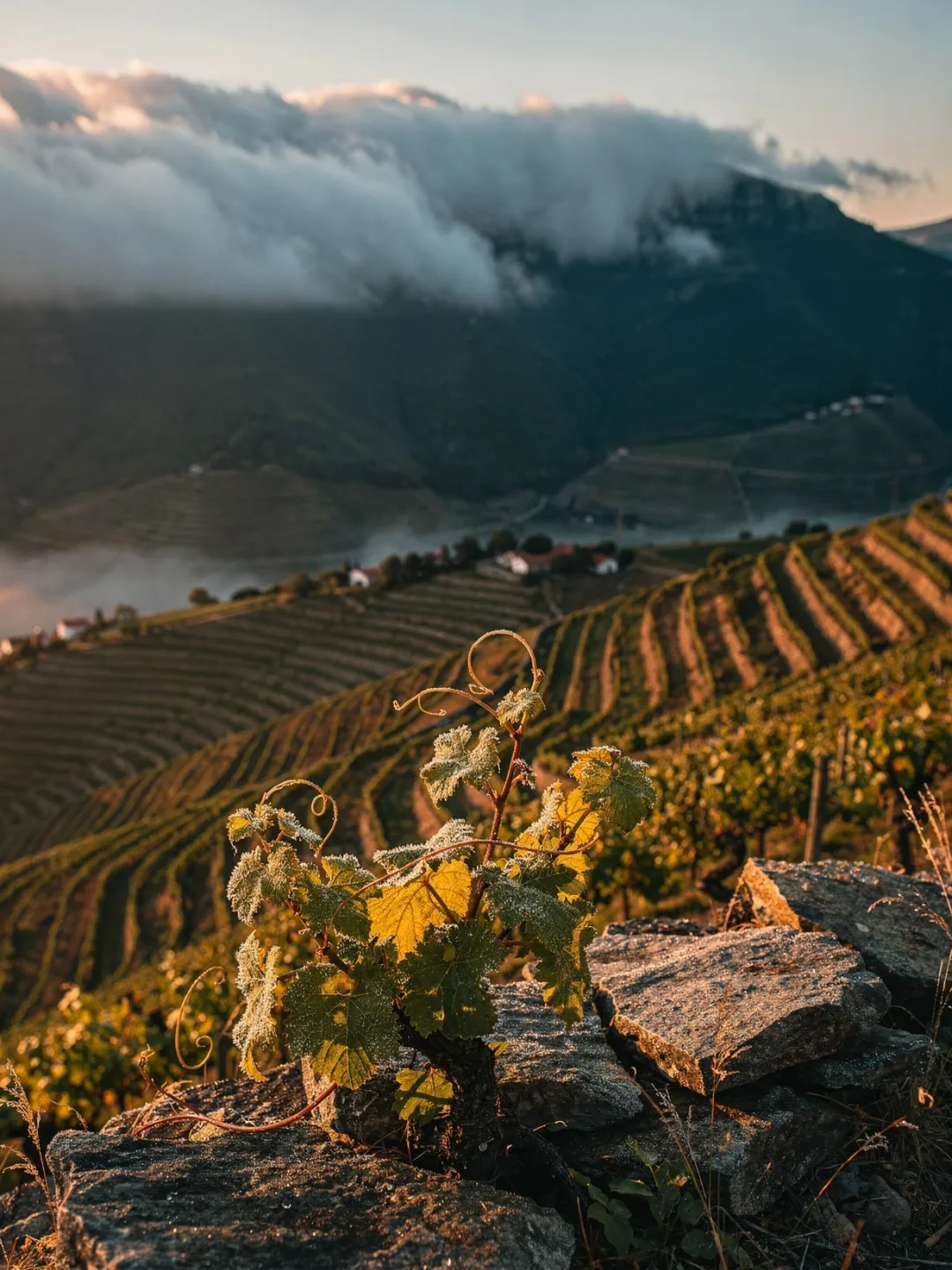
Marão versus the Atlantic
Climate
Stand at the Marão pass with your back to the sea, and you immediately feel the difference. Behind you lies the humid, green Minho; ahead, a landscape that looks scorched by summer. The Marão and, further east, the Montemuro block the moist Atlantic air before it reaches the river valley — which is why the Douro is dry, even though the sea is barely an hour's drive away.
Just how dry depends on location. In Fontes, in the Baixo Corgo, the westernmost and least sheltered part, annual rainfall reaches around twelve hundred millimeters. In the Cima Corgo, home to most of the great Port houses' best vineyards, it drops to just six hundred to eight hundred. Far to the east, near Barca d'Alva on the Spanish border, some years see barely three hundred and eighty millimeters — making the Douro Superior the driest of the three subzones.
In summer, temperatures in the Douro Superior regularly climb past forty degrees Celsius. Winters there turn hard and cold. Yet the region's overall annual average temperature ranges only between 11.8 and 16.5 degrees Celsius — the cold months simply pull the average down. This swing between scorching days and cool nights locks acidity into the berry even as ripening pushes far ahead. Without it, the wines would taste flat and tired.
The schist itself amplifies this effect. During the day, the dark rock stores heat; at night, it releases it slowly. This gives the vine more warmth than air temperature alone would provide. It's exactly what keeps even the cooler sites of the Baixo Corgo warm enough for ripe grapes. In the driest years in the Douro Superior, though, the same advantage turns against the vines. Without irrigation, young vines can die of thirst, and even old ones struggle.
This harshness isn't incidental — it's the very reason such powerful wine emerges here at all. Little water and abundant sun force the vine into small, thick-skinned berries packed with color and tannin. That's exactly the raw material needed for a wine that can withstand fortification and decades of barrel aging.