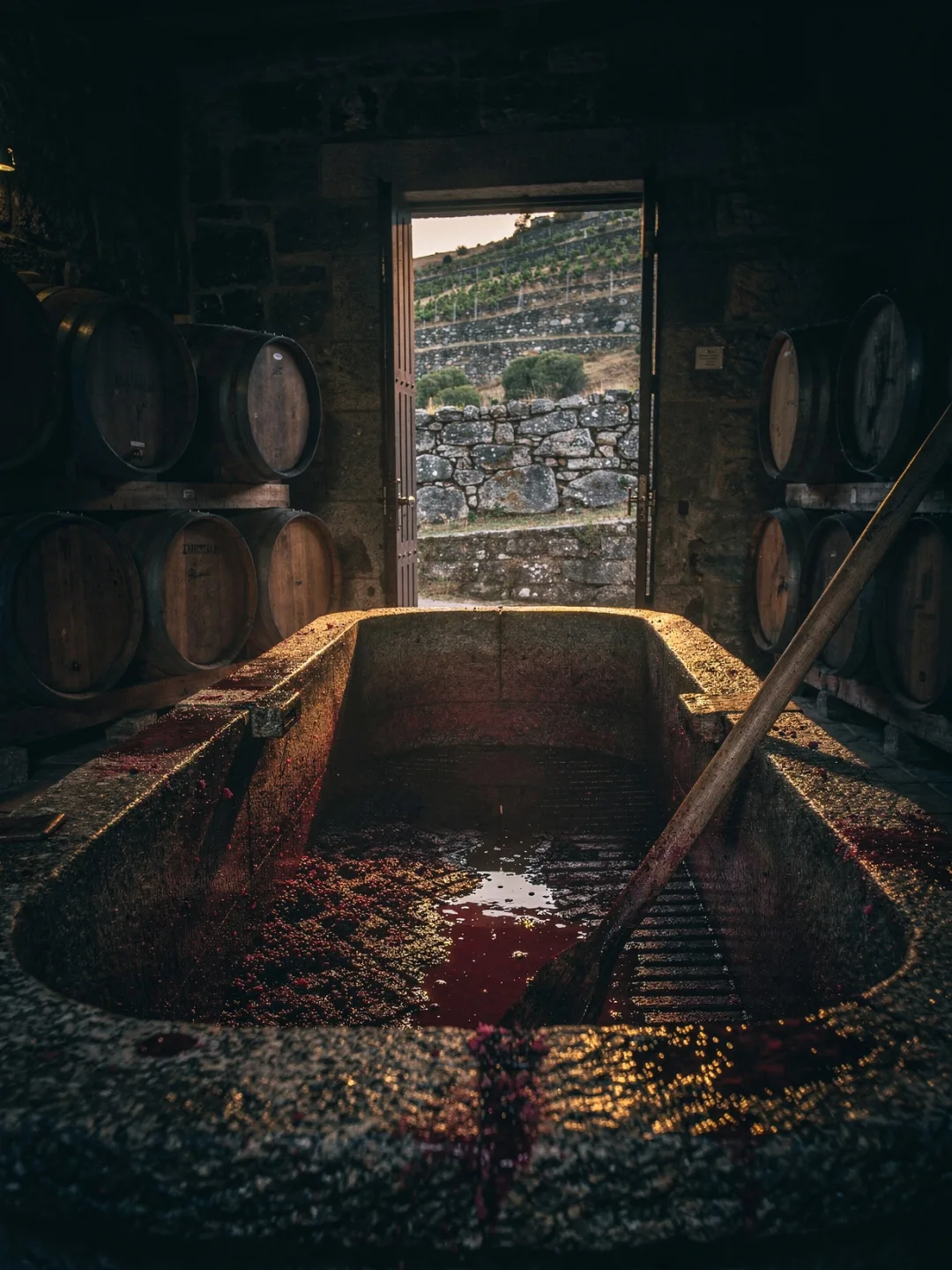
Lagares & Fortification
Production
Harvest in the Douro usually begins in September, often earlier than elsewhere in Portugal. Grapes overripen quickly in the summer heat. On the steep terraces, picking is still done mostly by hand, in baskets carried by pickers down to collection points at the foot of the slope. From there, things move fast — the hotter the day, the faster the grapes need to reach the press.
For the best sites, grapes are still trodden by bare feet, in shallow stone tanks called lagares. Rows of pickers tread for hours in rhythm, often to music, because the steady beat breaks skin and seed more gently than any press could. This often takes an entire night. Starting in 1998, the Symington Family Estates replaced this work at many of their properties with robotic lagares — granite tanks fitted with pistons that mimic the same treading motion. Other houses instead rely on autovinification tanks, which use the pressure of their own fermentation gases to circulate the must.
What turns this wine into Port happens in the middle of fermentation, not afterward. Once roughly half the sugar has fermented into alcohol, typically at six to nine percent, the cellar master adds neutral grape spirit at around seventy-seven percent alcohol. About one part spirit goes in for every four parts fermenting must. The yeast dies instantly, fermentation stops, and the remaining grape sugar stays in the wine. In the end, alcohol content is set by law between nineteen and twenty-two percent.
Not every vineyard is free to produce unlimited Port. The Instituto dos Vinhos do Douro e do Porto evaluates each parcel under the so-called Sistema do Benefício, scoring it against twelve criteria: altitude, slope, soil type, grape variety, vine age, yield. It then assigns a grade from A to F. Only once a vineyard reaches a minimum score — roughly between two hundred and one and four hundred points, depending on the year — does it earn its benefício, the official permit to fortify part of its harvest. The rest becomes dry Douro wine.
In the past, the finished wine traveled onward by boat, on rabelos — flat sailboats with crews of up to twelve men. They carried the barrels downstream to Vila Nova de Gaia, where the cool, damp air by the river favored maturation. In the hot Douro Valley itself, this was hardly possible for long. In 1964 the last boat sailed with cargo, after which trucks and the newly built dams took over the job. Most Port is still matured in Gaia to this day. Some houses, however, now mature their wines directly at the quinta in the valley, using modern climate control instead of the river's climate.