Touriga & Field Blends
Grape Varieties
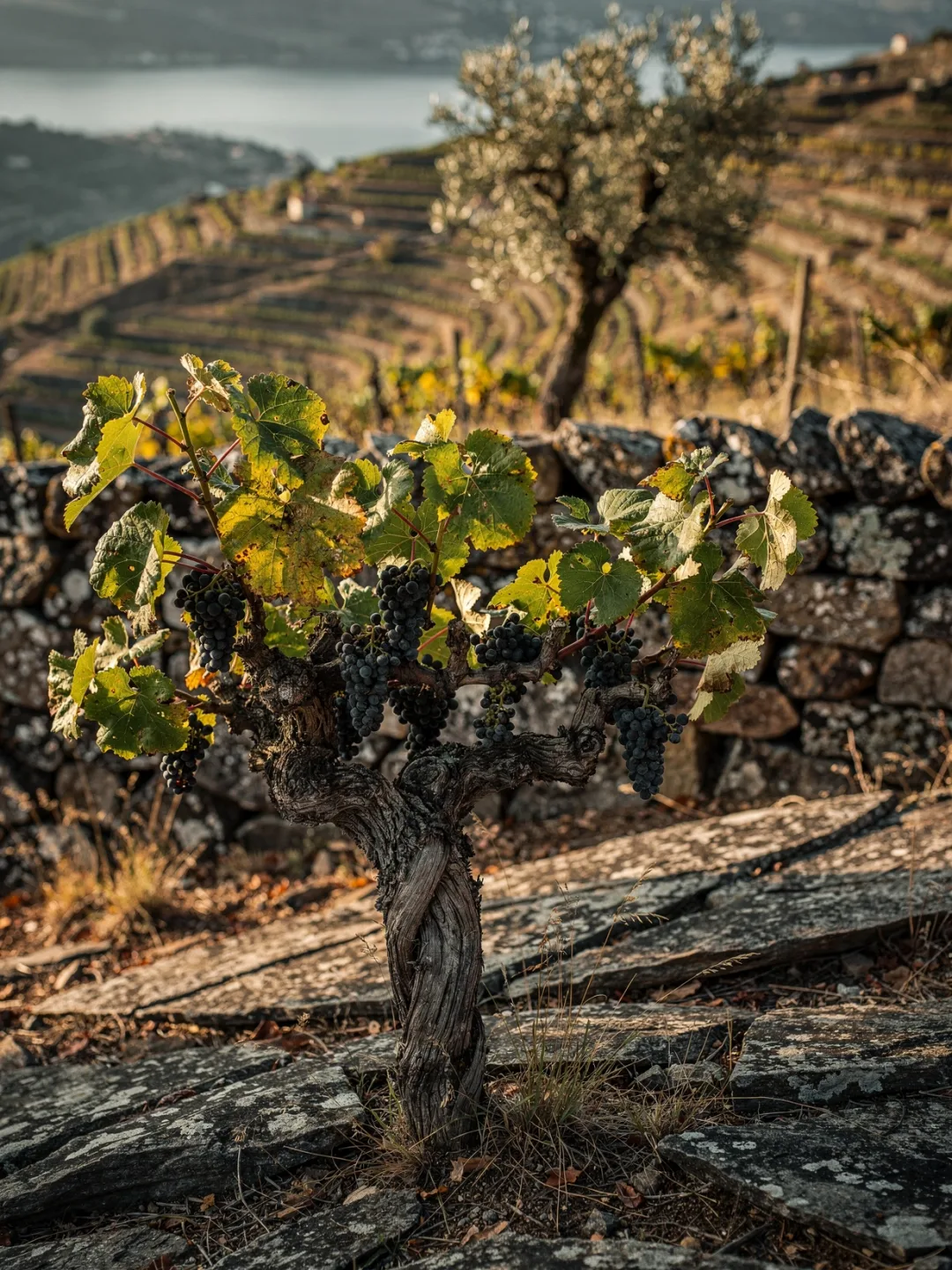
An old vineyard in the Douro is rarely a single variety. Earlier winemakers planted whatever was available, row by row mixed together, and harvested it all at once — such a vinha velha can contain twenty, thirty, or more grape varieties, often without anyone knowing exactly which ones. Yet just a handful of them determine how a Douro wine tastes today.
Touriga Nacional is considered the region's most important red variety, even though it covers only a bit more than ten percent of the vineyard area. The berries are small and thick-skinned, and yields are low. That's precisely why many growers nearly abandoned it in the 1970s. What remains gives the wine color, tannin, and a scent of violets and dark blackberry that comes through even in a blend making up just a tenth of the total.
The largest share, twenty-five percent, belongs to Touriga Franca. It grows more reliably and yields more. In return, it tastes softer and gives the blend body rather than definition. Tinta Roriz, known elsewhere as Tempranillo, accounts for a good fourteen percent. It tolerates drought well and delivers red fruit and structure. Tinto Cão, literally 'dog's claw' for its small, curved berries, has nearly disappeared, confined to just a few hectares because it yields poorly and ripens late — where it's planted, it provides acidity often missing in the region's typically lush blends. Tinta Barroca covers just under nine percent of the area. It ripens early and sweet, and thrives especially in the cooler Baixo Corgo.
The official list of approved varieties includes more than a hundred grapes. Only thirty of these are officially recommended. The logic behind this is practical: if one variety suffers in the summer heat, another carries the harvest. The final blend often only takes shape when tasting the individual barrels, not out in the vineyard.
Among white varieties, Rabigato, Malvasia Fina, Moscatel Galego Branco, and Viosinho lead the way, used for both dry white wines and white Port, even though none of them individually exceeds four percent of the vineyard area. A notable dry Douro wine is a fairly recent development. In 1952, Fernando Nicolau de Almeida released the first serious dry red wine of the region, Barca Velha, made from grapes at Quinta do Vale Meão in the Douro Superior that had previously been destined only for Port.