Chão de Areia
Soils
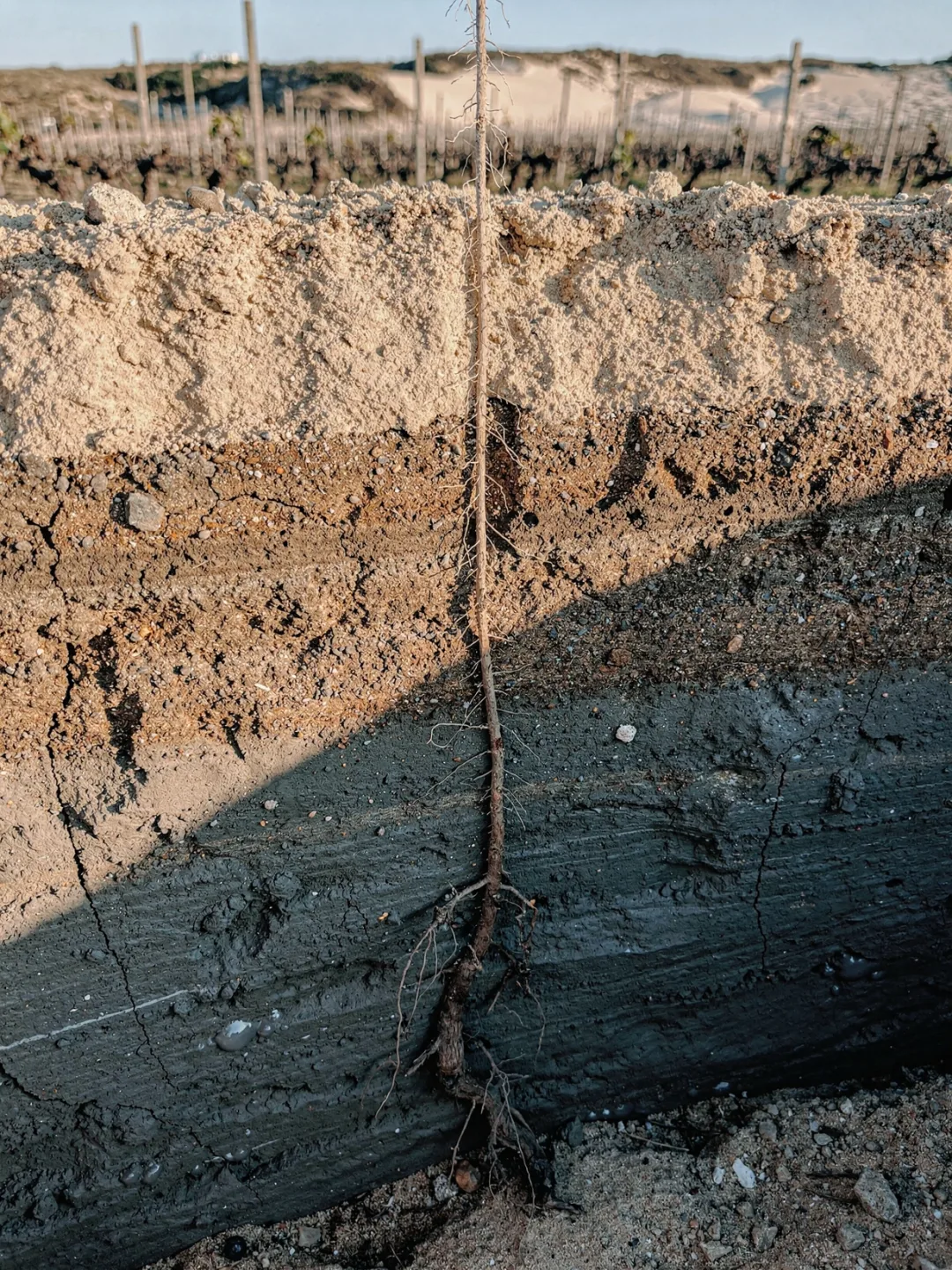
Dig a hole in a Colares vineyard, and you'll be digging for a while. Beneath the surface there's nothing but sand, without any structure, often far deeper than elsewhere. Winemakers call this pit a cova. It can run one to seven meters deep before clay finally appears. There, in the moist barro at the very bottom, the young vine is pressed firmly into place, a technique called unhada, so the young root finds a foothold right away.
Only afterward is the pit gradually refilled with sand as the vine grows. This reversed process seems cumbersome, yet it's exactly what spared the region from phylloxera: the pest attacks roots, but it makes little progress in pure sand and dies before digging deep enough. That's why the vines of Colares still stand ungrafted today, in the same sand as a hundred and fifty years ago.
Officially, the region distinguishes two soils. Chão de areia is the loose dune sand right by the sea, where only vines for Colares DOC may be planted. Chão rijo is the hard limestone marl a little further inland, firm and clay-rich. Standing in the vineyard, you'd notice nothing. Underground, the difference is absolute.
Above the sand, the vine itself does something unusual: instead of growing upward as a bush, it creeps flat along the ground. A small palisade of dry reeds surrounds each plant, protecting it from salty wind and drifting sand. From the air, entire vineyards look like hundreds of tiny giant octopi. No coincidence: during the day the pale sand stores heat and releases it back to the low-lying shoots as soon as the Nortada cools the air above.
Just a few kilometers away, in Alenquer and Arruda, lies a completely different earth. About seventy-two million years ago, as the Atlantic opened, the Lisbon Volcanic Complex broke through the crust here, leaving behind dark, deep basalt soils called barros. They hold water and nutrients that the sand of Colares completely lacks. Bucelas and Torres Vedras, by contrast, sit on pale Jurassic limestone. Three soils within barely twenty kilometers, ranging from sand to basalt.
Loose, pale windblown sand with no discernible layering, carried over millennia from the dunes onto the slope by the Nortada. No humus, barely any nutrients, water drains straight through.
The root: The fine roots find nothing to hold onto here and grow almost straight down, chasing the water.