Nortada and Fog
Climate
Just a few kilometers here separate a cool vineyard from a warm one. Rainfall averages six hundred to seven hundred millimeters a year, temperatures rarely swing to extremes, and yet a single wind shapes the difference between the coast and the interior: the Nortada. That's enough to create two distinct climate zones.
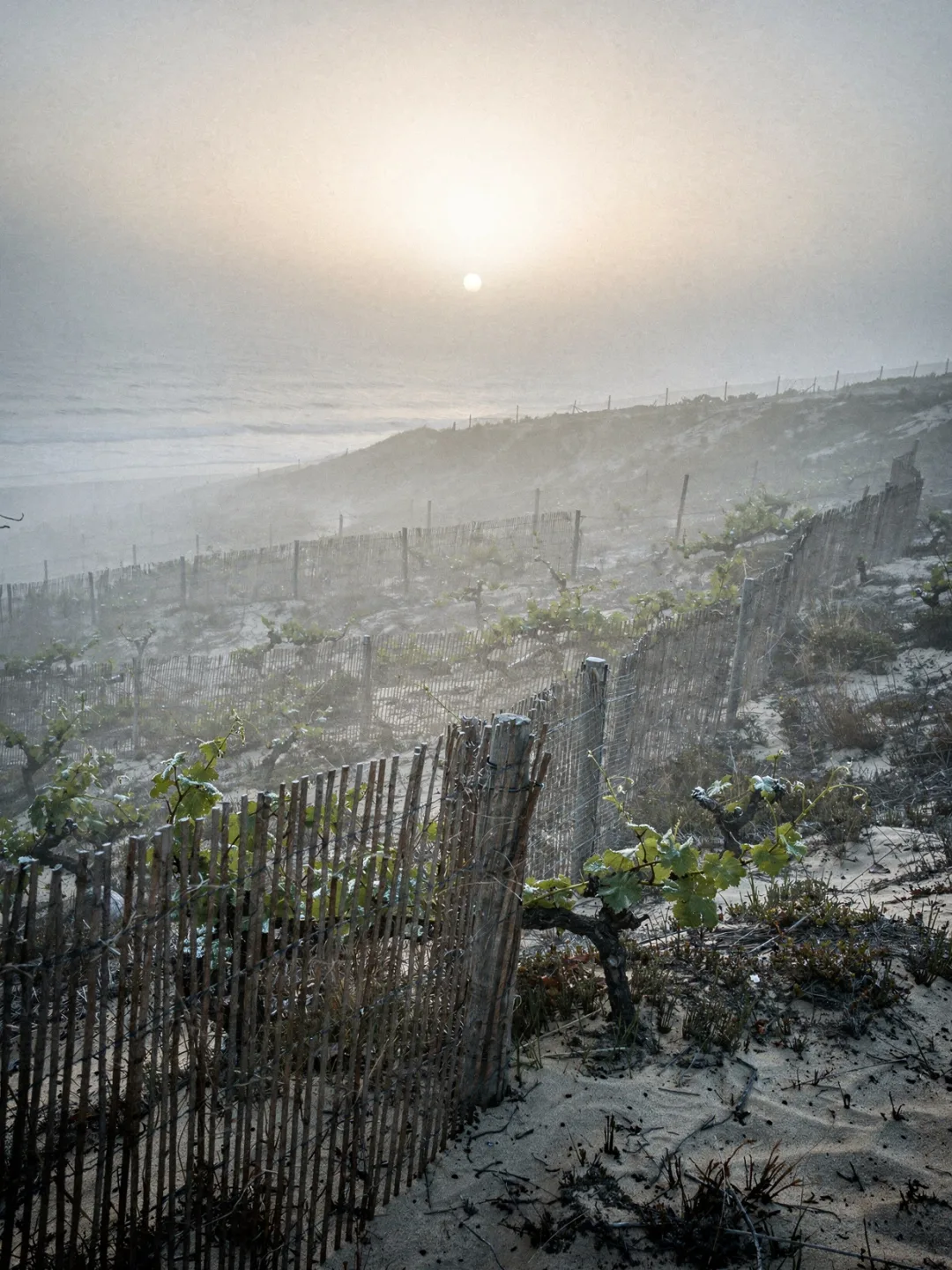
It blows mainly from the north between June and September, driven by a heat low over the peninsula and the Azores High over the Atlantic. Nothing complicated about it. The wind pushes warm surface water off the coast out to sea, cold deep water rises to replace it, and over this suddenly cool sea, fog forms and often drifts far inland. For beachgoers it's a nuisance, kicking up sand. For coastal vines, it's salvation from the summer heat.
It hits hardest in Colares, where the Serra de Sintra practically traps the fog and drives salty sea air right over the vineyards. Ramisco therefore rarely ripens beyond eleven percent alcohol by volume, lacking the warmth other Portuguese reds achieve easily. Colares stays restrained. At the same time, that same coolness locks in the acidity that lets the wine age for decades.
Bucelas, further inland along the Trancão river, gets a milder version of the same effect. The Trancão makes the difference. Days there turn hot and dry, while at night moist winds from the Tejo estuary and the Atlantic cool things down, and it's exactly this swing between day and night that preserves the acidity Arinto is famous for.
Further east, in Alenquer, Arruda, and Torres Vedras, the Serra de Sintra barely lets any wind through anymore. Warmth wins out in the end. Summers there grow hotter, nights stay milder, and that extra warmth is exactly what allows Castelão and Tinta Miúda to fully ripen, something Ramisco, just twenty kilometers away on the coast, would never manage. That's precisely what makes this region special.