Basalt & Poios
Soils
Dig a short way into the ground on a steep slope above Câmara de Lobos. After just a few hand-widths, you'll hit dark, hard rock. Madeira is an extinct volcano that rose from the seabed millions of years ago, and practically the entire subsoil to this day consists of basalt, a black, iron-rich lava rock.
As this basalt weathers, it forms a red to dark-brown soil, rich in iron and magnesium but poor in potassium, with a certain acidity in the soil itself that matches the acidity later found in the wine. Roots find little room and few nutrients between the broken slabs of rock. As a result, they push deep and yield small, concentrated berries.
The slopes are steep. Gradients of more than twenty-five percent are common, meaning that viticulture here would simply be impossible without terraces. Over centuries, generations of farmers stacked basalt stones into low walls and filled the space behind them with soil—the Poios. Some are barely wider than two rows of vines, linked by steps made of the same stone, and worked entirely by hand, since no tractor can reach them.
A myth persists here too: that a wine tastes like its rock. That's not really true. What the root absorbs are dissolved salts in such minuscule amounts that no one could ever taste them directly. Basalt instead works indirectly. It stores heat during the day and releases it at night, it drains water quickly, and it forces roots to grow deep. That indirect effect is enough to make the same grape variety taste noticeably different on two neighboring Poios.
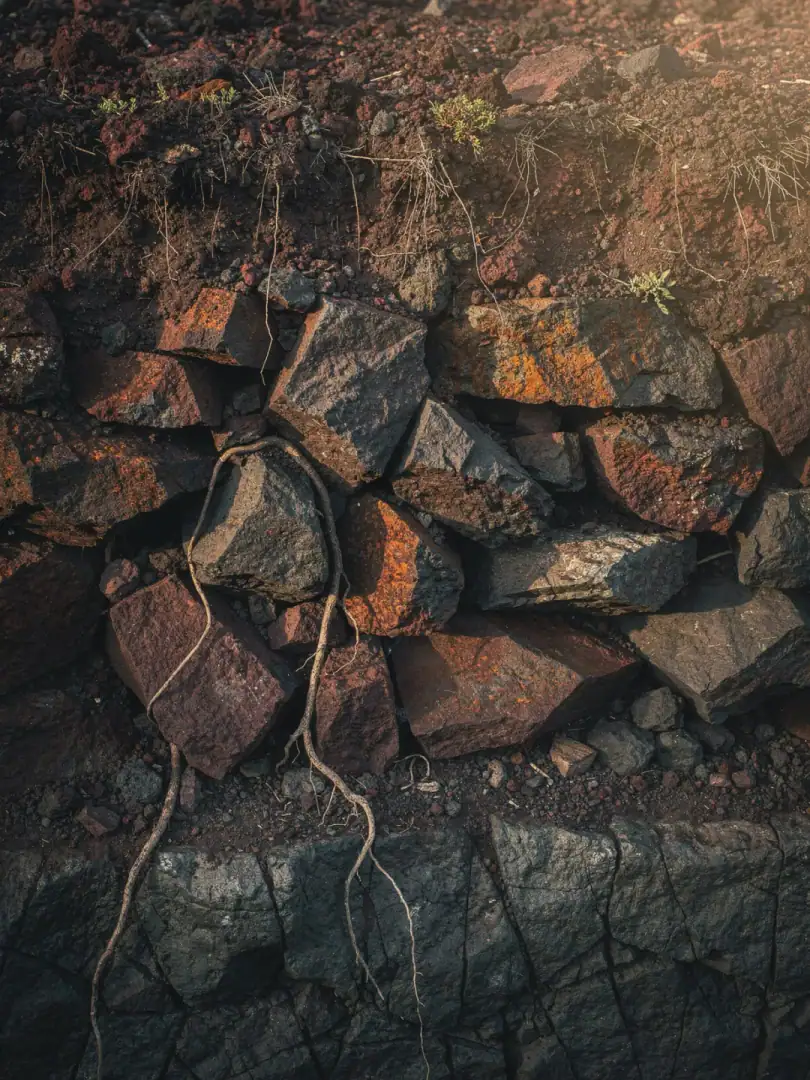
Weathered basalt, colored reddish-brown by iron oxide, thin and loosely layered.
The root: The fine roots here take up whatever the rain happens to bring, and after just a few dry days, they're the first to suffer.