Sea Meets Altitude
Climate
Madeira lies, contrary to what the map of continental Europe might suggest, at roughly the same latitude as Casablanca, out in the middle of the Atlantic. Yet it never really gets hot here. The surrounding sea keeps temperatures remarkably even all year round, the coast practically never sees frost, and in winter the thermometer rarely drops below fifteen degrees Celsius. That sounds like an easy, comfortable climate for vines. It isn't.
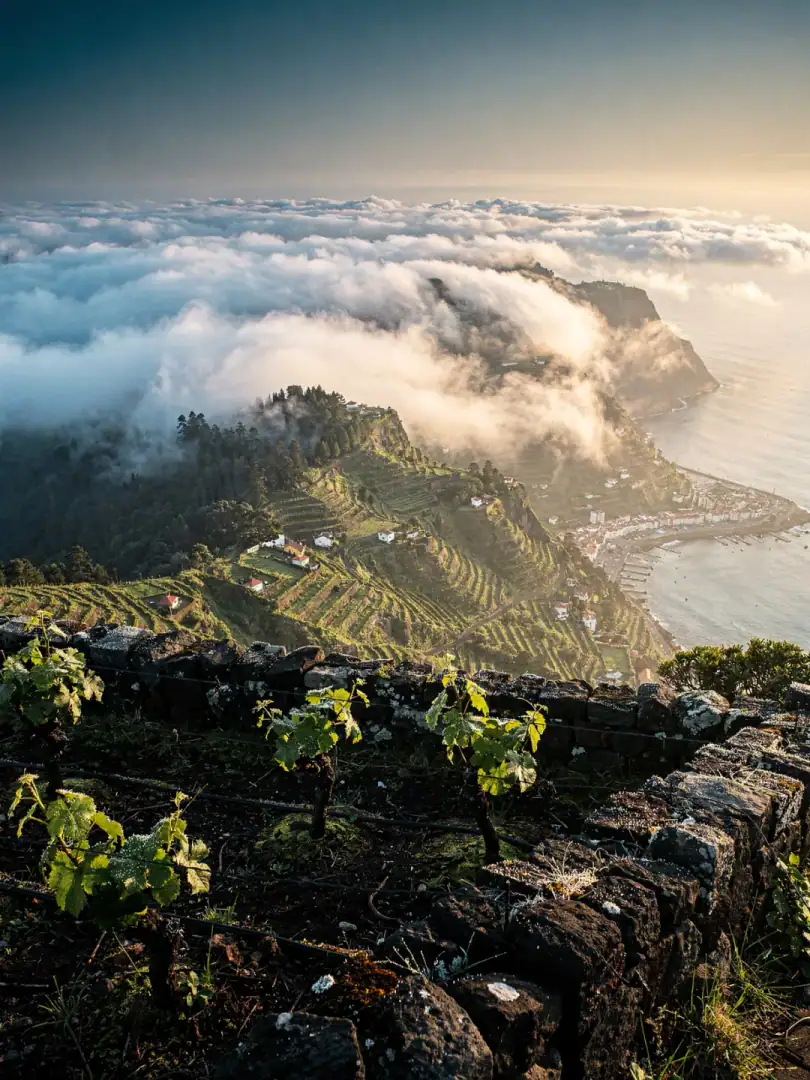
Vineyards here range from just a few meters above sea level, as around Câmara de Lobos or Caniçal, up to around seven hundred meters higher, in São Vicente, São Jorge, or Santana. Several degrees of temperature separate the bottom from the top. It's exactly this gap that determines where each of the four noble varieties grows: Malvasia down in the warmth, Sercial up high, where the grapes ripen more slowly and retain more acidity.
The island is also divided. The north lies exposed to moist trade winds and gets rain nearly all year round. The south lies in the lee of the mountain range and stays dry and sunny. So the vines there don't go thirsty, a centuries-old network of Levadas carries water from the wet mountains across the island. Levadas are narrow water channels cut into the rock, totaling more than a thousand kilometers in length.
Moisture has a downside, though: fungal disease. That's why many winemakers still train their vines on pergolas high above the ground. These structures are called Latadas, and you can walk upright beneath them. Air circulates better than with low-trained vines, and the grapes dry off faster after rain. The ground underneath can be used for vegetables or potatoes at the same time—on an island where flat land is rarer than a break in the rain in the northwest.