Campo, Charneca, Bairro
Soils
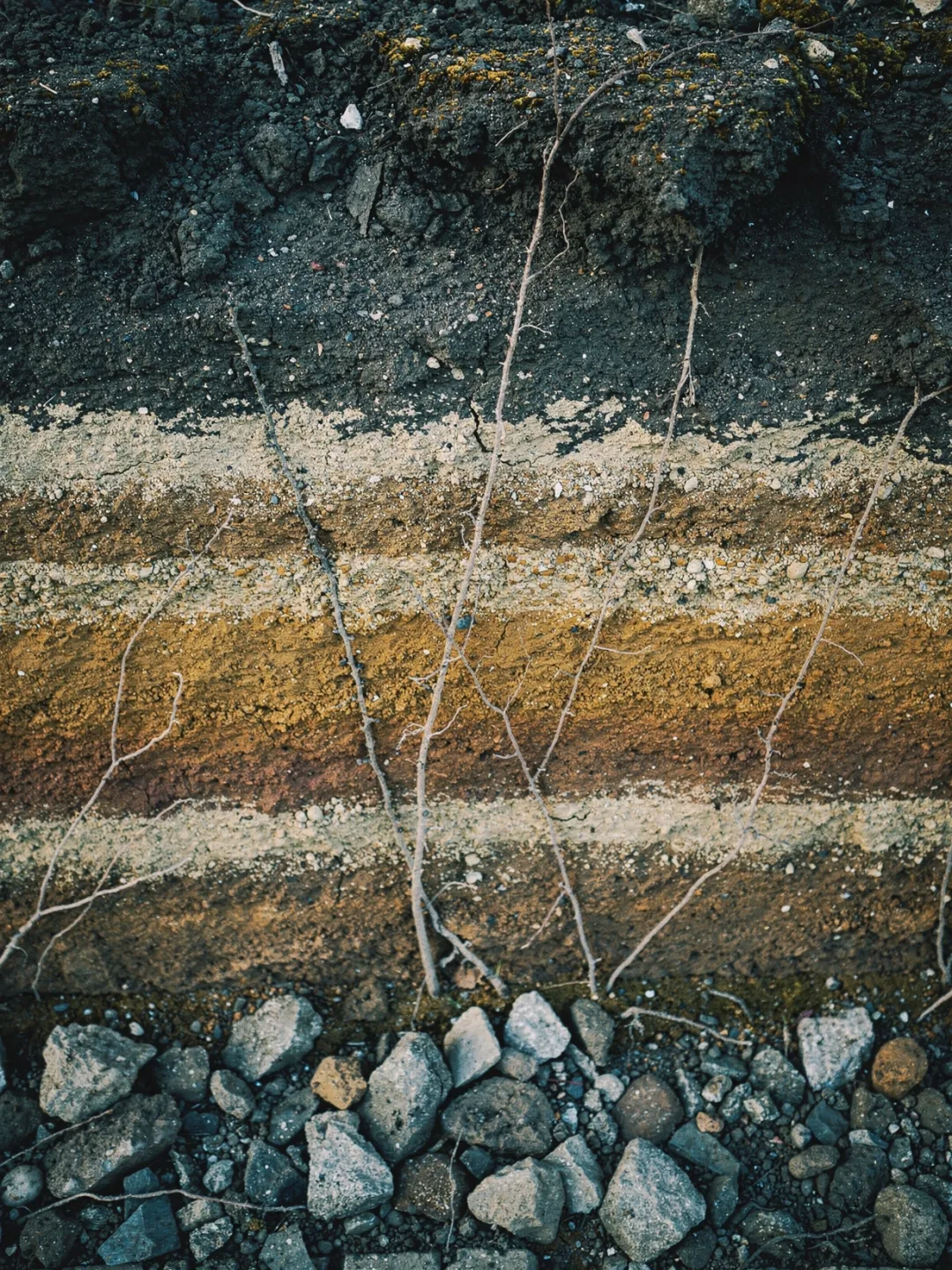
Dig a hole along the bank of the Tejo. After just a few spadefuls you'll hit fine, dark alluvial soil, laid down here over centuries by floods, layer by layer, each flood adding a new coat of fine silt. It's precisely this soil that makes the Campo zone the most fertile in the region. Fernão Pires grows so lushly here that people once called it, half-jokingly, the queen of the river.
A few kilometers to the south, across the river, the picture changes completely. There begins the Charneca, a dry, flat landscape with lean, sandy soil, in places mixed with gravel. Yields here fall noticeably below the region's average, because the vines find few nutrients and must drive their roots deep just to reach any water. What the grapes lack in quantity, they gain in concentration, and it's exactly this that produces the densest red Tejo wines.
North of the river, in the Bairro, yet another type of rock dominates. Hilly and rarely higher than two hundred meters, the soil here is limestone- and clay-rich, turning to schist further north. This schist forces the roots deep, much as in the Douro a little further north, and yields wines with more structure than the softer soils along the river.
Three such different soils in such a small area are rare. No single soil explains the wine from here on its own. It's the interplay of lean sand, hilly limestone and fertile river loam that ultimately makes the difference. A Tejo white wine tastes light and floral, a Tejo red wine, by contrast, powerful and dense, depending on which of the three zones the grapes come from.
A superstition travels with every bottle: that the rock itself can be tasted in the wine, because the root absorbs minerals and passes them on. Chemically, this barely holds up. A root draws only dissolved ions in tiny amounts, far too little to detect in the glass. What actually matters is the detour through water and warmth. Sandy Charneca soils let rain drain away immediately, forcing the root deep down. The river loam of the Campo, by contrast, retains moisture and gives the vine an easier life. It's this detour that explains the difference in the glass, not the rock itself.
Fine, dark silt that winter floods of the Tejo have deposited here over centuries. Loose, nutrient-rich, almost black shortly after a flood.
The root: The fine roots quickly draw water and nutrients here, which is why vines in this layer grow vigorously and fast.