Limestone, Marl, Föhn Warmth
Soils
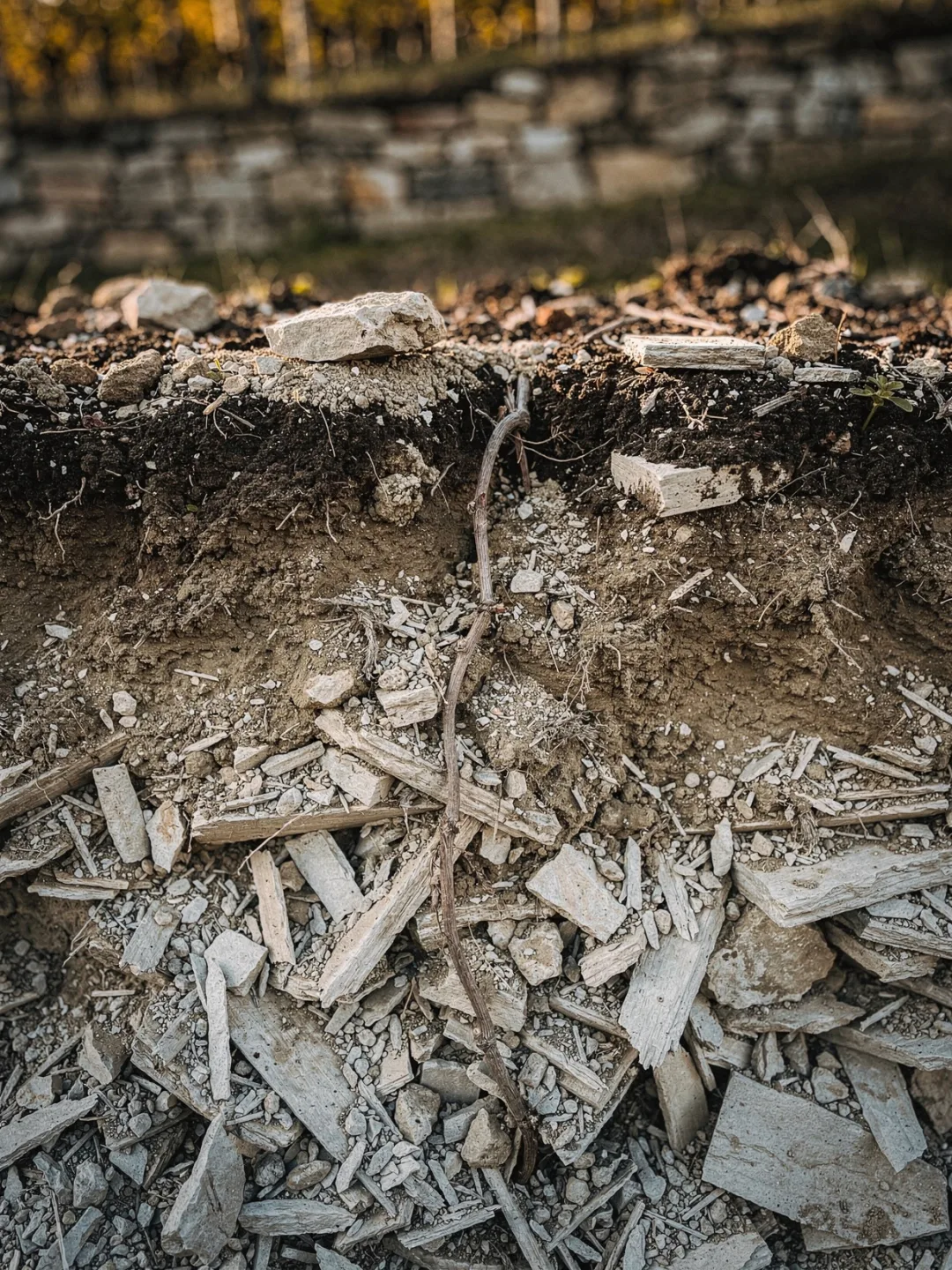
Dig a hole in a vineyard near Fläsch, and after just a handspan you'll hit pale, angular rock. It's limestone schist and marl, weathered down from the Rätikon, the limestone and dolomite massif that walls in the Bündner Herrschaft to the east. The mountain ground down its own rock. Over thousands of years, it sent the debris down into the valley, until it became the vineyards of Fläsch, Jenins, and Malans.
This rubble holds almost no water, but plenty of heat. By day, the sun bakes it. By night, it slowly releases that warmth back into the roots, working alongside the Föhn wind above — two heat sources for the same vine. The roots themselves have to force their way through the loose scree, driving deep down, since nutrients are scarce near the surface.
Ninety kilometers north, around Lake Zurich, the soil looks completely different. There's no limestone wall in the background here. Instead, a glacier tongue deposited moraine across the slopes ten thousand years ago: brown soil, in places up to forty percent limestone, deep and fertile. Räuschling and Blauburgunder root less desperately here than in the stony south, but the soil in turn delivers more water and higher yields.
In the Schaffhausen Klettgau, shell limestone dominates the picture — genuine seabed from an era when a shallow Triassic sea covered today's plateau. It weathers into a pale, lime-rich loam. It holds water better than the Graubünden scree, giving Hallau Blauburgunder its comparatively soft, rounded character.
What stays constant across all three soils is the roundabout way they exert their influence. No root hair tastes limestone and passes that flavor directly into the glass, tempting as that image sounds. What matters is water, warmth, and depth — and how hard a vine has to work to reach all three.
A dark, humus-rich topsoil made of weathered limestone rubble and leaf litter, rarely thicker than a forearm in the Bündner Herrschaft.
The root: This is where the fine roots sit, catching the first rains — and in high summer, they're the first to dry out.