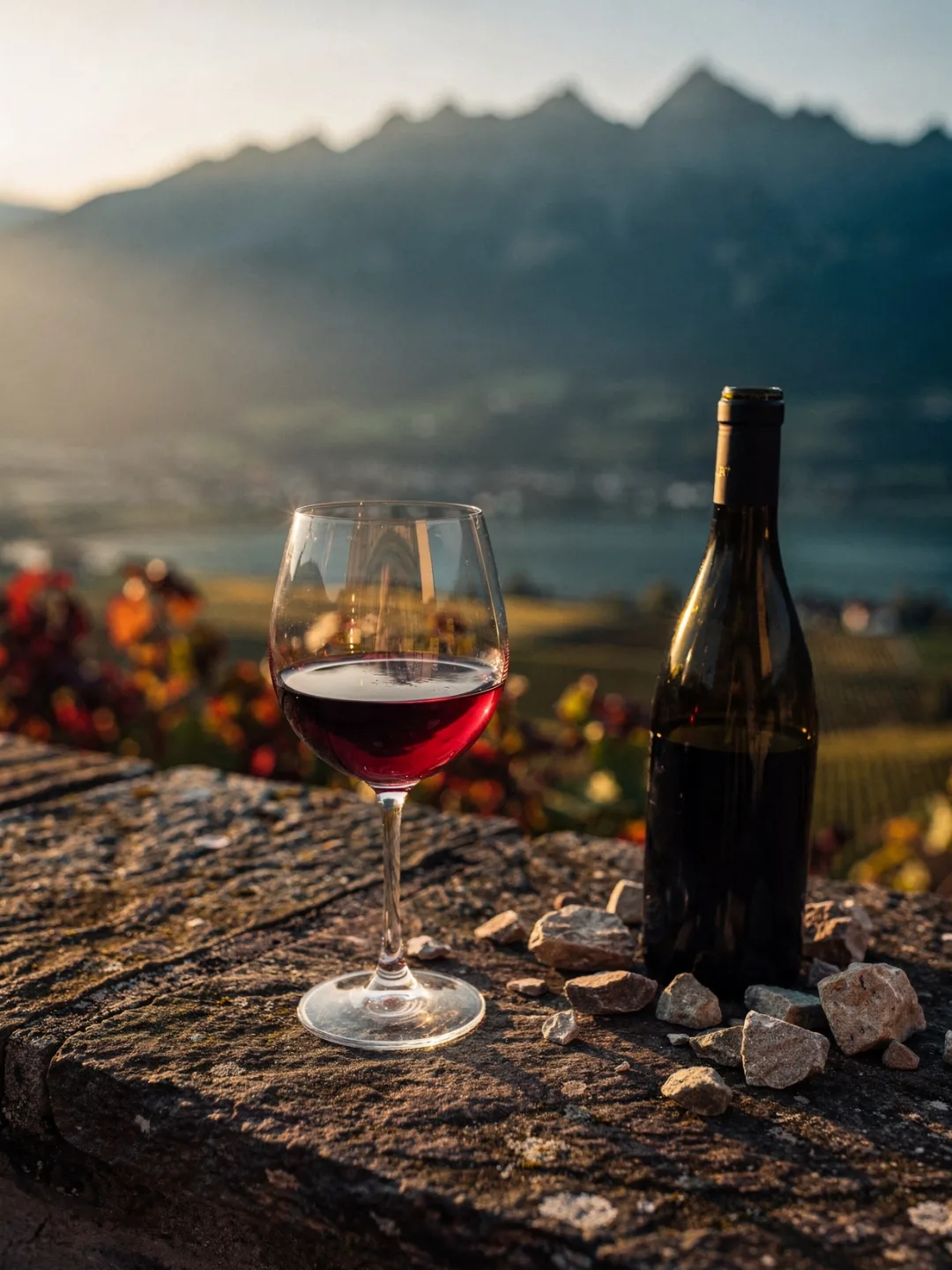
A Burgundy Glass, Not Bordeaux
Glassware
How pale and light a Blauburgunder from the Bündner Herrschaft turns out plays a role in choosing the right glass for it. A rounded Burgundy glass with a wide opening gives the delicate fruit room to breathe, without masking the fine acidity this northerly site lends the wine. A narrow Bordeaux glass, by contrast, compresses the same wine and makes it seem duller than it really is.
Räuschling calls for the opposite: a slender, rather small glass that concentrates its restrained citrus fruit instead of letting it dissipate in a wide bowl. Serve it cool, at eight to ten degrees Celsius, straight from the fridge, since all its tension lies in the acidity — and acidity fades with warmth.
Completer is trickier. The wine is powerful, with roughly fourteen percent alcohol by volume and pronounced acidity that keeps it from ever feeling heavy despite its richness. A standard white wine glass constrains it. A larger, more open bowl suits it better. In such a glass, the wine best shows its aromas of quince, honey, and beeswax, served at twelve to fourteen degrees — any cooler and it turns dull, any warmer and the alcohol pushes through.
Decanting, too, follows its own rule in the Bündner Herrschaft. A young Blauburgunder needs no carafe. A ten-year-old, however, benefits from half an hour of air. After so much time in the bottle, its aromas need to open back up — with Completer, a vigorous swirl in the glass is often enough to achieve the same.
On quantity: a glass of Blauburgunder should never be filled past its widest point, which amounts to roughly one hundred fifty milliliters. Above that, there needs to be room for the aromas. Pour to the rim, and you might be drinking the same wine, but you'll be smelling a far poorer version of it.