Gneiss Meets Dolomite
Soils
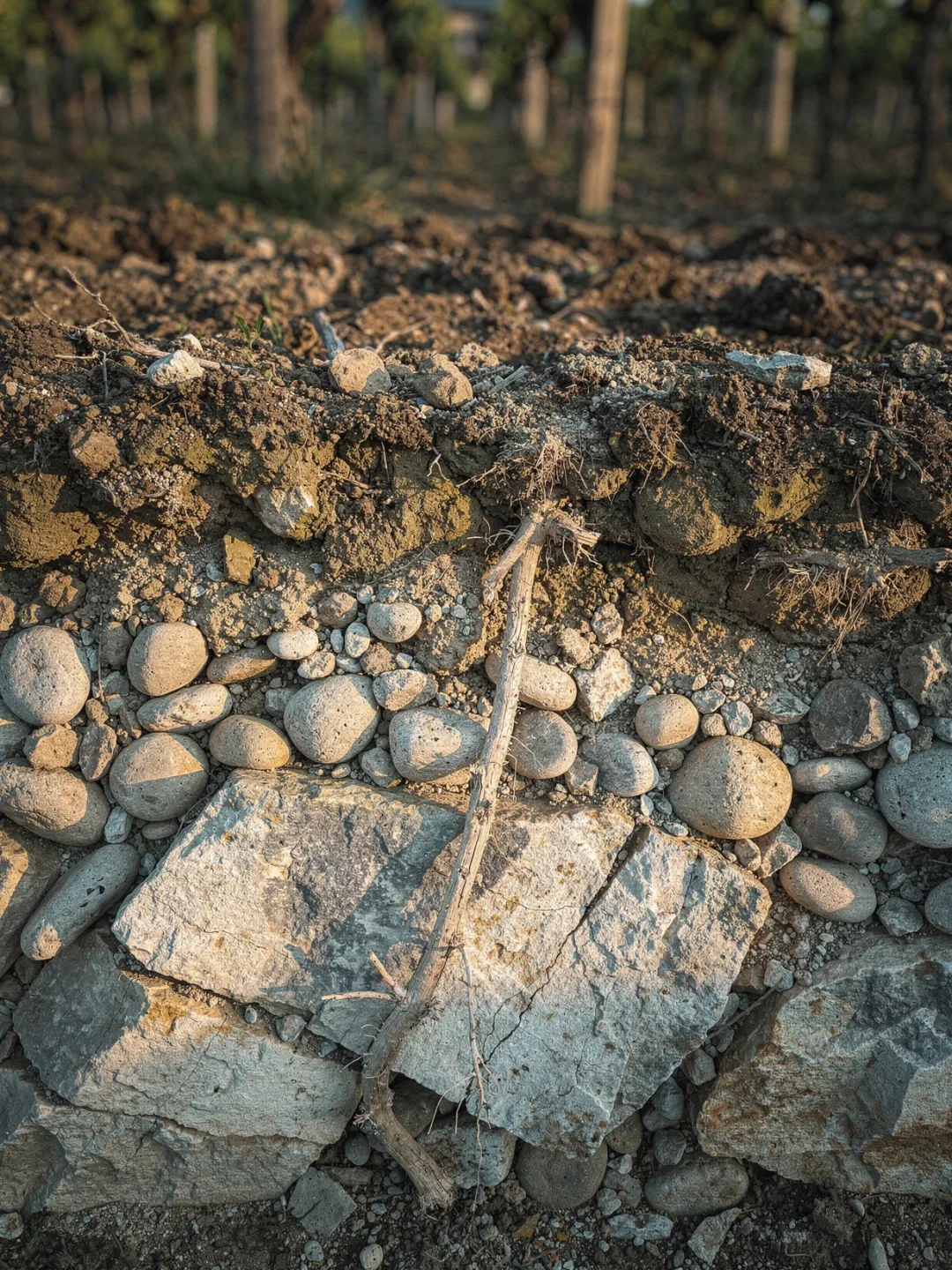
Dig a hole in a vineyard in the Mendrisiotto and you'll first hit dark, crumbly earth, barely a hand's width deep. Beneath it lies pale, chalky clay studded with rounded pebbles, smooth as if polished. A glacier ground them this way as it pushed through the valley more than ten thousand years ago and left its debris behind. This layer is called moraine, and it's one reason the Mendrisiotto tastes so different from the valleys further north. It's pure glacial inheritance.
Beneath the moraine, the bedrock itself eventually appears, and it tells a much older story. It's the same pale dolomite and limestone that a few kilometers away builds Monte San Giorgio, where paleontologists have recovered more than twenty thousand fossils of fish and marine reptiles, roughly two hundred thirty to one hundred eighty million years old. That's how long ago a tropical shallow sea lay here. The rock beneath these vines is, in other words, fossilized sea, not mountain rock. That explains the difference.
Limestone and dolomite hold water better than the gneiss that lies beneath the vines further north, in the Sopraceneri: hard, crystalline rock from the Alps' basement complex, low in lime but permeable to water. Roots there have to dig deeper and search faster. In the south, by contrast, enough moisture stays in the clay above the limestone, even when no rain falls for weeks in August.
You can taste the result. Merlot from the clay-and-limestone south comes across rounder and denser, with riper fruit. Merlot from the stony, crystalline north shows more acidity and a brighter, tighter edge. No cellar master on earth can recreate that difference after the fact; it's baked into the soil long before the first grape ripens.
A thin, dark layer of decomposed leaves and grass between the vine rows. Holds barely any water through the summer.
The root: This is where the fine roots sit, absorbing the first rain after a dry spell immediately.