Bianco, Rosso, Riserva
Glassware
Hardly any canton demands as many different glasses for a single grape variety as Ticino. Here Merlot comes to the table pale as Merlot bianco, young and light as a simple red, or as Riserva, the longer-aged style, dense and oaky from the barrique, the small oak barrel. One grape, three wines, and each needs its own glass. It's not worth mixing them up.
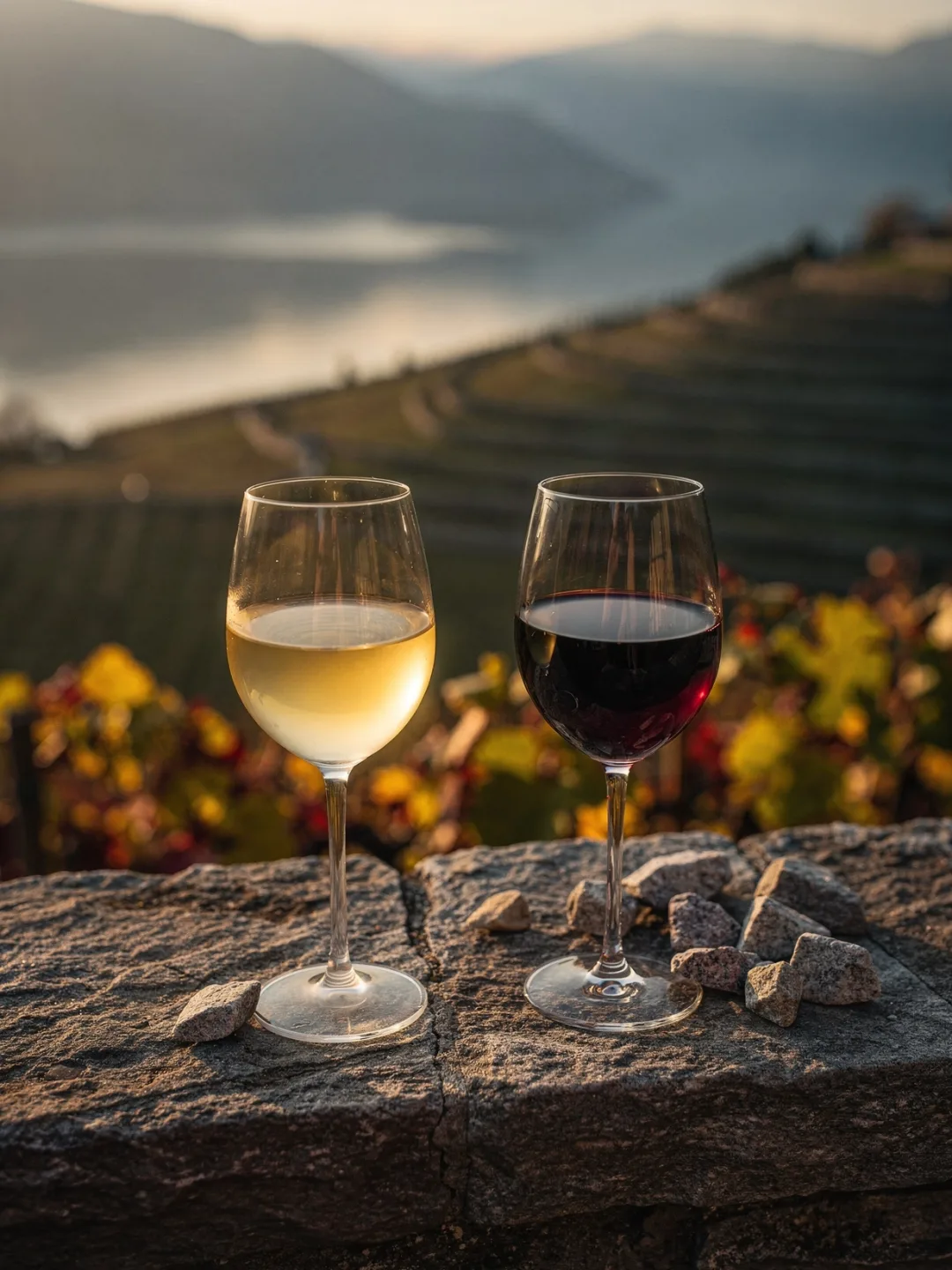
Merlot bianco belongs in a narrow, tall white wine glass, chilled to eight to ten degrees Celsius, forty-six to fifty degrees Fahrenheit. It tastes better cold. Its aroma is delicate, often white blossom and citrus peel. A glass that's too wide scatters it before the nose can even catch it, whereas a narrow bowl concentrates what little it has to offer and sends it straight upward.
The young, uncomplicated Merlot from the Sopraceneri, by contrast, needs a medium-sized, slightly rounded glass, the kind used for a simple Bordeaux, served at sixteen to eighteen degrees Celsius, sixty-one to sixty-four degrees Fahrenheit. At the twenty degrees, sixty-eight Fahrenheit, many consider room temperature, its already gentle tannin turns flabby and the ripe plum tips toward jam.
A Riserva demands more room: a large, tall glass. It separates the vanilla and toasty notes from the oak from the dark fruit instead of blending the two, and after years in the bottle it's worth thirty minutes in a decanter, since only then do tannin and fruit find their way back to each other. Even so, pour sparingly, only up to the widest point of the bowl, leaving the rest as space for the aroma.