Red or White
Winemaking
At the start stands the same ripe, dark Merlot grape, no matter what ends up in the glass. The decision falls right at the press. If the skins stay in the must, red wine results. If they're removed immediately, Merlot bianco results, pale as a Chardonnay, even though the grapes were blue-black.
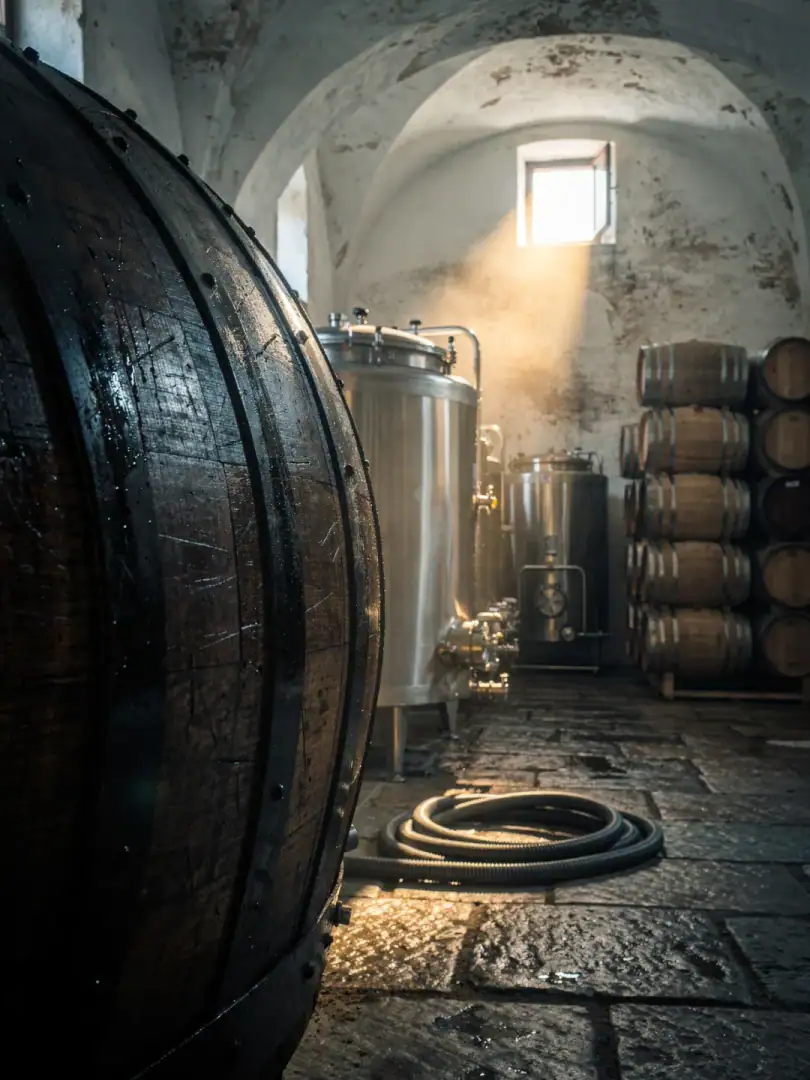
For Merlot bianco, the grapes are pressed gently, often in the cool of night right after picking, so the color never even makes it into the juice. The must then ferments like a white wine at low temperature, usually in stainless steel tanks, with no contact whatsoever with skin or seed, and what results has barely more tannin than grape juice and tastes of pear, citrus, and a hint of almond.
For red Merlot, by contrast, the skins stay in the vat for one to three weeks. The longer they stay, the more color and tannin they release. The cantonal DOC rules permit only ripe, concentrated grapes for this: at most one kilogram of grapes per square meter of vineyard, with no tolerance above that limit, plus a minimum sugar content of 17.6 degrees Brix, equivalent to 72.4 degrees Oechsle, the measure of sugar in the must. Anyone who harvests more or picks less ripe grapes may not call their barrel Ticino DOC. The rule applies without exception.
After that, the barrel decides the style. Simple Merlots age briefly in stainless steel tanks or in old, large wooden casks, the botti, which give off very little aroma. For the Riserva, by contrast, small French barriques of two hundred twenty-five liters are the standard, ever since the cellars in the Sottoceneri and Sopraceneri took their cue from Bordeaux in the 1980s. They lend the wine vanilla, toasty notes, and additional tannin. That's how two completely different Merlots come into being.